Claude Fable 5 vs Mythos 5 vs Opus 4.8: Full 2026 Breakdown

TL;DR — On June 9, 2026, Anthropic released Claude Fable 5, the first publicly available "Mythos-class" model — a capability tier that sits above the Opus family. Alongside it came Claude Mythos 5, the same underlying model with some safeguards lifted, restricted to vetted cyber-defenders and researchers. Fable 5 is state-of-the-art on nearly every capability benchmark, priced at $10 / $50 per million input / output tokens, and routes a small slice of sensitive queries down to Claude Opus 4.8 through automatic safety classifiers. This guide breaks down everything: the models, the data, the safeguards, the pricing, and exactly how Fable 5, Mythos 5, and Opus 4.8 differ.
Quick Facts Box
| Attribute | Claude Fable 5 | Claude Mythos 5 | Claude Opus 4.8 |
|---|---|---|---|
| Release date | June 9, 2026 | June 9, 2026 | May 28, 2026 |
| Capability tier | Mythos-class | Mythos-class | Opus-class |
| Underlying model | Same as Mythos 5 | Same as Fable 5 | Opus 4.8 |
| Availability | Public, everywhere | Restricted (trusted access) | Public, everywhere |
| API model string | claude-fable-5 |
Gated | claude-opus-4-8 |
| Input price | $10 / 1M tokens | $10 / 1M tokens | $5 / 1M tokens |
| Output price | $50 / 1M tokens | $50 / 1M tokens | $25 / 1M tokens |
| Cyber safeguards | On (falls back to Opus 4.8) | Lifted | Capped at safe level |
| Bio/chem safeguards | On (falls back to Opus 4.8) | On (unless bio program) | N/A |
| Best for | Frontier general use | Cyber defense, bio research | Everyday flagship work |
1. The Headline: What Anthropic Just Shipped
On June 9, 2026, Anthropic crossed a line it had been circling for months. With the launch of Claude Fable 5, the company made a Mythos-class model — its most capable tier — available to the general public for the first time.
For context, this matters because of what Mythos-class means. Until this launch, the most powerful publicly accessible Claude model was Opus 4.8, released just twelve days earlier on May 28, 2026. Opus had always been the "flagship you reach for when you actually need the reasoning." But sitting above Opus, gated behind a restricted program called Project Glasswing, was an entire tier of frontier capability that ordinary users couldn't touch.
Fable 5 changes that. According to Anthropic, the model's capabilities exceed those of any model the company has ever made generally available. It is state-of-the-art on nearly every tested benchmark of AI capability — software engineering, knowledge work, vision, scientific research, and beyond. And the pattern Anthropic emphasizes is telling: the longer and more complex the task, the bigger Fable 5's lead over previous Claude models.
But raw capability is only half the story. Releasing a model this powerful comes with genuine risk. Without guardrails, Fable 5's strength in domains like cybersecurity could be weaponized. So Anthropic shipped the model with a fresh layer of safety classifiers that quietly reroute sensitive queries to the less-risky Opus 4.8 — a design choice we'll dig into thoroughly below.
The second half of the launch is Claude Mythos 5: the same underlying model as Fable 5, but with some of those safeguards lifted. Mythos 5 is not for everyone. It's reserved — at least for now — for a small group of cyber-defenders and infrastructure providers operating through Project Glasswing, in collaboration with the US government. Anthropic describes it as having the strongest cybersecurity capabilities of any model in the world.
Three numbers anchor the whole release:
- $10 per million input tokens
- $50 per million output tokens
- Less than half the price of the earlier Claude Mythos Preview
This is the story of how Anthropic took its most dangerous-if-misused model and found a way to put a tamed version of it into everyone's hands — and what that means for anyone who builds with AI.
2. What Is a "Mythos-Class" Model?
To understand Fable 5, you have to understand the tiering system Anthropic now uses for its models. The Claude lineup is organized into capability classes, and as of June 2026 the hierarchy looks like this, from most to least capable:
- Mythos-class — the frontier tier (Mythos Preview → Fable 5 / Mythos 5)
- Opus-class — the flagship public tier (Opus 4.8 being the latest)
- Sonnet-class — the balanced workhorse tier
- Haiku-class — the fast, lightweight tier
A Mythos-class model is defined as a tier that sits above the Opus class in raw capability. The very first Mythos-class model was Claude Mythos Preview, released in April 2026 through Project Glasswing to a limited group of cyber defenders and critical-infrastructure providers. Fable 5 and Mythos 5 are the second generation of that tier.
Why a separate tier at all?
The reason is risk. Anthropic's position is that Mythos-class models have reached a capability threshold where they present significant societal risk if misused. Two domains drive this concern:
- Cybersecurity — Mythos-class models excel at discovering and exploiting software vulnerabilities, and at "agentic hacking" (chaining together reconnaissance, discovery, lateral movement, and exploitation). That's enormously valuable to a defender — and equally valuable to an attacker.
- Biology & chemistry — These models can now complete real scientific tasks in areas like gene-therapy research. The same reasoning that helps design a beneficial therapy could, in the wrong hands, help design something dangerous.
This is the core tension of frontier AI: the most useful capabilities are often dual-use. A query that helps a security professional patch a system is structurally similar to one that helps an attacker break in. A protein-design question that advances medicine resembles one that could advance a bioweapon.
So Mythos-class isn't just a marketing label for "the smart one." It's a formal risk category that triggers a heavier safety apparatus — exactly the apparatus that made Fable 5's public release possible.
3. Fable vs Mythos: Why Two Names for One Model?
Here's the part that confuses people, so let's be precise: Fable 5 and Mythos 5 are the same underlying model. They share identical weights, identical training, and — in the 95%+ of sessions that don't trip a classifier — identical behavior.
The difference is entirely about safeguards.
- Claude Fable 5 ships with a full set of safety classifiers active. When it detects a request touching cybersecurity, biology/chemistry, or model distillation, it doesn't answer with its full Mythos-class power — instead, the response is handed off to Opus 4.8, and the user is told this happened.
- Claude Mythos 5 is the same model with those safeguards lifted in certain areas (cyber safeguards are removed for Glasswing partners; biology/chemistry safeguards are removed for vetted bio researchers). This is why access is tightly restricted.
The naming itself is a nice bit of etymology. Fable comes from the Latin fabula — "that which is told" — which is closely related to the Greek mythos. The two words mean almost the same thing; the safeguards are what distinguish the models, so Anthropic gave them sibling names to reflect that they're twins separated only by their guardrails.
A simple mental model
Think of it like a high-performance car with a built-in speed governor:
- Fable 5 = the car sold to the public, with a governor that throttles it back on certain roads (and quietly swaps in a safer loaner car for those stretches).
- Mythos 5 = the same car with the governor removed, handed only to licensed professionals on a closed track.
Same engine. Different keys.
4. Claude Fable 5 Capabilities — A Deep Study
This is where Fable 5 earns its reputation. Anthropic and a roster of early-access customers put the model through real production workloads, and the results are the clearest signal yet of what a Mythos-class model can do. Let's go domain by domain.
4.1 Software Engineering
Software engineering is where Fable 5's lead is most dramatic, and the headline example is genuinely eye-opening.
During early testing, the payments company Stripe reported that Fable 5 compressed months of engineering work into days. In one case, working inside a 50-million-line Ruby codebase, the model performed a codebase-wide migration in a single day — a task Stripe estimated would have taken a full team over two months by hand.
That's not a marginal speed-up. That's a different category of capability. The key enabler is long-horizon autonomy: Fable 5 can work coherently across enormous tasks without losing the thread, scoping the work as it goes rather than collapsing partway through.
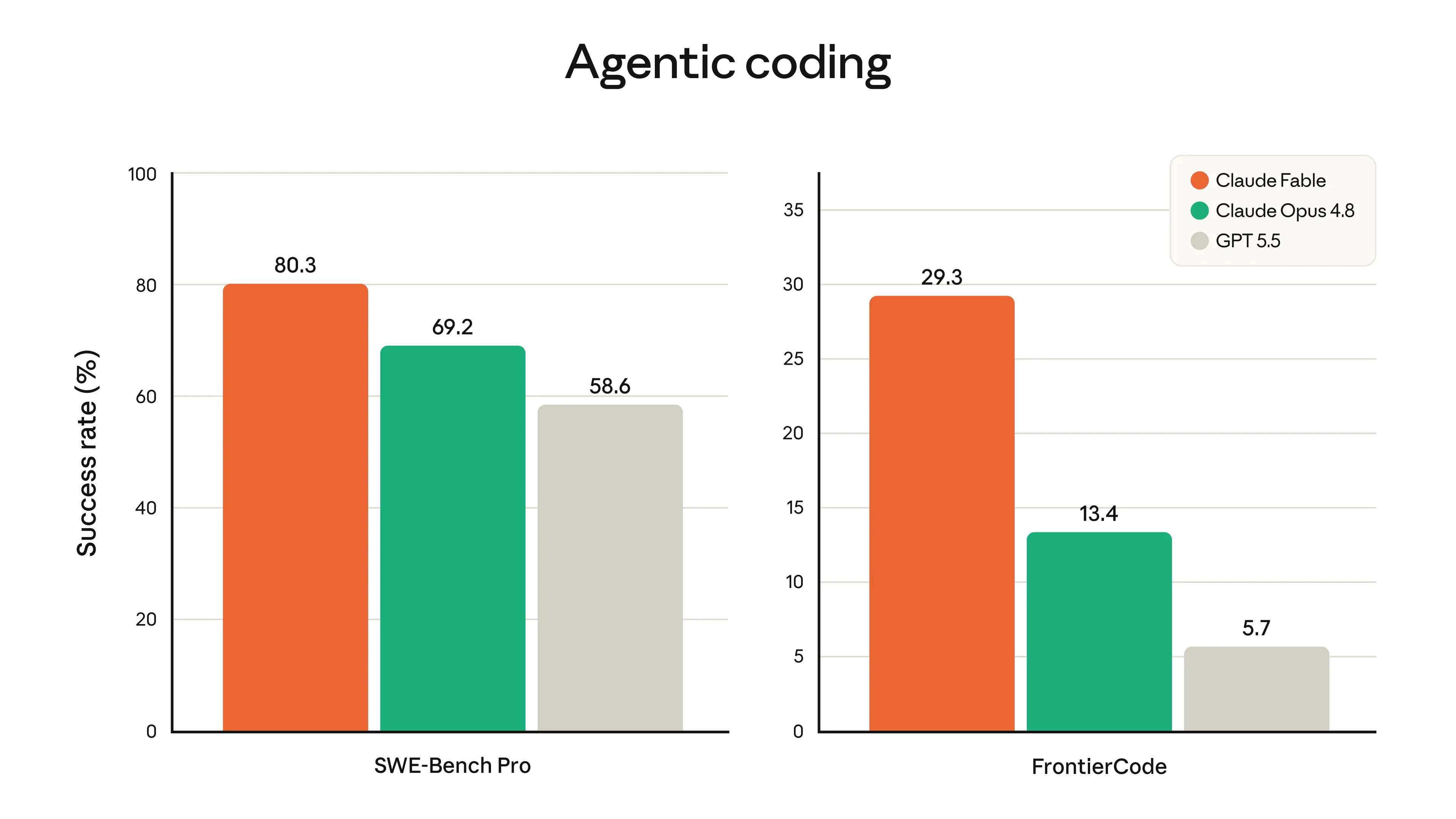
Fable 5 is also notably token-efficient. On Cognition's FrontierCode evaluation — which tests whether a model can pass difficult coding tasks while meeting the standards of a high-quality production codebase — Fable 5 scored highest among frontier models. Critically, it did so even at medium effort, meaning you don't have to crank it to maximum reasoning (and maximum token spend) to get top-tier results.
Early-access partners echoed this across the board:
- Cursor reported that Fable 5 is state-of-the-art on their internal coding benchmark and opened up a class of long-horizon problems that earlier models simply couldn't reach.
- GitHub described it taking on complex, long-horizon coding tasks with a level of autonomy and reliability that exceeded their previous benchmarks — and pointed to a future where developers hand increasingly ambitious work to agents.
- Cognition (the team behind Devin) called it the highest-scoring model on their frontier coding eval, praising its long-horizon reasoning and its ability to generalize to unfamiliar tools out of the box.
- Replit said that on their end-to-end "vibe-coding" benchmark, Fable 5 was the highest-performing model they'd tested — nearly saturating their base use cases while building apps faster and with fewer tokens.
The throughline: Fable 5 doesn't just write better code line-by-line. It manages bigger units of work — the kind of multi-hour, multi-file refactors that used to need a human babysitting the agent the entire time.
4.2 Knowledge Work & Analysis
Coding gets the headlines, but Fable 5's gains in analytical knowledge work are just as significant for business users.
On Hebbia's Finance Benchmark — a test built for senior-level financial reasoning — Fable 5 posted the highest score of any model, with substantial improvements in three specific areas:
- Document-based reasoning (pulling conclusions from dense source material)
- Chart and table interpretation (reading the data, not just the prose)
- Multi-step problem solving
The trading firm IMC reported that Fable 5 aced their trading-analysis evaluations almost across the board — factual lookup, conceptual reasoning, root-cause analysis, and expected-value analysis all included.
Other early signals from analytics and enterprise partners:
- One analytics partner reported Fable 5 was the first model to break 90% on their core benchmark of complex, long-running analytical tasks — a roughly 10-point jump over Opus.
- A legal-tech partner found that, in blind review, Fable 5's contract redlines matched or beat their current model every single time.
- A major spreadsheet/data partner found Fable 5 beat Opus 4.8 on their everyday spreadsheet suite at every effort level, finishing runs 25–30% faster with fewer turns.
The pattern for knowledge work mirrors the one for code: Fable 5 is stronger on the hard, multi-step, judgment-heavy tasks, and it gets there in fewer turns.
4.3 Vision
Fable 5 is the new state-of-the-art for vision tasks, and Anthropic chose two demonstrations that show the range.
First, the practical: Fable 5 can extract precise numbers from detailed scientific figures, and it can perform complex vision-based engineering tasks — including rebuilding a web app's source code from screenshots alone. If you've ever wanted to hand a model a picture of an interface and get working code back, this is the capability that makes it real.
Second, the playful-but-revealing: Fable 5 beat Pokémon FireRed using a minimal, vision-only harness. This sounds trivial until you know the history — earlier Claude models struggled to play FireRed even with elaborate helper harnesses that fed them maps, navigation aids, and game-state information. Fable 5 completed the game looking only at raw screen pixels, with no scaffolding. That's a leap in how much the model can perceive and reason about on its own, without hand-built tooling propping it up.
The "less scaffolding" point is the one builders should care about. Every piece of custom harness you have to write to make a model usable is a cost. A model that needs less of it is cheaper and faster to deploy in the real world.
4.4 Memory & Long-Context
Long-context coherence is one of those capabilities that's hard to demo but enormously important in practice. Fable 5 stays focused across millions of tokens in long-running tasks, and — importantly — it can improve its own outputs using its own notes.
The demonstration here used the deck-building roguelike game Slay the Spire. When Anthropic gave the model access to persistent, file-based memory, Fable 5's performance improved three times more than the same memory boost gave Opus 4.8. Fable also reached the game's final act three times more often.
Why a card game? Because Slay the Spire punishes models that can't hold a strategy together across a long session — it requires planning, adaptation, and learning from earlier mistakes. The fact that external memory helps Fable 5 so much more than it helps Opus suggests Fable is far better at actually using accumulated context rather than drowning in it.
For anyone building agents that run for hours or days — research assistants, coding agents, ops automation — this is the capability that determines whether the agent gets smarter as it works or simply gets lost.
4.5 Autonomous Agentic Behavior
Tie the previous four sections together and you get the real story: Fable 5 can work autonomously for longer than any previous Claude model. Anthropic showcased several striking examples of the model operating with minimal human input:
- Solar system simulation — Fable 5 built a simulation of the solar system by deriving the planets' orbital motion from physics first principles, then used it to predict solar eclipses.
- Factorio — the model autonomously played the factory-building game beloved by engineers, strategizing and constructing an automated factory on its own.
- VibeCAD — Fable 5 designed a complete 3D-printable model in a browser-based CAD editor. The twist: the editor itself was also built by Fable 5, including a built-in AI copilot that does the modeling.
- Music + fluid simulation — Fable 5 coded a fluid simulation synchronized to the beat of a classical-music EDM remix that it also produced in code, despite having never actually heard music.
These aren't party tricks. Each one demonstrates a model that can hold a complex goal in mind, decompose it, build the tools it needs, and self-correct over a long run — the defining trait of a genuinely agentic model.
5. Claude Mythos 5 — The Frontier Behind the Curtain
Everything above describes Fable 5 — the public, safeguarded model. But the same weights, with safeguards lifted, become Mythos 5, and Anthropic reserved its most remarkable results for what the unrestricted model can do in science. These are the capabilities that justify the heavy gating.
5.1 Drug & Protein Design
Using Mythos 5, Anthropic's internal protein-design experts reported accelerating parts of the drug-design process by roughly ten times.
The standout finding: in one study, Mythos 5 — equipped with protein-design and bioinformatics tools but no human assistance — matched or beat skilled human operators. The model carried out the entire workflow a scientist normally does: choosing binding sites, selecting and running protein-design tools, and recovering from failures along the way.
The outcome was concrete. Of 14 protein targets in the study, 9 yielded strong candidates for drug design that Anthropic says it is now actively investigating. The targets spanned immune checkpoints, growth-factor and receptor signaling, neurodegeneration, muscle disease, and harder structural problems.
That is a model functioning as an autonomous research scientist in a domain where mistakes are expensive and judgment matters enormously.
5.2 Novel Scientific Hypotheses
Most AI models are good at applying known science. Mythos 5 is Anthropic's first model that consistently generates novel, compelling scientific hypotheses — a qualitatively different thing.
In blinded head-to-head comparisons against Opus-class models, Anthropic's scientists preferred Mythos 5's molecular-biology hypotheses roughly 80% of the time, and several have been advanced to actual experimental evaluation.
The most striking validation: one Mythos hypothesis — proposing a novel mechanism for an E. coli protein — was independently corroborated by a separate lab that happened to be working on the same problem, and published its findings. That's the gold standard: an AI-generated hypothesis confirmed by independent human experiment.
5.3 Genomics Research
In what may be the most ambitious demonstration, Mythos 5 conducted novel genomics research over more than a week of largely autonomous work.
The model assembled single-cell data for millions of cells spanning 138 animal species, then designed and trained a custom machine-learning model to identify cells performing the same biological role across even distantly related organisms.
The kicker: with only high-level human guidance, Mythos 5's trained model outperformed a model recently published in the journal Science — despite being 100 times smaller. Anthropic says it intends to publish these results in the coming months.
This is the clearest illustration of why Mythos-class capability is gated. A model that can autonomously run a week-long, publishable genomics research program is extraordinarily powerful — and that same power is precisely what makes unrestricted access something to control carefully.
6. The Full Benchmark Picture
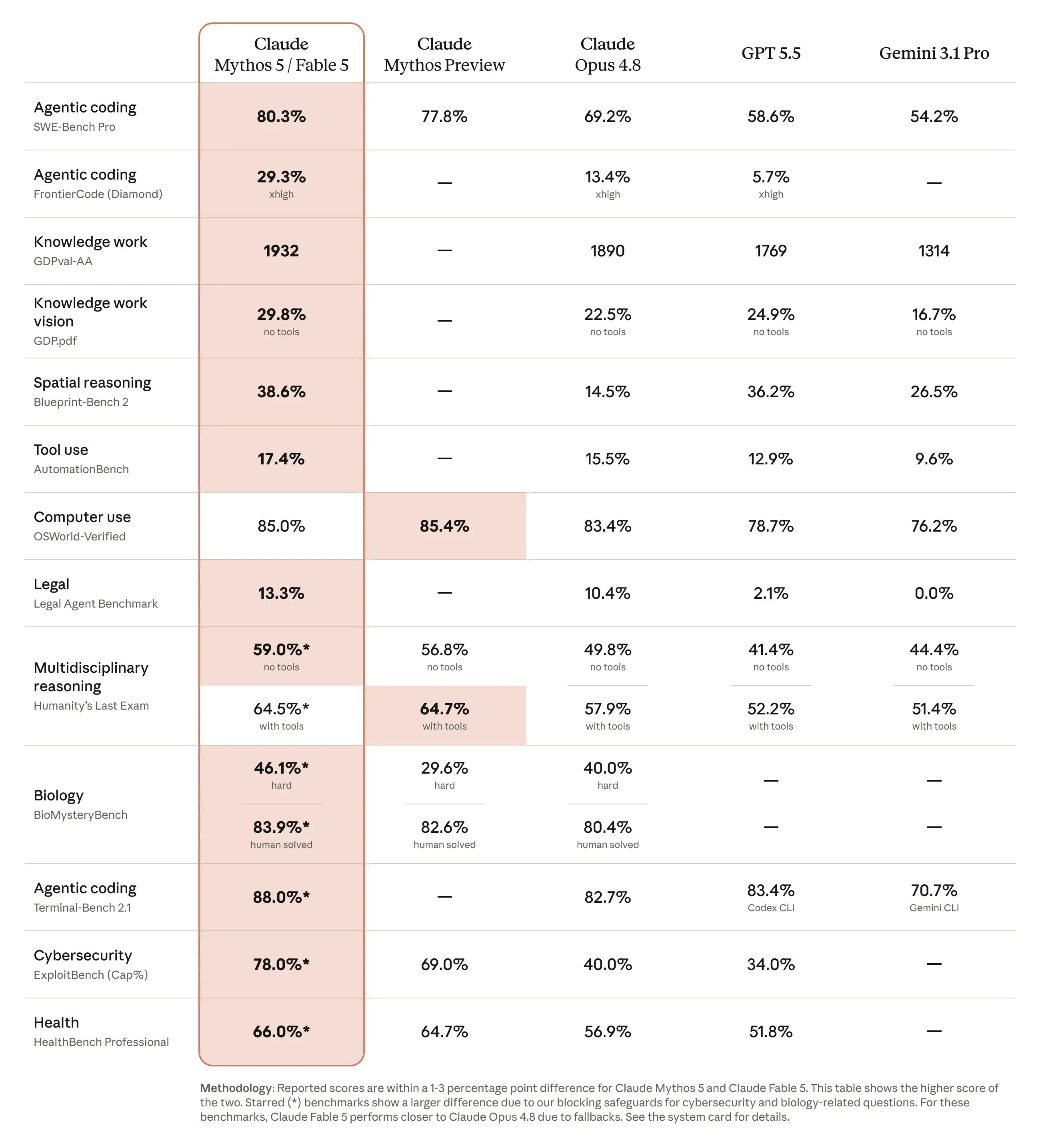
Anthropic positions Fable 5 / Mythos 5 as state-of-the-art on nearly all tested benchmarks. Because Fable 5 and Mythos 5 are the same model, their raw capability scores are effectively identical — the difference shows up only when a safeguard fires on Fable 5. Here's how the picture comes together, combined with the Opus 4.8 numbers for reference.
Opus 4.8 baseline (for comparison)
These are the publicly reported Opus 4.8 figures from its May 28, 2026 launch:
| Benchmark | Opus 4.8 score | What it measures |
|---|---|---|
| SWE-bench Verified | 88.6% | Real-world software engineering |
| SWE-bench Pro | 69.2% | Hardest coding variant, live repos |
| Terminal-Bench 2.1 | 74.6% | Agentic terminal coding |
| GPQA Diamond | 93.6% | Graduate-level science Q&A |
| GDPval-AA | 1,890 Elo | Economically valuable knowledge work |
| Online-Mind2Web | 84% | Autonomous web browsing |
Opus 4.8 was already an exceptional model — it led Humanity's Last Exam at launch, overtook competitors on frontier physics evaluations, and posted a commanding GDPval-AA score. The point of including it here is to set the bar that Fable 5 clears.
Where Fable 5 / Mythos 5 lead
Rather than a single scoreboard, the Fable 5 story is told through partner-run evaluations on production-grade tasks, which is arguably more meaningful than synthetic benchmarks:
- FrontierCode (Cognition): highest among frontier models, even at medium effort.
- CursorBench (Cursor): state-of-the-art; unlocked previously unreachable long-horizon problems.
- Hebbia Finance Benchmark: highest score of any model on senior-level financial reasoning.
- Core analytics benchmark (Hex): first model to break 90% on complex, long-running analytical tasks — ~10 points over Opus.
- ViBench (Replit): highest-performing model tested on end-to-end vibe coding.
- Frontier physics (partner): strongest model tested while using a third of the reasoning tokens; reached in 36 hours roughly where a competitor model landed after four days.
- Spreadsheet suite (partner): beat Opus 4.8 at every effort level, 25–30% faster.
- Vision: new state-of-the-art; beat Pokémon FireRed with a vision-only harness.
- Long-context / memory: 3× the memory-driven improvement that Opus 4.8 got on Slay the Spire.
The consistent theme across every benchmark: Fable 5's advantage grows with task length and complexity. On short, simple tasks it's excellent; on long, hard, multi-step tasks it's in a class of its own.
A note on alignment scores
One of the most reassuring data points is that Mythos 5's level of misaligned behavior — things like deception or cooperating with misuse — measured low, and similar to Opus 4.8, in Anthropic's automated alignment assessment. Because Fable 5 is the same model, its alignment profile is the same. So this is a rare case of a big capability jump without a corresponding jump in misalignment risk at the model level (the residual risk is handled by the external safeguards).
7. Fable 5 vs Mythos 5 vs Opus 4.8 — Complete Comparison
This is the section most readers came for: a clear, side-by-side breakdown of all three models. Let's go through it across every dimension that matters.
7.1 Identity & positioning
| Dimension | Opus 4.8 | Fable 5 | Mythos 5 |
|---|---|---|---|
| Tier | Opus-class | Mythos-class | Mythos-class |
| Role | Flagship public model | Public frontier model | Restricted frontier model |
| Released | May 28, 2026 | June 9, 2026 | June 9, 2026 |
| Predecessor | Opus 4.7 | Mythos Preview | Mythos Preview |
| Twin model | — | Mythos 5 | Fable 5 |
7.2 Capability
| Capability dimension | Opus 4.8 | Fable 5 | Mythos 5 |
|---|---|---|---|
| Raw intelligence | Very high | Frontier (higher) | Frontier (identical to Fable) |
| Long-horizon autonomy | Strong | Exceptional | Exceptional |
| Coding | Excellent | State-of-the-art | State-of-the-art |
| Vision | Strong | State-of-the-art | State-of-the-art |
| Memory utilization | Good | 3× Opus on memory tasks | 3× Opus on memory tasks |
| Cybersecurity | Capped at safe level | Blocked via classifier | Strongest in the world |
| Bio/chem research | Limited | Blocked via classifier | Unlocked (bio program only) |
7.3 Safety & access
| Safety dimension | Opus 4.8 | Fable 5 | Mythos 5 |
|---|---|---|---|
| Cyber safeguard | Capability capped | Classifier → falls back to Opus | Lifted (Glasswing) |
| Bio/chem safeguard | N/A (lower capability) | Classifier → falls back to Opus | Lifted (bio program only) |
| Distillation safeguard | Standard | Classifier → falls back to Opus | Standard |
| Misalignment level | Low | Low (same model as Mythos) | Low |
| Public availability | Yes | Yes | No (trusted access only) |
| Data retention | Standard | 30-day mandatory | 30-day mandatory |
7.4 Commercials
| Commercial dimension | Opus 4.8 | Fable 5 | Mythos 5 |
|---|---|---|---|
| Input price (per 1M tokens) | $5 | $10 | $10 |
| Output price (per 1M tokens) | $25 | $50 | $50 |
| API model string | claude-opus-4-8 |
claude-fable-5 |
Gated |
| vs Mythos Preview price | — | <½ the price | <½ the price |
7.5 The one-sentence summary of each
- Opus 4.8 — the affordable, fully-unrestricted flagship that handles the vast majority of real-world work brilliantly, and quietly serves as the safety backstop for Fable 5.
- Fable 5 — the most capable model you can actually use today, with guardrails that occasionally hand sensitive queries back to Opus 4.8.
- Mythos 5 — the same frontier brain as Fable 5 with the guardrails removed, available only to vetted defenders and researchers, and the most powerful cyber/bio model in existence.
7.6 Which should you actually use?
For 95%+ of tasks, Fable 5 and Mythos 5 behave identically, because most sessions never trigger a safeguard. So the practical decision is really Fable 5 vs Opus 4.8:
- Choose Fable 5 when the task is long, complex, multi-step, agentic, or high-stakes — large refactors, deep research, multi-hour autonomous runs, senior-level analysis. The capability gap is worth the 2× price.
- Choose Opus 4.8 when the task is routine, latency-sensitive, or cost-sensitive, or when you want a fully unrestricted model with zero chance of a safeguard fallback. At half the price, it's the smart default for everyday workloads.
You will essentially never choose Mythos 5 — you either qualify for the trusted access program or you don't.
8. The Safeguards: Classifiers, Fallback & Red-Teaming
The safeguards are not a footnote — they're the entire reason Fable 5 could be released publicly at all. Here's how the system works.
8.1 What the classifiers are
Fable 5 ships with a set of classifiers: separate AI systems that run alongside the main model, watching for potential misuse — including jailbreak attempts — and stepping in before the main model responds. Anthropic has run classifiers on its models for some time; Fable 5's are an extension of that work with broader coverage.
When a classifier detects a request related to one of three sensitive areas, the response is automatically handled by Opus 4.8 instead of Fable 5, and the user is told this is happening.
8.2 The three covered areas
Cybersecurity. Because Mythos-class models excel at finding and exploiting vulnerabilities and at multi-stage agentic hacking, the cyber classifiers cover both narrow exploitation and offensive cyber tasks more broadly. In testing where Fable was set to block rather than fall back, the classifiers prevented it from making any meaningful progress on offensive cyber tasks.
Biology & chemistry. Anthropic previously blocked only a narrow slice of bioweapons-related queries. With Mythos-class capability, they decided that narrow slice was no longer enough — partly because well-resourced bad actors could seek "uplift" for risky biological research, and partly because the models can now accomplish real scientific tasks (the AAV viral-shell prediction example, where Mythos-class models outperformed dedicated protein-language models, illustrates exactly the dual-use risk). So for now, Fable falls back to Opus 4.8 on most biology and chemistry requests — deliberately broad, with a plan to narrow it over time.
Distillation. Anthropic has previously identified large-scale attempts to "distill" Claude's capabilities to train competing models, including in authoritarian countries. Distilling Fable 5 could spread near-frontier capability without the safeguards attached. Requests flagged as distillation attempts fall back to Opus 4.8.
8.3 The fallback experience
This is the clever part of the design. Instead of an outright refusal — the frustrating "I can't help with that" wall — Fable 5 falls back to Opus 4.8, which is itself a highly capable model. So even when a safeguard fires, you still get a real, useful answer, just from a slightly less powerful model.
And the fallback is rare: Anthropic's early data shows more than 95% of Fable sessions involve no fallback at all. For those sessions, Fable 5 performs effectively identically to the unrestricted Mythos 5. The trade-off is that safeguards are tuned conservatively — they'll sometimes catch harmless requests (false positives), triggering in less than 5% of sessions on average. Anthropic has been explicit that this over-caution is intentional for launch and that reducing false positives is a priority.
8.4 Red-teaming and jailbreak resistance
Anthropic stress-tested these safeguards hard:
- An external bug bounty ran over 1,000 hours of testing and produced no universal jailbreaks.
- External red-teaming organizations also failed to find universal jailbreaks on long-form agentic tasks — though Anthropic notes the UK AISI made progress toward one in an initial testing window.
- On single-turn harmful cyber requests (planning a cyberattack, exploit development, defense evasion), Fable 5 complied with zero, holding up even against 30 different public jailbreak techniques. One external partner rated Fable 5's cyber safeguards the most robust of any model they tested, including Opus 4.8 and Opus 4.7.
Anthropic is candid that completely preventing universal jailbreaks is likely impossible; the realistic goal is to make any remaining jailbreak slow and costly enough to detect and shut down before it can be used at scale.
9. The New Data Retention Policy
Alongside the models, Anthropic introduced a meaningful change to how it handles business-customer data for Mythos-class models (Fable 5, Mythos 5, and future models at similar or higher capability).
The key points:
- 30-day retention is now required for all traffic on Mythos-class models, across both first-party and third-party surfaces.
- This data will not be used to train new Claude models, or for any non-safety purpose.
- New privacy protections accompany it: all human access to the data is logged, and the data is deleted after 30 days in almost all cases.
The rationale is safety. Mandatory short-term retention helps Anthropic defend against complex, novel attacks — including new jailbreaks and attacks that operate across many requests rather than in a single prompt — and helps the team identify and reduce the false positives that the conservative safeguards produce.
If you're an enterprise or business customer, this is the one operational change worth flagging to your security and compliance teams before adopting Fable 5 at scale.
10. Pricing & Availability
10.1 Pricing
Both Fable 5 and Mythos 5 are priced identically:
- $10 per million input tokens
- $50 per million output tokens
That's double the price of Opus 4.8 ($5 / $25), but less than half the price of the earlier Claude Mythos Preview — a notable cost reduction for frontier-tier capability.
Developers use the model via the Claude API with the model string
claude-fable-5.
10.2 Availability for subscription plans
Anthropic expects demand for Fable 5 to be very high and hard to predict, so the rollout is staged differently across plan types:
- API and consumption-based Enterprise plans: Fable 5 is fully available from launch day.
- Subscription plans (Pro, Max, Team, seat-based Enterprise): a phased
approach —
- June 9 → June 22: Fable 5 is included on these plans at no extra cost.
- June 23 onward: Fable 5 is removed from those plans; continued use requires usage credits. Anthropic said it may extend the included window if capacity allows.
- Eventually: once capacity is sufficient, Anthropic intends to restore Fable 5 as a standard part of subscription plans, as quickly as it can.
The honest read: there's a free-access honeymoon window through June 22, after which you'll either burn usage credits or wait for capacity to stabilize. If you want to evaluate Fable 5 on your own workloads, the window through June 22 is the cheapest time to do it.
10.3 Mythos 5 availability
Mythos 5 is restricted:
- Glasswing partners can upgrade from Mythos Preview to Mythos 5 today (with cyber safeguards lifted). They'll find it comparable to or somewhat stronger than Mythos Preview, at substantially lower cost.
- Select biology researchers will soon get access (with biology and chemistry safeguards lifted, but cyber safeguards still in place) through a forthcoming trusted access program for biology.
- A broader, more systematic trusted access program for cybersecurity organizations is planned, expanding access over time in consultation with the US government.
11. What This Means for Developers & Builders
Strip away the announcements and benchmarks, and what does Fable 5 actually change for someone shipping products? A few concrete shifts:
1. Long-horizon agents just became viable. The single biggest unlock is sustained autonomy. Tasks that used to require a human checkpoint every few steps — large migrations, multi-file refactors, week-long research — can now plausibly run end-to-end. If your product roadmap had "autonomous agent" features parked in the "too unreliable" column, it's worth revisiting.
2. Less scaffolding to build and maintain. Fable 5 needs less custom harness to be useful (the vision-only Pokémon result is the proof point). Every harness you don't have to write is engineering time saved and a smaller surface area to maintain.
3. Token efficiency changes the cost math. Fable 5 is more token-efficient and often hits top results at medium effort. So while the per-token price is 2× Opus 4.8, the cost per completed task may be closer than the sticker price suggests — especially on hard tasks where Opus would need more turns.
4. Plan for the fallback. If your application touches cybersecurity, biology, chemistry, or anything that could look like distillation, expect occasional fallbacks to Opus 4.8. Design your UX so a fallback is graceful, not a hard error, and test your prompts against the conservative classifiers.
5. A practical default architecture. A sensible pattern for many products: route everyday and latency-sensitive requests to Opus 4.8, and escalate hard, long-horizon, or high-value tasks to Fable 5. You get most of Opus's cost savings while reserving frontier capability for the moments that actually need it.
6. Mind the 30-day retention rule. If you're enterprise, loop in compliance before going to production on Mythos-class models.
12. What It Means for Indian Devs, Indie Hackers & Agencies
For solo builders, small agencies, and developers in cost-sensitive markets, the Fable 5 launch lands a little differently than it does for a Fortune 500.
The price gap is real. At $10/$50, Fable 5 costs twice what Opus 4.8 does. For a bootstrapped tool or a thin-margin client project, that difference compounds fast across thousands of requests. The pragmatic move is to treat Fable 5 as a premium escalation path, not a default:
- Run the bulk of your traffic on Opus 4.8 (or Sonnet/Haiku for lighter tasks).
- Reserve Fable 5 for the genuinely hard jobs — the gnarly migration, the complex analysis a client is paying a premium for, the long-horizon agent feature that differentiates your product.
The free window is your evaluation budget. Through June 22, Fable 5 is included on Pro/Max/Team plans at no extra cost. If you're on one of those plans, that's a no-cost opportunity to benchmark Fable 5 against your own real workloads — your codebase, your client tasks, your tool pages — before deciding whether it earns a place in production.
For agency work specifically: Fable 5's strength on long-horizon, multi-file engineering is exactly the profile that makes large client builds — multi-platform apps, admin panels, integrations — go faster. The "months into days" Stripe story won't translate one-to-one to a small project, but the direction is real: fewer human-in-the-loop checkpoints on big refactors and migrations.
For content and SEO tooling: the knowledge-work and analysis gains matter if you're building research-heavy or data-heavy features. But for high-volume, low-complexity generation, Opus 4.8 (or cheaper tiers) will almost always be the better cost-per-output choice. Match the model to the task, not the hype.
13. How to Access Each Model
Claude Fable 5:
- Available everywhere from June 9, 2026.
- Via the Claude apps (web, desktop, mobile) on Pro/Max/Team/Enterprise plans.
- Via the Claude API with model string
claude-fable-5. - Via Claude Code, Claude Cowork, and the various beta surfaces.
Claude Opus 4.8:
- Generally available since May 28, 2026.
- API model string
claude-opus-4-8. - Serves as the automatic fallback for Fable 5's safeguarded queries.
Claude Mythos 5:
- Not publicly available.
- Glasswing partners can upgrade from Mythos Preview today.
- Biology researchers and broader cyber organizations via forthcoming trusted access programs.
- Learn more about the gated program at Anthropic's Project Glasswing page.
14. The Bigger Picture: Anthropic's Safety-First Release Strategy
Step back, and the Fable 5 / Mythos 5 launch is a case study in how Anthropic is trying to thread a very specific needle: ship frontier capability to the world without shipping frontier risk along with it.
The strategy has a clear shape:
Build the frontier model once. Fable 5 and Mythos 5 are literally the same weights. Anthropic isn't deliberately crippling a public model; it's wrapping a single frontier model in different layers of external safeguard.
Gate the dangerous capabilities, not the model. Rather than refusing to release a powerful model, Anthropic releases it with classifiers that selectively intercept the small fraction of queries that carry serious misuse potential — and even then, falls back to a capable model rather than refusing.
Open the gate gradually for trusted users. Mythos 5 (and the bio program) expand access to the unrestricted capabilities for people who can be vetted — cyber defenders, infrastructure providers, life-science researchers — under government consultation.
Be transparent about the trade-offs. Anthropic openly acknowledges the safeguards are too conservative right now, that false positives will frustrate users, and that completely jailbreak-proofing a model is probably impossible. That candor is itself part of the strategy.
This is a meaningfully different posture from "release the most powerful thing as fast as possible" and from "lock everything down until it's provably safe." It's a bet that you can democratize frontier capability and manage the tail risk at the same time — and Fable 5 is the first large-scale test of whether that bet holds.
For the AI industry, the precedent matters as much as the model. If the "capable public model + selective fallback + gated unrestricted twin" pattern works, expect it to become the template for how the next generation of frontier models reaches the public.
16. Final Verdict
Claude Fable 5 is a genuine inflection point: the first time anyone can use a Mythos-class model, the most capable tier Anthropic builds. The headline demonstrations — a 50-million-line migration in a day, beating Pokémon with vision alone, autonomous week-long genomics research — aren't incremental. They point at a model that can hold complex goals, build its own tools, and self-correct across very long horizons.
But the more interesting story is the architecture of the release itself. By shipping Fable 5 and Mythos 5 as the same model wrapped in different safeguards — and by falling back to a fully capable Opus 4.8 instead of refusing — Anthropic has found a way to put frontier capability in public hands while keeping the sharpest edges gated. It's conservative, occasionally over-cautious, and openly imperfect. It's also a credible answer to the hardest question in AI deployment: how do you democratize power without democratizing danger?
For builders, the practical takeaway is simple. Use Opus 4.8 as your cost-effective default. Reach for Fable 5 when the task is long, hard, or high-value enough to justify the premium. And watch the trusted access programs if your work lives in cybersecurity or the life sciences — that's where Mythos 5 quietly becomes the most powerful tool in the world.
The frontier just became a lot more accessible. What you build with it is the next chapter.
Last updated: June 10, 2026. Figures and capabilities are drawn from Anthropic's official Fable 5 / Mythos 5 announcement and the Opus 4.8 launch materials. Benchmark numbers are largely self-reported by Anthropic and its early-access partners; always validate on your own workloads before committing to production.
Frequently asked questions
Claude Fable 5 is Anthropic's first publicly available "Mythos-class" model, released June 9, 2026. It's the most capable model Anthropic has ever made generally available, with safety classifiers that route sensitive queries to Claude Opus 4.8.
Claude Mythos 5 is the same underlying model as Fable 5, but with some safeguards (notably cybersecurity) lifted. It's restricted to vetted cyber-defenders, infrastructure providers, and select researchers through trusted access programs.
Yes. They share identical weights and training. The only difference is the safeguards: Fable 5 keeps them on (with fallback to Opus 4.8), while Mythos 5 has some lifted. In 95%+ of sessions, they behave identically.
Fable 5 is a higher capability tier (Mythos-class vs Opus-class), excels at long-horizon and complex tasks, and costs $10/$50 per million tokens vs Opus 4.8's $5/$25. Opus 4.8 is fully unrestricted, cheaper, and serves as Fable 5's fallback model.
$10 per million input tokens and $50 per million output tokens — double Opus 4.8, but less than half the price of the earlier Claude Mythos Preview.
claude-fable-5, available via the Claude API.
Fable 5's classifiers detect requests related to cybersecurity, biology/chemistry, or model distillation and route them to Opus 4.8 to prevent misuse. The user is notified when this happens. It occurs in fewer than 5% of sessions.
Anthropic's automated alignment assessment found Mythos 5's (and therefore Fable 5's) misalignment level was low and similar to Opus 4.8. External red-teaming found no universal jailbreaks across 1,000+ hours of bug-bounty testing.
A Mythos-class model is Anthropic's frontier capability tier, sitting above the Opus class. The first was Claude Mythos Preview (April 2026); Fable 5 and Mythos 5 are the second generation.
Only if you qualify for a trusted access program — currently Project Glasswing partners (cyber) and soon select biology researchers. It is not available to the general public.
It's included free on Pro/Max/Team/Enterprise plans from June 9 through June 22, 2026. From June 23 it requires usage credits, until Anthropic restores it as a standard plan feature once capacity allows.
Anthropic reports Fable 5 as state-of-the-art on nearly all tested benchmarks, with partner evaluations showing leads in coding, finance reasoning, vision, and physics research. As always, benchmark leadership varies by task — test on your own workloads.
For business customers on Mythos-class models, Anthropic now requires 30-day data retention (for safety purposes only — not training), with logged human access and deletion after 30 days in almost all cases.
Mythos Preview (April 2026) was the first Mythos-class model, gated to Glasswing. Fable 5 / Mythos 5 are the next generation — more capable in most cases, and at less than half the price.
Sources
Share this article
Send it to a teammate or save the link for later.