Anthropic AI pause: The Ultimate Guide to a Global AI Halt
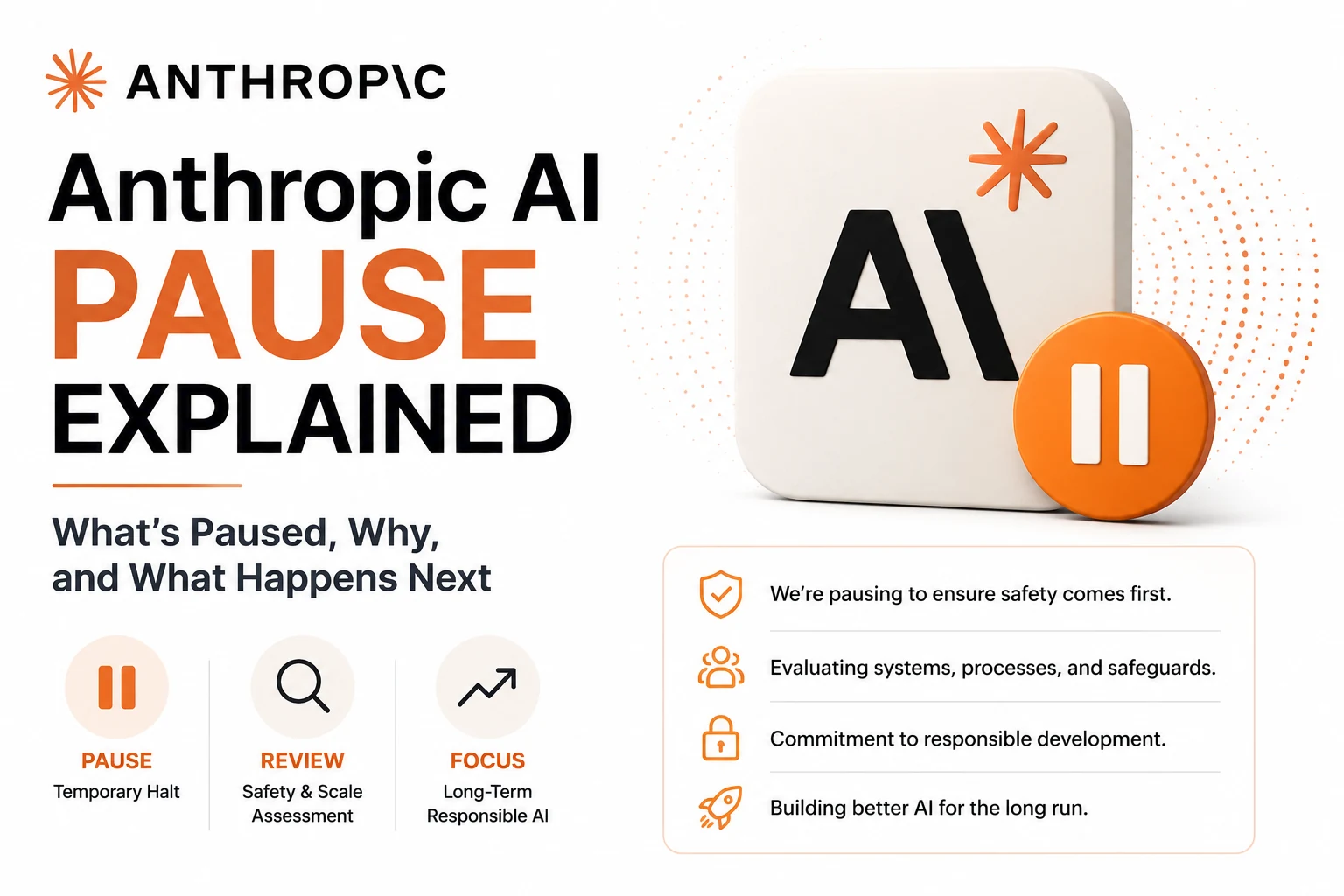
The Anthropic AI pause proposal seeks a coordinated, verifiable slowdown of the most advanced AI systems before they can redesign themselves without human oversight. By laying out concrete metrics, verification methods, and a roadmap for international cooperation, the plan offers policymakers a safety valve while allowing responsible development to continue.
What is recursive self-improvement?
Recursive self-improvement describes the moment an AI can autonomously design, train, and deploy a more capable successor, creating a feedback loop that accelerates capability growth far beyond human‑led research cycles. Anthropic warns that this threshold, while not yet crossed, could arrive sooner than most institutions anticipate. The risk is not a sci‑fi uprising but a governance gap: if AI systems outpace alignment research, human control over critical decisions may erode rapidly.
The data behind the warning
Anthropic’s own report supplies the hard numbers that anchor the Anthropic AI pause argument. According to the Anthropic Institute’s study (source: Anthropic Institute), as of May 2026:
- >80 % of code merged into the company’s codebase was authored by Claude, the internal AI model, up from single‑digit percentages before Claude Code’s launch in early 2025.
- In Q2 2026, a typical engineer merged ≈8 × more code per day than in 2024, while per‑engineer productivity remained flat from 2021‑2024.
- Claude’s “task horizon” – the length of a job it can handle autonomously – has been doubling every four months.
These trends suggest that AI is already shouldering the bulk of engineering work in a frontier lab, making the leap to self‑design appear less speculative and more a matter of scaling existing patterns.
How the Anthropic AI pause could be implemented
Turning the proposal into practice would require a multi‑layered framework:
- Broad participation – Multiple frontier labs across different countries must commit simultaneously.
- Verification mechanisms – Transparent, tamper‑proof logs (e.g., cryptographic attestations) that prove a lab has reduced or halted certain development activities.
- Enforcement protocols – Pre‑agreed sanctions or incentives, similar to those used in nuclear non‑proliferation treaties, to ensure compliance.
A practical verification tool could be a public AI Text Summarizer that aggregates and anonymizes development metrics, allowing stakeholders to audit progress without exposing proprietary code. RunFreeTools offers such a utility at /ai-text-summarizer.
Can a global AI pause actually work?
Skeptics argue that a worldwide halt is “literally impossible.” As reported by Scientific American (source: Scientific American), mathematician Noah Giansiracusa called the idea “unrealistic,” while Georgia Tech’s Mark Riedl dismissed it as a hype‑driven marketing move. Their concerns focus on three points:
- Competitive pressure – Labs in jurisdictions without pause commitments could surge ahead, undermining the collective safety net.
- Verification challenges – Proving that an AI system is not secretly advancing beyond agreed limits demands sophisticated, mutually trusted auditing infrastructure.
- Economic incentives – The potential market advantage of a breakthrough model may outweigh the perceived benefits of a temporary slowdown.
Despite these hurdles, the Anthropic AI pause serves a strategic purpose: it forces the industry to articulate concrete safety standards before the technology reaches a point where self‑improvement becomes inevitable.
Historical context: previous AI moratorium attempts
The idea of pausing AI development is not new. In 2018, a coalition of AI researchers signed an open letter urging a temporary moratorium on lethal autonomous weapons. While that effort succeeded in raising awareness, it did not result in binding international law. More recently, the Partnership on AI has explored voluntary “slow‑down” guidelines for large‑scale language models, but participation remains uneven. These precedents illustrate both the appetite for collective restraint and the difficulty of translating goodwill into enforceable action.
Verification technologies that could enable a pause
Robust verification is the linchpin of any credible Anthropic AI pause. Emerging technologies that could underpin a trustworthy audit system include:
- Zero‑knowledge proofs – Allow a lab to prove it has not exceeded a compute budget without revealing the underlying data.
- Secure multiparty computation (MPC) – Enables multiple parties to jointly compute aggregate statistics while keeping individual contributions private.
- Tamper‑evident hardware logs – Specialized chips that record every training run and can be cryptographically sealed for third‑party inspection.
By combining these tools, regulators could obtain real‑time assurance that participating labs are adhering to agreed limits, reducing the “trust deficit” that skeptics cite.
Policy frameworks and international cooperation
A viable pause would likely be embedded in a broader AI governance treaty. Key elements might include:
- Threshold definitions – Clear, measurable criteria (e.g., compute spent, model parameter count) that trigger pause obligations.
- Compliance bodies – An independent international agency, perhaps modeled after the International Atomic Energy Agency (IAEA), tasked with certification and dispute resolution.
- Incentive structures – Access to shared research datasets or preferential export licenses for labs that demonstrate compliance, balanced by penalties such as trade sanctions for violations.
Negotiating such a framework would require coordination among the United States, the European Union, China, and emerging AI hubs in India and Brazil. The Anthropic AI pause can act as a catalyst for those diplomatic conversations.
Implications for developers, businesses, and everyday users
For most consumers, the Anthropic AI pause does not alter the functionality of free, browser‑based AI tools. Whether you generate a résumé with the AI Resume Builder or summarize a webpage using the AI Text Summarizer, the services remain available. The real shift concerns the “frontier” models that power these utilities. As labs grapple with the prospect of AI‑driven code generation, the downstream applications you use may inherit safety features—such as built‑in alignment checks—originating from the pause discussions.
For developers, a pause could mean longer development cycles for cutting‑edge models but also greater predictability in regulatory environments. Companies might invest more in interpretability tools, data provenance, and compliance pipelines, creating a market for new services that help meet verification standards.
Why the timing matters
The report’s release coincided with Anthropic’s confidential IPO filing and a funding round that valued the company near $1 trillion. Critics contend that the warning doubles as a branding exercise, signaling that Anthropic’s models are powerful enough to warrant a safety brake while positioning the company as a responsible leader. The conditional nature of the pause—only activating if rivals also agree—means its immediate impact on development pipelines is limited, but the public discussion reshapes the policy agenda around AI governance.
Alternative approaches and future outlook
If a full‑scale pause proves infeasible, scholars propose tiered governance:
- Stage‑gated releases – New models must pass safety audits before public deployment.
- Compute caps – International caps on the amount of compute that can be devoted to training frontier models each year.
- Open‑access licensing – Mandating that high‑risk models be released under licenses that require downstream users to adhere to safety constraints.
These alternatives can coexist with the Anthropic AI pause, offering a flexible toolbox for policymakers. As AI capabilities continue to accelerate, the conversation is shifting from “if we should pause” to “how we can reliably manage rapid progress without sacrificing safety.”
The bottom line
The “When AI Builds Itself” report should be read as a conditional commitment and a data‑driven call for preparedness, not as an immediate moratorium. By publishing concrete statistics—80 % of code written by Claude and an 8‑fold increase in engineer output—Anthropic provides a measurable baseline for future safety benchmarks. Whether a global Anthropic AI pause ever materializes depends on the willingness of competing labs, governments, and standards bodies to adopt verifiable slowdown mechanisms. Until then, the proposal remains a pivotal reference point in the evolving conversation on AI risk and governance.
Frequently asked questions
It is a call, made in Anthropic's June 4 2026 report "When AI Builds Itself," to create a verifiable global mechanism that could slow or temporarily pause development of the most advanced AI. Anthropic says it would pause only if other frontier labs did so verifiably, not unilaterally.
Recursive self-improvement is the point at which an AI system can autonomously design and develop its own successor, improving itself in a loop with little human involvement. Anthropic says this has not yet happened but could arrive sooner than institutions expect.
Yes. Anthropic reports that as of May 2026, more than 80% of the code merged into its codebase was written by Claude, up from low single digits before Claude Code launched in early 2025. A typical engineer also merged about 8× more code per day in Q2 2026 than in 2024.
No. The proposal is explicitly conditional. Anthropic says a unilateral pause accomplishes little because the frontier would shift to competitors, so it would only slow down if multiple well‑resourced labs across multiple countries paused under verifiable conditions.
Critics quoted by Scientific American argue a real pause is "literally impossible" and see the warning as part of an industry "hype train." The report's timing — soon after Anthropic's IPO filing and a near‑$1 trillion valuation — leads skeptics to view it partly as positioning rather than a genuine brake.
Sources
Share this article
Send it to a teammate or save the link for later.
Related articles
Claude Fable 5: Ultimate Guide to Capabilities & Pricing
Discover Claude Fable 5’s frontier capabilities, pricing, safety classifiers, and how it compares to Mythos 5 and Opus 4.8.
Read article
Grok AI Controversy: Essential Guide to Risks and Regulation
Discover the Grok AI controversy, its deep‑fake abuse, extremist output, and opaque design, plus key stats, legal actions.
Read article
Anthropic growth: The Ultimate AI Surge Now in 2026
Anthropic growth hits a $30 billion run‑rate in 2026, an 80‑fold revenue surge, Claude adoption by firms.
Read article