Anthropic Mythos Is Back: Claude's Most Powerful AI
Anthropic Mythos Is Back: Claude's Most Powerful AI Returns With Limited Access
Anthropic's most powerful AI model, Claude Mythos, is back. After a U.S. export-control directive forced the company to switch it off on June 12, the government cleared Anthropic in late June 2026 to redeploy Claude Mythos 5 to a tightly vetted group of more than 100 U.S. institutions. It is not a public launch: Mythos remains an invitation-only, restricted-access model, while a safer sibling called Claude Fable 5 carries the same raw capabilities to everyone else.
If you have been searching for how to access Mythos, here is the short answer up front: most people cannot get the raw Mythos model, and Anthropic does not plan a general release. What you can use today is Claude Fable 5, the Mythos-class model with built-in safeguards. Below is what Mythos actually is, why access is locked down, what it can do, what it costs, how to qualify for access, and how it stacks up against other frontier models.
What Is Claude Mythos?
Claude Mythos is the codename for Anthropic's most capable frontier model. It first surfaced in March 2026 not through a press release but through a data leak: roughly 3,000 unpublished assets, including draft blog posts, were briefly discoverable in Anthropic's content management system because of a misconfiguration, as Fortune first reported. One leaked draft described the model as "by far the most powerful AI model we've ever developed."
Anthropic confirmed the model and shipped a research preview on April 7, then released the current generation, Claude Mythos 5, on June 9 alongside Claude Fable 5. According to Anthropic's own documentation, Mythos 5 and Fable 5 are the same model with the same capabilities. The crucial difference is safety: Fable 5 ships with safety classifiers that can decline certain requests, while Mythos 5 (API model ID claude-mythos-5) does not include those classifiers at all.
In other words, Mythos is the unfiltered version. That single design choice is the reason it is restricted, and the reason regulators got involved.
Why Is Access to Mythos Restricted?
Anthropic argues that Mythos crosses a line in cybersecurity. In its testing, the model autonomously found and exploited serious vulnerabilities without human help. Anthropic's red-team writeup and subsequent reporting describe Mythos identifying flaws in "every major operating system and every major web browser," fully autonomously exploiting a 17-year-old remote code execution bug in FreeBSD, and surfacing hundreds of issues in widely used software. Built In reported the model flagged 271 Firefox bugs and a decades-old OpenBSD flaw, and that it could let people with no formal security training breach systems.
The worry is asymmetry: a tool that hands attackers expert-level offensive capability could outrun defenders if it were broadly available. That is why Anthropic seeded Mythos first to cyber defenders and critical-infrastructure operators through a program called Project Glasswing, so they could harden important systems before similar capabilities spread.
Then the government stepped in. As Fortune reported and later coverage of the export directive detailed, concerns about a purported jailbreak and potential foreign access prompted a June 12 export-control directive that forced Anthropic to disable both Mythos 5 and Fable 5 for all customers. Not everyone is convinced the danger is real. OpenAI CEO Sam Altman publicly dismissed Anthropic's framing as "fear-based marketing," per Built In. Anthropic maintains the caution is warranted.
The "Back, But Limited" News: What Just Happened
The headline reason Mythos is in the news again is that the U.S. government partially reversed course. According to 9to5Mac, Commerce Secretary Howard Lutnick wrote to Anthropic chief compute officer Tom Brown authorizing access for "certain trusted partners," determining that "appropriate safeguards are in place to permit certain trusted partners to access the Claude Mythos 5 Model."
Here is the practical shape of the deal:
- More than 100 U.S. institutions, including major companies, Fortune 500 firms, and government agencies, are cleared to use Mythos 5.
- The focus is cybersecurity operations and critical-infrastructure defense.
- Claude Fable 5, the public model, was not addressed in the letter and remains restricted as of late June, though people close to the talks indicated movement toward releasing it on an unclear timeline.
So Mythos is "back," but in the narrowest possible sense: a controlled redeployment to vetted partners, not a return to general availability.
What Can Claude Mythos Do?
Because Mythos 5 and Fable 5 are the same model, their capability profile is identical. Per Anthropic, the model is built for the most demanding reasoning and long-horizon agentic work, and posts state-of-the-art results on nearly all tested benchmarks. Highlights from Anthropic's launch announcement include:
- Software engineering at scale. Stripe used Fable 5 to complete a 50-million-line Ruby migration in a single day, work Anthropic says would have taken roughly two months by hand. It posted the top score on Cognition's FrontierCode evaluation among frontier models.
- Advanced analysis and finance. It led Hebbia's finance benchmark for senior-level reasoning and was, per Anthropic, the first model to break 90% on core analytics benchmarks, a 10-point jump over Claude Opus 4.8.
- Long context and vision. A 1M-token context window lets it reason over millions of tokens at once, and it can extract data from figures or rebuild code from screenshots.
- Scientific research. In internal testing, Anthropic says Mythos 5 accelerated parts of its protein-design process around tenfold, with strong drug-design candidates for nine of 14 protein targets.
- Cybersecurity. This is where Mythos most clearly separates from the public field, and it is exactly the capability that triggered the restrictions.
It is worth flagging what is confirmed versus contested. The benchmark and customer figures above come from Anthropic and named partners; independent, like-for-like third-party benchmarks for Mythos specifically remain limited because so few organizations can run it.
Pricing and Availability
Mythos 5 and Fable 5 share pricing and specs, per Anthropic's documentation:
| Model | Access | Input (per 1M tokens) | Output (per 1M tokens) | Context | Max output |
|---|---|---|---|---|---|
| Claude Mythos 5 | Restricted (Project Glasswing) | $10 | $50 | 1M tokens | 128K tokens |
| Claude Fable 5 | Generally available | $10 | $50 | 1M tokens | 128K tokens |
| Claude Mythos Preview | Retired research preview | $25 | $125 | 1M tokens | 128K tokens |
| Claude Opus 4.8 | Generally available | $5 | $25 | 200K tokens | n/a |
A few notes on the table. Mythos 5 is less than half the price of the earlier Mythos Preview, which launched at $25 and $125 per million tokens. Both Mythos 5 and Fable 5 carry a 30-day data-retention requirement and are not available under zero data retention. Opus 4.8 pricing and the 200K context figure come from independent comparison reporting and Anthropic's models overview, and are included for reference only.
How to Get Access to Mythos
For the vast majority of users, the honest answer is that you cannot get raw Mythos, and Anthropic has said it does not currently plan a general release. Access runs through Project Glasswing, the cross-industry program Anthropic launched with the model. Based on Pluralsight's explainer and Anthropic's docs, the realistic paths are:
- Be an approved Project Glasswing partner. Glasswing began with a small set of founding partners plus a larger group of organizations that build or maintain critical software infrastructure. With the new clearance, the vetted list now exceeds 100 U.S. institutions.
- Go through your cloud account team. Anthropic's documentation says customers seeking Mythos 5 should contact their Anthropic, AWS, or Google Cloud account team. Approved partners can receive it via the Claude API, Amazon Bedrock, Google Vertex AI, or Microsoft Foundry.
- Apply as a security researcher. Anthropic has run vetting tracks for cyber defenders, so qualified researchers may be able to apply through Anthropic's cyber programs.
If none of that applies to you, Anthropic's own guidance is to use Claude Fable 5 instead, which it describes as offering the same capabilities with safeguards that make it safe for broad use. Fable 5's classifiers route high-risk cybersecurity, biology, chemistry, and model-distillation requests to Claude Opus 4.8, and Anthropic says that fallback happens in less than 5% of sessions on average.
How Mythos Compares to Other Frontier Models
The most useful comparison is not Mythos versus rival labs, but Mythos versus the model you can actually buy. For general reasoning and coding, Anthropic's own system cards point to a real but modest and uneven gap between Mythos-class models and Claude Opus 4.8. The dramatic separation is in cybersecurity, where Anthropic says Mythos is far ahead of any other model.
Against the broader field, public frontier models remain highly competitive. In June 2026, independent comparison coverage and aggregated leaderboards put Claude Opus 4.8, OpenAI's GPT-5.5, and Google's Gemini 3.x lineup within a few points of one another on general-intelligence indexes, with each leading on different tasks. GPT-5.5 and Gemini offer 1M-token context windows at the API; Opus 4.8 has historically held at 200K, while Mythos-class models bring 1M context to Anthropic's top tier.
The practical takeaway: for everyday coding, analysis, and agent work, Fable 5 (or Opus 4.8, GPT-5.5, and Gemini) will serve most teams well. Mythos's unique edge is concentrated in exactly the domain that keeps it behind a vetting wall.
Bottom Line
Claude Mythos is back, but "back" means a controlled redeployment to more than 100 vetted U.S. institutions, not a public release. Mythos 5 and the publicly available Fable 5 are the same model at heart; the difference is that Mythos ships without the safety classifiers, which is why regulators paused it and then cleared it only for trusted partners. It costs $10 per million input tokens and $50 per million output tokens, offers a 1M-token context window, and posts state-of-the-art benchmarks, with a cybersecurity capability so strong it is the entire reason for the restrictions. For almost everyone, the right move is Claude Fable 5, which delivers Mythos-level performance with guardrails. If you genuinely operate critical infrastructure or defensive cybersecurity at scale, your path to Mythos runs through Project Glasswing and your cloud account team. Watch for further updates on Fable 5's full reinstatement, which sources say is moving forward on a timeline Anthropic has not yet confirmed.
Frequently asked questions
Claude Mythos is the codename for Anthropic's most powerful frontier AI model. The current version, Claude Mythos 5, shares the same capabilities as the public Claude Fable 5 but ships without safety classifiers, which is why it is restricted to vetted partners through Project Glasswing.
No. Mythos 5 is not generally available and Anthropic has said it does not currently plan a general release. It is offered in limited availability to approved Project Glasswing partners. Everyone else can use Claude Fable 5, which offers the same capabilities with safeguards.
Access runs through Project Glasswing. Approved cybersecurity and critical-infrastructure organizations can contact their Anthropic, AWS, or Google Cloud account team to request Mythos 5 via the Claude API, Amazon Bedrock, Google Vertex AI, or Microsoft Foundry. Qualified security researchers may apply through Anthropic's cyber programs.
Anthropic says Mythos can autonomously find and exploit serious cybersecurity vulnerabilities, including a 17-year-old remote code execution bug in FreeBSD. A US export-control directive on June 12, 2026 forced Anthropic to disable it, before the government cleared it for trusted partners in late June.
Claude Mythos 5 and Claude Fable 5 cost $10 per million input tokens and $50 per million output tokens, with a 1M-token context window and up to 128K output tokens. That is less than half the price of the earlier Claude Mythos Preview, which launched at $25 and $125.
They are the same underlying model with identical capabilities and pricing. Claude Fable 5 includes safety classifiers that can decline high-risk requests and route them to Claude Opus 4.8, while Claude Mythos 5 does not include those classifiers and is restricted to Project Glasswing partners.
For general reasoning and coding, Anthropic's system cards point to a modest, uneven gap between Mythos-class models and Opus 4.8, with public models like GPT-5.5 and Gemini 3.x close behind on intelligence indexes. Mythos's clearest advantage is in cybersecurity, where Anthropic says it is far ahead of any other model.
The late-June 2026 clearance applies to more than 100 US institutions. A US export-control directive previously restricted access, including foreign-national access, so availability outside vetted US partners remains limited and subject to ongoing government consultation.
Share this article
Send it to a teammate or save the link for later.
Related articles
Claude Fable 5: Ultimate Guide to Capabilities & Pricing
Discover Claude Fable 5’s frontier capabilities, pricing, safety classifiers, and how it compares to Mythos 5 and Opus 4.8.
Read article
Free AI Tools to Use Now While Claude Fable 5 Is Down
Claude Fable 5 down? Use these free AI tools right now — no signup, no login. A practical roundup of free AI tools for writing, resumes, images, and OCR.
Read article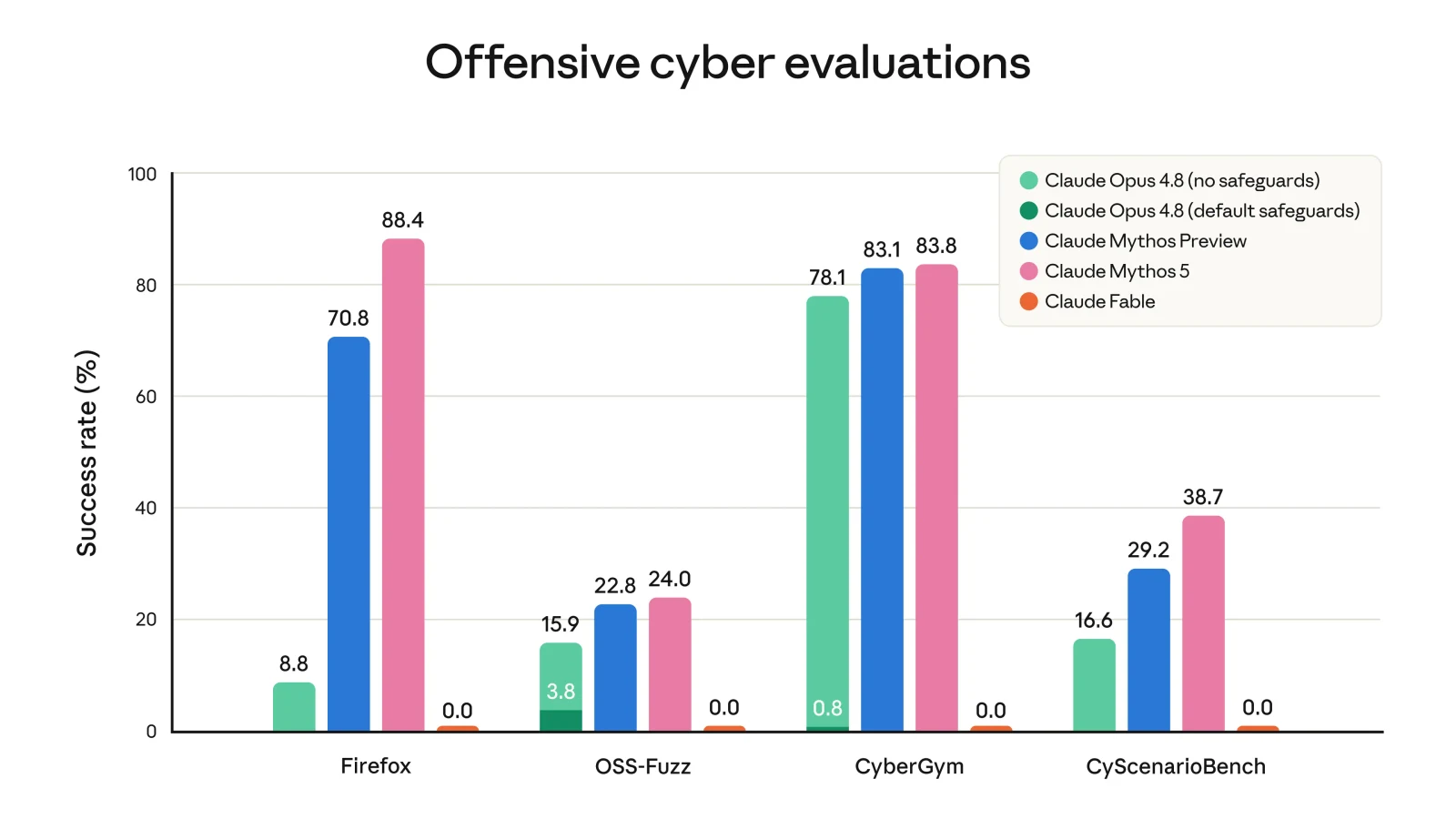
Claude Mythos 5 Cybersecurity: The Ultimate AI Threat
Claude mythos 5 cybersecurity reshapes AI offense and defense.
Read article