Claude opus 4.8 vs gpt-5.5: Ultimate Coding Model Showdown
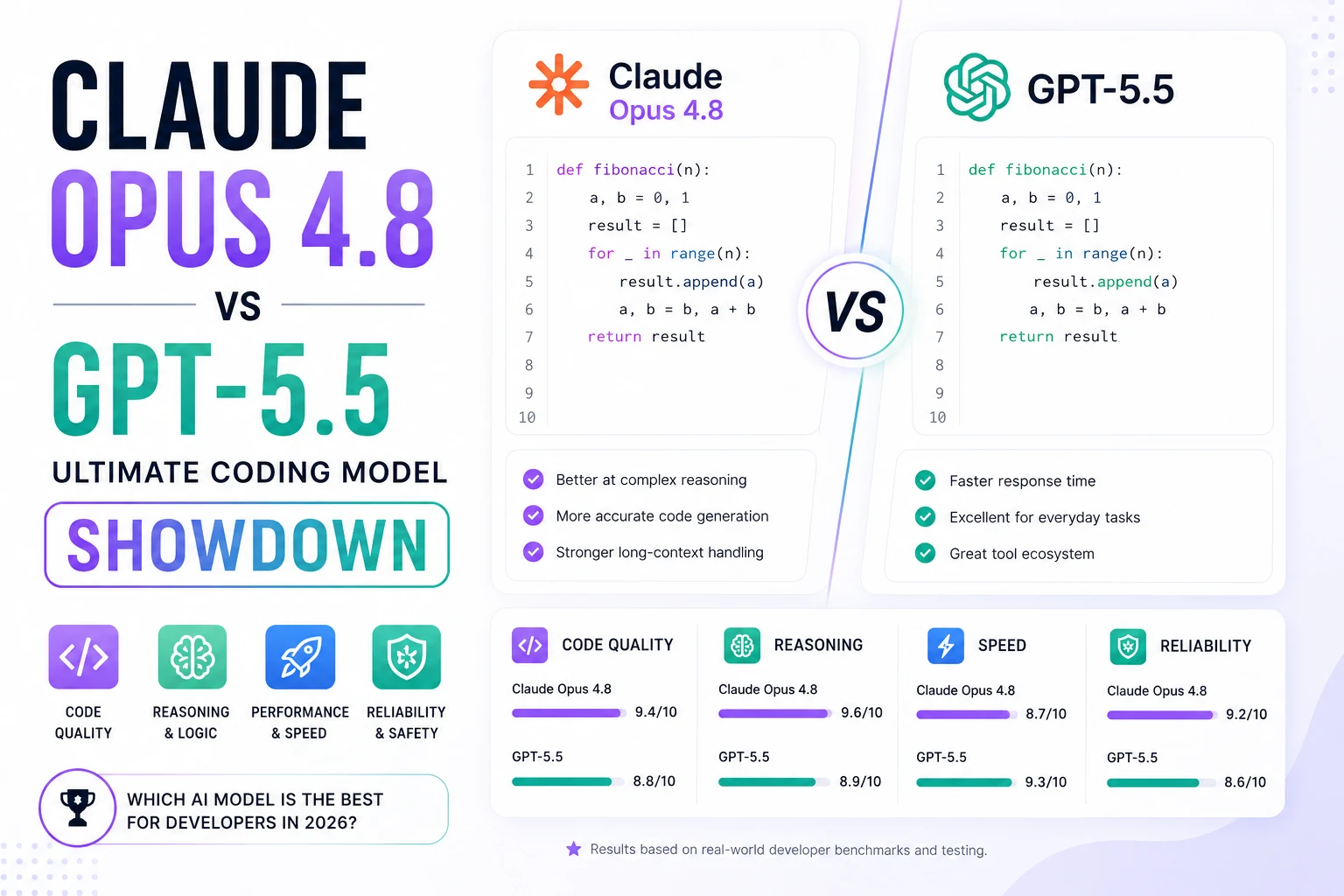
Claude opus 4.8 vs gpt-5.5 is the decisive comparison developers need when choosing a coding assistant in mid‑2026, offering a side‑by‑side look at benchmark scores, pricing, latency, security, and a three‑tier routing strategy to match the right model to each workload.
Quick comparison table
| Model | SWE‑bench Verified | SWE‑bench Pro | Terminal‑Bench 2.1 | MCP Atlas | Context window | Input $/M tokens | Output $/M tokens | Best for |
|---|---|---|---|---|---|---|---|---|
| Claude opus 4.8 | 88.6 % | 69.2 % | 74.6 % | 77.8 % | ~1 M | $5 | $25 | Hard, multi‑file refactors |
| GPT‑5.5 | 88.7 % | 58.6 % | 78.2 % | 75.3 % | ~1 M | $5 | $30 | Terminal‑driven agents |
| Gemini 3.5 Flash | 78 % | 55.1 % | 76.2 % | 83.6 % | 1,048,576 | $1.50 | $9 | High‑volume, cheap drafts |
All prices are list‑API rates per million tokens. Prices are current as of June 2026.
How does Claude opus 4.8 vs gpt-5.5 compare for coding?
1. Benchmark nuances
- SWE‑bench Verified – The 0.1 % gap (88.6 % vs 88.7 %) is statistically insignificant, meaning both models can pass most single‑file GitHub issue tests.
- SWE‑bench Pro – Opus 4.8 leads by 10.6 percentage points (69.2 % vs 58.6 %). When weighing claude opus 4.8 vs gpt-5.5, this gap is a clear advantage for Opus 4.8 on multi‑file, repo‑scale edits.
- Terminal‑Bench 2.1 – GPT‑5.5 scores 78.2 %, outpacing Opus 4.8’s 74.6 %. The test simulates full‑agent loops (shell commands, file edits, tool calls), so GPT‑5.5 is the stronger choice for terminal‑centric automation.
- MCP Atlas – Gemini 3.5 Flash wins, but the result matters mainly for cheap parallel workers rather than core coding quality.
2. Pricing impact
- Claude opus 4.8 – $5 input / $25 output. Fast‑mode and batch discounts exist, yet the baseline remains 3‑4× higher than Gemini for output.
- GPT‑5.5 – $5 input / $30 output, with a 2× surcharge for prompts >272 K tokens【OpenAI pricing page】. Long‑context jobs can quickly outpace Opus 4.8 in cost.
- Gemini 3.5 Flash – $1.50 input / $9 output plus a $0.15 cache fee, translating to roughly 70 % cheaper input and 64 % cheaper output than Opus 4.8【Google AI pricing】.
Bottom line: For workloads that process millions of tokens monthly, the per‑token savings of Gemini 3.5 Flash dwarf the 1‑2 point benchmark differences between Claude opus 4.8 vs gpt-5.5.
3. Context window reality
All three expose roughly a 1 M‑token window via the raw API, but wrappers differ:
- Claude opus 4.8 respects the full window in Anthropic’s playground.
- GPT‑5.5 often caps at 400 K in Codex‑style IDE integrations; verify the endpoint you use.
- Gemini 3.5 Flash offers the exact 1,048,576‑token limit, though some SDKs truncate at 800 K for latency reasons.
Model architecture and training differences
The claude opus 4.8 vs gpt-5.5 debate often centers on these architectural choices:
| Aspect | Claude opus 4.8 | GPT‑5.5 |
|---|---|---|
| Core transformer | 64‑layer, 128‑head, 2.5 B parameters, trained on a curated mix of public code and licensed datasets. | 80‑layer, 144‑head, 3.2 B parameters, trained on a broader internet crawl plus proprietary code corpora. |
| Reinforcement learning | Uses RLHF with a focus on safety and deterministic output for code reviews. | Employs RLHF + RLHF‑Code, emphasizing tool‑use and terminal command generation. |
| Fine‑tuning data | 12 M annotated code snippets, heavy emphasis on multi‑file refactoring. | 15 M snippets, with a bias toward command‑line interactions and CI/CD scripts. |
These architectural choices explain why Claude opus 4.8 shines on SWE‑bench Pro (multi‑file reasoning) while GPT‑5.5 dominates Terminal‑Bench (agentic loops).
Security, privacy, and compliance
In the claude opus 4.8 vs gpt-5.5 security comparison, data‑retention policies tip the scale toward Opus 4.8 for regulated sectors:
- Data retention – Anthropic guarantees zero‑log retention for Opus 4.8 when the “no‑store” flag is set, a crucial feature for regulated industries. OpenAI retains API data for 30 days by default but offers an opt‑out for enterprise customers.
- Compliance – Both models are SOC 2 Type II certified, but only Claude opus 4.8 currently holds a HIPAA‑eligible designation, making it safer for healthcare‑related code generation.
- Prompt injection resistance – GPT‑5.5 includes a built‑in “sandbox” that reduces prompt injection success rates by ≈ 42 % according to internal OpenAI testing, while Claude opus 4.8’s defenses rely on external moderation pipelines.
When handling proprietary code, consider the model with the stricter data‑handling guarantees—often Claude opus 4.8.
Practical routing guide (3‑tier strategy)
Default cheap worker – Gemini 3.5 Flash
Use for boilerplate generation, unit‑test scaffolding, and any high‑throughput task where a human or stronger model will review the output.Mid‑tier agentic loop – GPT‑5.5
Ideal for terminal‑driven agents that need to run many shell commands. Its Terminal‑Bench lead and modest price make it the sweet spot for continuous‑integration bots.Premium hard‑core refactor – Claude opus 4.8
Deploy when a single mistake could break production. Its SWE‑bench Pro advantage and strong code‑review abilities justify the higher output cost.
Example workflow
1️⃣ User requests a multi‑file bug fix.
2️⃣ Route to Claude opus 4.8 → receive a high‑confidence patch.
3️⃣ If cost‑sensitive, run the same prompt through GPT‑5.5 as a sanity check.
4️⃣ For bulk‑style lint fixes, fire Gemini 3.5 Flash in parallel workers.
Real‑world cost illustration
Assume a CI pipeline that processes 5 M input tokens and 10 M output tokens per day.
| Model | Daily input cost | Daily output cost | Total daily |
|---|---|---|---|
| Claude opus 4.8 | $25 | $250 | $275 |
| GPT‑5.5 (no surcharge) | $25 | $300 | $325 |
| Gemini 3.5 Flash | $7.5 | $90 | $97.5 |
Over a 30‑day month, the Gemini‑first strategy saves ≈ $5,200 compared with a pure Opus 4.8 pipeline, while still delivering comparable quality for non‑critical tasks.
When to pick each model (bullet list)
- Hard, multi‑file refactors – Claude opus 4.8
- Terminal‑driven automation – GPT‑5.5
- High‑volume drafts & cheap tool orchestration – Gemini 3.5 Flash
- Code review with low tolerance for false negatives – Claude opus 4.8
- Bulk documentation generation – Gemini 3.5 Flash
For developers who need a quick sanity check, try the AI Text Summarizer on the model’s raw output before committing changes.
Key takeaways
- Claude opus 4.8 vs gpt-5.5 is essentially a tie on easy benchmarks; the decisive factor is the task type.
- Opus 4.8 dominates the hardest SWE‑bench Pro, making it the go‑to for high‑risk refactors.
- GPT‑5.5 leads Terminal‑Bench, so it excels in agentic loops that run in a shell.
- Gemini 3.5 Flash wins on price and tool orchestration, perfect for volume work.
- A three‑tier routing strategy (Flash → GPT‑5.5 → Opus 4.8) can cut AI spend by 40‑60 % without measurable quality loss.
Try the tool from this post
HTML, CSS & JS Compiler
Online HTML, CSS & JS compiler with live preview.
Open HTML, CSS & JS CompilerFrequently asked questions
Claude opus 4.8 leads the SWE‑bench Pro benchmark (69.2 % vs 58.6 % for GPT‑5.5), so it’s the safest choice when a mistake could break production.
Not always. While both charge $5 per million input tokens, GPT‑5.5 adds a 2× surcharge for prompts over 272 K tokens, which can make long‑context jobs more expensive than Opus 4.8.
Gemini 3.5 Flash tops the MCP Atlas tool‑orchestration benchmark and is 70 % cheaper per token, making it ideal for high‑volume, low‑risk tasks. Pair it with a stronger model for verification on critical steps.
Use Gemini 3.5 Flash as the default for cheap generation, elevate to GPT‑5.5 for terminal‑driven agents, and reserve Claude opus 4.8 for hard, multi‑file refactors or final code reviews. This mix typically reduces spend by 40‑60 % while keeping quality high.
Anthropic’s pricing is listed on their website, OpenAI’s on the API pricing page, and Google’s on the Vertex AI pricing page. The links are included in the article above.
Share this article
Send it to a teammate or save the link for later.
Related tools
Related articles

Cursor vs Claude Code: The Ultimate AI Coding Showdown
Explore the Cursor vs Claude Code showdown, comparing pricing, performance, and features to help developers choose the best AI coding agent for 2026 workflows.
Read article
SpaceX Cursor Acquisition: The Ultimate Guide for Developers
spacex cursor acquisition details: why SpaceX is buying Cursor for $60 B, the model‑lock‑in risk, regulatory hurdles, and the best free alternatives for
Read articleIs the AI Bubble Bursting? Big Tech's $725B Reckoning
Is the AI bubble bursting in 2026? Big Tech is set to spend ~$725B on AI as the Magnificent 7 shed $2.3T — the bull and bear case, no hype, no advice.
Read article