SpaceX Cursor Acquisition: The Ultimate Guide for Developers
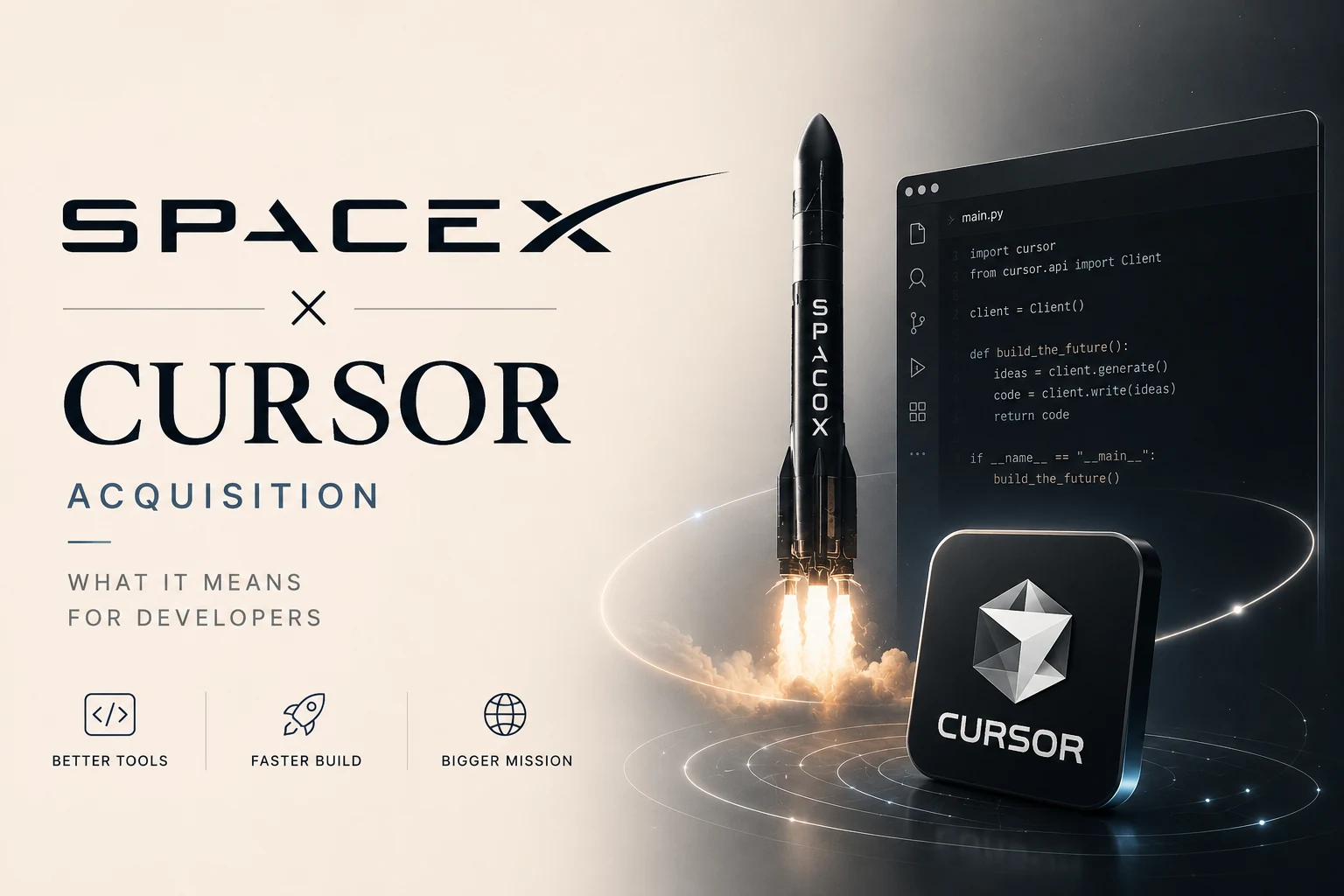
spacex cursor acquisition is a landmark $60 billion all‑stock deal that could reshape AI‑assisted coding, and developers must understand its strategic motives, regulatory hurdles, and how to safeguard their workflow. This guide breaks down the transaction, potential model‑lock‑in risks, and concrete steps to keep your code generation flexible across any editor.
What the spacex cursor acquisition actually says
The agreement, announced on June 16 2026, outlines an all‑stock purchase of Anysphere Inc., the maker of the Cursor editor, for roughly $60 billion. Key points extracted from the filings and coverage include TechCrunch and CNBC:
- Buyer & target: SpaceX → Anysphere (Cursor)
- Structure: Shares of SpaceX Class A stock issued to Cursor shareholders at a price based on a seven‑day VWAP.
- Timing: Announcement June 16 2026; expected close Q3 2026, subject to antitrust clearance.
- Revenue & users: Reported annualized revenue ≈ $2.6 billion; ~4 million active developers.
- Regulatory note: The deal remains a signed agreement; the FTC and EU competition authorities must sign off (SEC filing).
No public commitment has been made to preserve Cursor’s current multi‑model support after the transaction closes.
Why SpaceX would buy a code editor
At first glance a rocket manufacturer purchasing an IDE seems odd, but three strategic motives emerge for the spacex cursor acquisition:
- Distribution channel for Grok. SpaceX’s recent integration of xAI gives it the Grok family of models. Owning Cursor places Grok directly in the daily hands of millions of developers.
- Revenue capture. Each request routed to a rival model represents lost inference revenue. By steering Cursor traffic to Grok, SpaceX can improve its AI‑division profitability, which posted a 12 % YoY loss in 2025 (NASA press release).
- Enterprise AI foothold. Cursor’s growing B2B sales diversify SpaceX’s portfolio beyond launch services, positioning it as a full‑stack AI platform.
How the spacex cursor acquisition impacts developers
The practical impact hinges on model neutrality. Today Cursor lets users select Anthropic’s Claude, OpenAI’s GPT, or its own Composer models. Post‑acquisition scenarios include:
- Soft default shift: Grok becomes the cheapest tier and the most tightly integrated option, while other models remain available but with higher friction.
- Hard lock‑in: Future releases could de‑prioritize non‑Grok APIs, effectively nudging users toward the in‑house model.
- Pricing changes: Bundling Grok could lead to new pricing tiers that make third‑party models comparatively expensive.
For teams that rely on specific model characteristics—such as Claude’s “explainability” or GPT‑4‑Turbo’s token efficiency—these shifts could affect code‑generation quality, latency, and compliance.
Regulatory landscape
Antitrust regulators in the United States and the European Union are scrutinizing the spacex cursor acquisition for potential market‑consolidation risks. The FTC’s “AI‑tool concentration” report from early 2025 flagged any acquisition that could limit developers’ ability to choose independent inference providers. If the agencies require divestitures or behavioral remedies, SpaceX may be forced to keep non‑Grok models accessible. Monitoring the FTC docket and EU Commission decisions will give early warning of any mandated concessions.
Will the spacex cursor acquisition force a model switch to Grok?
Analysts agree that a hard‑coded switch is unlikely before regulators intervene, but the deal creates strong incentives for SpaceX to promote Grok. Expect the default model in new Cursor releases to be Grok, with a UI that makes third‑party keys slightly more cumbersome to configure. Developers who need guaranteed model independence should prepare a fallback plan now.
What does the spacex cursor acquisition mean for my coding workflow?
- Short term (now‑to‑close): No functional changes. Continue using your preferred model; the deal is still pending.
- Mid term (post‑close, 0‑6 months): Watch changelogs for default model adjustments, API‑key handling, and any new pricing tiers.
- Long term (6‑12 months+): If Grok becomes the default and you cannot easily switch, consider adopting a bring‑your‑own‑key (BYOK) editor to retain control.
Migration checklist (numbered)
- Audit current model usage. Identify which APIs (Claude, GPT, Composer) power your CI pipelines.
- Export configuration. Save Cursor’s
.cursorrcor equivalent settings to a version‑controlled location. - Test alternatives. Use a sandbox environment (see next section) to benchmark code‑completion quality.
- Implement BYOK. Switch to an editor that lets you inject your own API keys, ensuring you can point to any provider.
- Document fallback plan. Keep a short “roll‑back” guide for teammates in case the default model changes overnight.
The best Cursor alternatives in 2026
| Tool | Model flexibility | Pricing (entry) | Best for |
|---|---|---|---|
| Windsurf | Broad: Claude, GPT, others via Cascade agent | Free tier; Pro ≈ $15/mo | Direct Cursor‑style experience |
| GitHub Copilot | Multiple models on paid tiers; usage‑based credits | Free tier; Pro ≈ $10/mo | Teams already on GitHub |
| Zed | Anthropic, OpenAI, Google, Ollama, OpenRouter | Free tier; Pro ≈ $10/mo | Speed, open‑source core |
| Cline | Bring‑your‑own‑key (any compatible API) | Free (pay API usage) | Maximum control, no lock‑in |
| VS Code + Continue | Fully configurable, BYOK | Free (pay API usage) | Staying in VS Code while owning routing |
| JetBrains AI Assistant | Claude, GPT, Gemini, local models | Free tier; Pro ≈ $10/mo | JetBrains IDE users |
Why these matter: Windsurf mimics Cursor’s UI, Zed offers the fastest native experience, while Cline and Continue give you the ability to swap models instantly—critical if SpaceX pushes Grok as the default.
How to test an alternative without disrupting your week
- Select a recent, real task (bug fix or refactor) as a benchmark.
- Re‑create the task in the new editor and record suggestion quality, latency, and any model‑specific quirks.
- Use a sandbox environment – the free AI Text Summarizer can help you quickly compare output snippets without touching your main repo.
- Force a model switch within the tool to verify that swapping APIs is straightforward.
- Document the results in a shared note so the team can decide collectively.
Technical deep‑dive: Model‑lock‑in risk
When an IDE hard‑codes a provider, three technical consequences arise:
- API version drift. Providers release new endpoints; a locked‑in editor may lag, causing compatibility warnings.
- Latency spikes. If the default model experiences high load, developers see slower suggestions, potentially halting productivity.
- Compliance exposure. Certain industries (finance, health) require audit‑ready logs. A proprietary model may not expose the necessary metadata, forcing teams to adopt BYOK solutions.
Mitigating these risks means keeping the API abstraction layer in your own codebase. For example, wrap all AI calls behind a thin Python module that reads the provider from an environment variable. This pattern works across Cursor, VS Code + Continue, and any future editor.
Future outlook: What could SpaceX do next?
Analysts speculate three possible post‑acquisition moves for the spacex cursor acquisition:
- Open‑source Grok SDK. To placate regulators, SpaceX may release a lightweight SDK that lets any editor call Grok, preserving a degree of openness.
- Hybrid pricing. Offer a “Grok‑plus‑third‑party” bundle where developers pay a single subscription but can allocate a quota to external models.
- Vertical integration. Embed Grok directly into SpaceX’s internal tooling (e.g., launch‑sequence simulators), creating a closed ecosystem that only indirectly affects public editors.
Staying aware of these signals—press releases, developer blog posts, and SEC filings—will help you anticipate changes before they hit production.
Action plan for developers
- Monitor official channels. Subscribe to SpaceX’s developer newsletter and the FTC’s docket alerts.
- Run the migration checklist before the Q3 2026 closing date.
- Pilot a BYOK editor (Cline or VS Code + Continue) on a low‑risk project today.
- Document a fallback strategy that includes code‑generation scripts you can run locally with open‑source models like Llama 3.
By staying informed and maintaining a portable workflow, developers can reap the benefits of any AI coding tool while safeguarding against vendor‑driven lock‑in.
Try the tool from this post
HTML, CSS & JS Compiler
Online HTML, CSS & JS compiler with live preview.
Open HTML, CSS & JS CompilerFrequently asked questions
On June 16 2026 SpaceX announced an all‑stock agreement to acquire Anysphere, the maker of Cursor, for about $60 billion. The price reflects Cursor’s $2.6 billion annual revenue and its 4 million‑developer user base. The deal remains pending regulatory approval.
No public commitment has been made. Analysts expect a soft default shift where Grok becomes the cheapest and most integrated option, but other models should remain accessible—though possibly with higher friction.
Windsurf offers the closest UI match, Zed provides speed and an open‑source core, while Cline and VS Code + Continue let you bring your own API key, guaranteeing model independence.
Pick a recent task, reproduce it in the alternative, use a sandbox tool like the AI Text Summarizer, force a model swap, and compare results. Document findings before committing to a switch.
It is a signed definitive agreement but still requires FTC and EU antitrust clearance. Expected closing is Q3 2026; until then the product and its model options remain unchanged.
Sources
Share this article
Send it to a teammate or save the link for later.
Related tools
Related articles

Cursor vs Claude Code: The Ultimate AI Coding Showdown
Explore the Cursor vs Claude Code showdown, comparing pricing, performance, and features to help developers choose the best AI coding agent for 2026 workflows.
Read article
Best Free AI Coding Assistants 2026 Ai Tools for Developers
Discover the best AI coding assistants of 2024, comparing free and paid options, autocomplete vs autonomous agents, pricing, privacy, and IDE fit for every
Read article
Cursor AI code editor Fast Guide: Why Developers Love It
Discover how the Cursor AI code editor accelerates development with full‑codebase indexing, multi‑file edits, privacy‑first AI assistance, and productivity
Read article