WhatsApp EU ruling: Fast Path to Business API Access
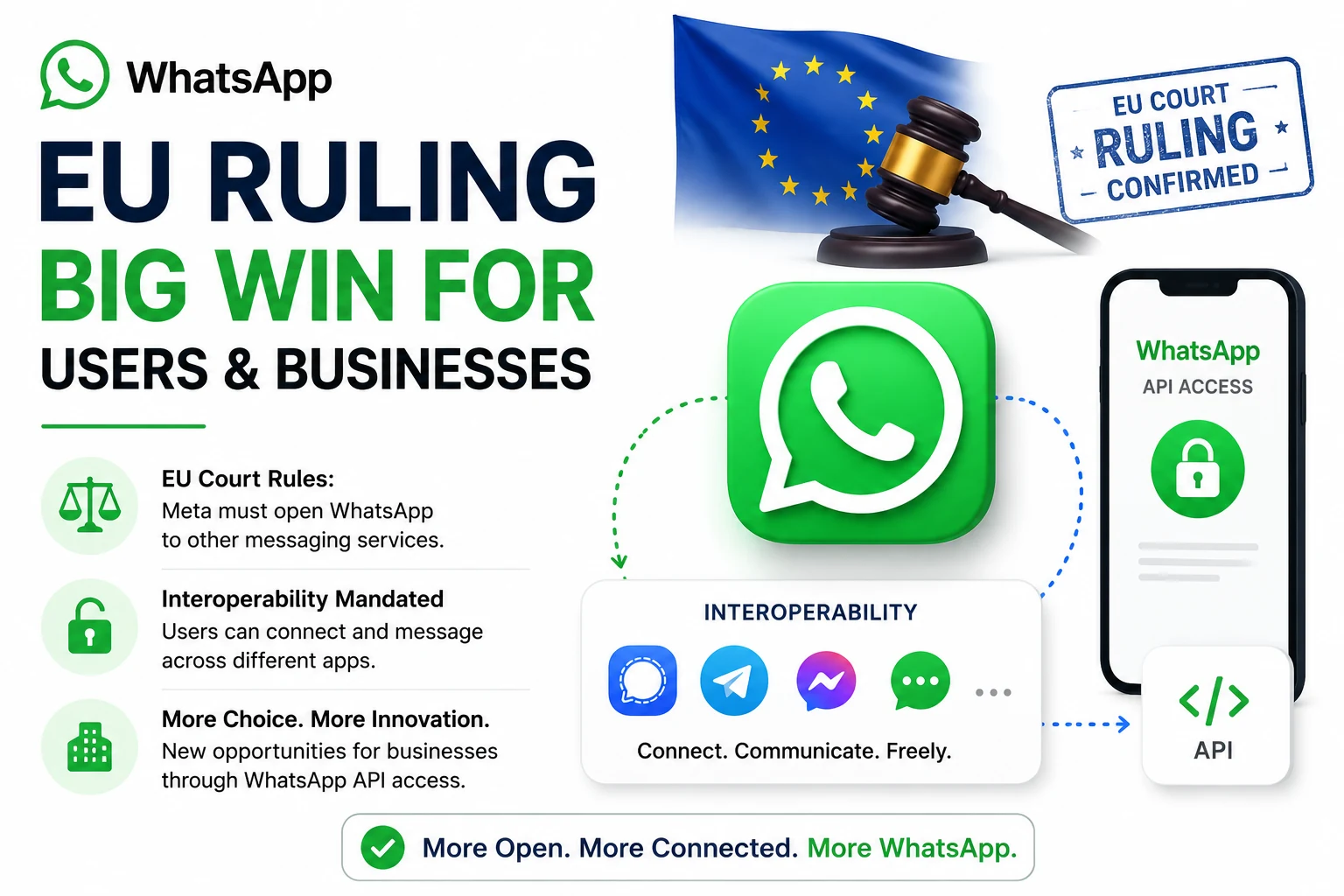
WhatsApp EU ruling forces Meta to reopen its Business API for third‑party AI assistants, restoring free access within five working days and safeguarding competition across Europe’s messaging market. The interim antitrust order targets a channel used by over 2 billion monthly users.
What does the WhatsApp EU ruling require Meta to do?
The European Commission’s press release details the obligations as three concrete actions:
- Re‑enable access to the WhatsApp Business API for third‑party AI assistants on the same commercial terms that applied before 15 October 2025.
- Implement the change within 5 working days, underscoring the urgency of the competition risk.
- Maintain “free” access, meaning no prohibitive fees or technical barriers that would effectively block rivals.
Non‑compliance can trigger periodic penalty payments of up to 10 % of Meta’s worldwide annual turnover—potentially billions of euros source.
Why does the WhatsApp EU ruling matter for AI competition?
Two factors make this order unusually significant:
- Rare use of Article 8 interim measures – This is only the second time the Commission has invoked Article 8 of Regulation 1/2003 — a tool reserved for “serious and irreparable” market risks EU law text. The first instance was the 2019 Broadcom case details.
- Control over AI distribution pipelines – The WhatsApp Business API is the primary conduit for billions of messages, powering the integration of AI assistants into everyday chat flows. By restricting that pipe, Meta could have tilted the emerging AI‑assistant market in favor of its own Meta AI offering.
How does the WhatsApp EU ruling affect businesses and developers?
Practical implications
- AI developers can again integrate their assistants into WhatsApp without paying a prohibitive fee, opening a distribution channel that reaches a massive European audience.
- Businesses gain bargaining power, able to select from multiple AI vendors and negotiate better service‑level agreements.
- End‑users may see a broader variety of assistant personalities within their familiar chat interface, fostering faster innovation.
Checklist for businesses adopting AI assistants on WhatsApp
- Verify that the assistant provider complies with the WhatsApp EU ruling (free API access).
- Review data‑privacy policies to align with GDPR requirements.
- Test the assistant in a sandbox environment before full deployment.
Tools to stay compliant
- Use our AI Translator to adapt assistant responses for multilingual European audiences.
- Summarize lengthy regulatory documents with the AI Text Summarizer.
- Polish public statements using the AI Grammar Checker to meet compliance standards.
- Re‑write internal policy briefs with the AI Paraphrasing Tool.
- Human‑tone‑enhance chatbot replies via the AI Humanizer.
Legal background of the EU’s Article 8 interim measures
Article 8 of Regulation 1/2003 allows the Commission to impose interim measures when it identifies a “serious and irreparable” risk to competition. The measure is temporary, intended to preserve the status quo until a full investigation concludes. In the Broadcom case (2019) the Commission ordered the company to stop abusing its dominant licensing model for chip patents. The WhatsApp EU ruling follows the same legal logic, but applies it to a digital‑service platform rather than hardware, reflecting the Commission’s expanding scope into AI‑driven markets.
How developers can implement the WhatsApp Business API after the ruling
- Register a Business Account – Create a verified WhatsApp Business Profile through Meta’s Business Manager.
- Obtain API credentials – Request the API key via the newly opened “Third‑Party Access” portal.
- Integrate with your AI stack – Connect the API endpoint to your natural‑language‑processing service (e.g., OpenAI, Anthropic).
- Run compliance checks – Use the AI Text Summarizer to verify that your data‑processing notices meet GDPR transparency requirements.
- Launch in sandbox – Test message flows with a limited user group before scaling.
Tip: Keep a log of all API calls and response times. The Commission may request audit logs if it launches a deeper probe.
Potential challenges and how to mitigate them
- Rate‑limit constraints – Meta may impose technical caps to manage traffic. Mitigate by implementing exponential back‑off and queuing mechanisms.
- Data‑privacy alignment – Cross‑border data transfers must respect the EU‑US Data Privacy Framework. Use the AI Translator to generate multilingual privacy notices.
- Vendor lock‑in risk – Diversify by maintaining fallback integrations with alternative messaging platforms (e.g., Telegram, Signal).
Timeline of key events (chronological overview)
- 15 Oct 2025 – Meta revises its policy, excluding third‑party AI assistants from the WhatsApp Business API.
- Dec 2025 – The Commission opens a formal antitrust investigation into the exclusion.
- Feb 2026 – A Statement of Objections is issued; a supplementary statement follows in April 2026.
- 4 Mar 2026 – Meta re‑opens the API but attaches a fee the Commission deems a “de‑facto access ban.”
- 9 Jun 2026 – The Commission adopts the interim‑measure decision that constitutes the WhatsApp EU ruling.
Does the WhatsApp EU ruling change consumer pricing?
No. The order is narrowly scoped to the WhatsApp Business API used by businesses and AI developers. It does not affect the free consumer app that individuals use to chat with friends and family. There are no new charges for end‑users, and the “free access” the Commission protects applies solely to rival AI providers.
How the WhatsApp EU ruling compares with other EU interventions
| Aspect | WhatsApp EU ruling | Broadcom interim measure (2019) | Apple iMessage probe (2024) |
|---|---|---|---|
| Legal basis | Article 8, Regulation 1/2003 | Article 8, Regulation 1/2003 | Article 8, Regulation 1/2003 |
| Market focus | AI‑assistant distribution via messaging API | Semiconductor chip dominance | Messaging ecosystem lock‑in |
| Immediate remedy | Restore free API access within 5 days | Suspend abusive licensing practices | Request data‑portability changes |
| Potential fine | Up to 10 % of global turnover | Up to €2.5 bn (actual fine) | Up to 10 % of global turnover |
The table highlights that the WhatsApp EU ruling is part of a broader EU strategy to safeguard competition in fast‑evolving tech sectors.
What to watch next?
- Final decision – The Commission will eventually issue a full judgment, which could impose additional remedies or confirm the interim measures.
- Meta’s appeal – While Meta has signaled intent to appeal, the appeal does not suspend compliance obligations.
- Industry response – Expect a surge of AI startups announcing WhatsApp‑enabled assistants, leveraging the newly opened pipe.
- Potential follow‑up measures – The Commission may extend its scrutiny to other Meta messaging services such as Instagram Direct if similar access restrictions emerge.
How RunFreeTools can help you stay compliant
Navigating EU competition law can be complex, but our suite of free, privacy‑first tools makes it easier. Use the AI Text Summarizer to condense lengthy regulatory documents, the AI Grammar Checker to ensure public statements meet compliance standards, and the AI Paraphrasing Tool to rewrite internal policies without losing legal nuance.
Frequently asked questions
It is an interim antitrust order from the European Commission, dated 9 June 2026, requiring Meta to restore free access to the WhatsApp Business API for third‑party AI assistants on the same terms that applied before 15 October 2025. It does not affect the consumer‑facing app.
No. The decision only concerns the Business API used by businesses and AI providers. Consumers continue to use the free messaging app without new fees.
Meta was given 5 working days to re‑enable access. Failure can trigger periodic penalty payments of up to 10 % of its worldwide annual turnover, amounting to billions of euros.
It is only the second interim‑measure decision ever adopted under Article 8 of Regulation 1/2003, after the Broadcom case in 2019. The tool allows the Commission to act quickly when a market risk is deemed “serious and irreparable.”
It remains in effect for the duration of the Commission’s broader antitrust investigation. It is a temporary, precautionary order, not a final finding of wrongdoing.
Sources
Share this article
Send it to a teammate or save the link for later.
Related articles
EU Meta WhatsApp: Essential Guide to New AI Access Rules
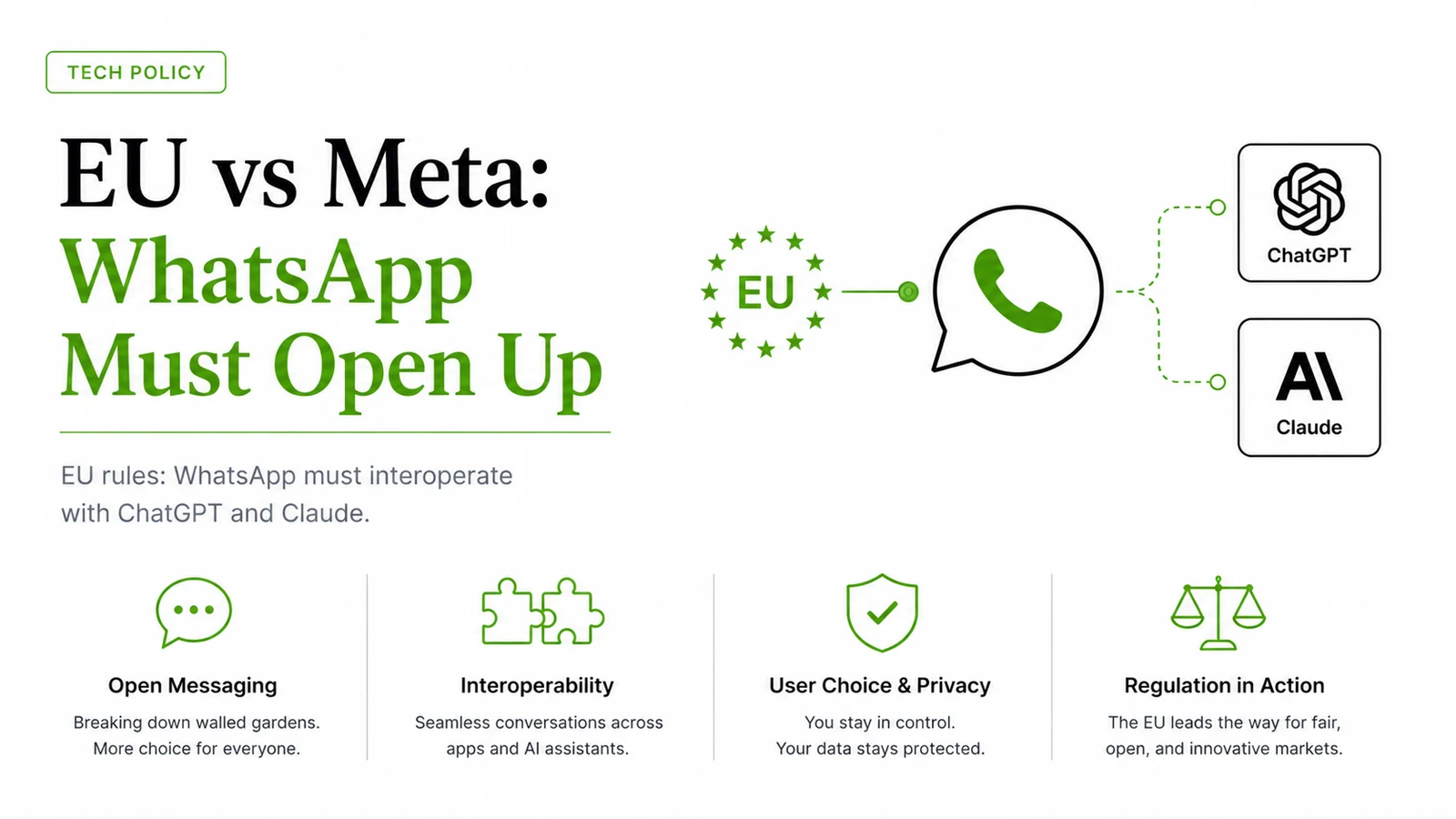
The EU Meta WhatsApp order forces Meta to restore free WhatsApp Business API access for rival AI assistants within five days, or face fines up to 10% of revenue.
Read articleIs the AI Bubble Bursting? Big Tech's $725B Reckoning
Is the AI bubble bursting in 2026? Big Tech is set to spend ~$725B on AI as the Magnificent 7 shed $2.3T — the bull and bear case, no hype, no advice.
Read articleApple Lost a Major EU Antitrust Fight: What It Means
Apple lost a major EU antitrust ruling on July 8, 2026, upholding DMA rules on the iPhone. What's decided, what's still pending, and what changes for you.
Read article