EU Meta WhatsApp: Essential Guide to New AI Access Rules
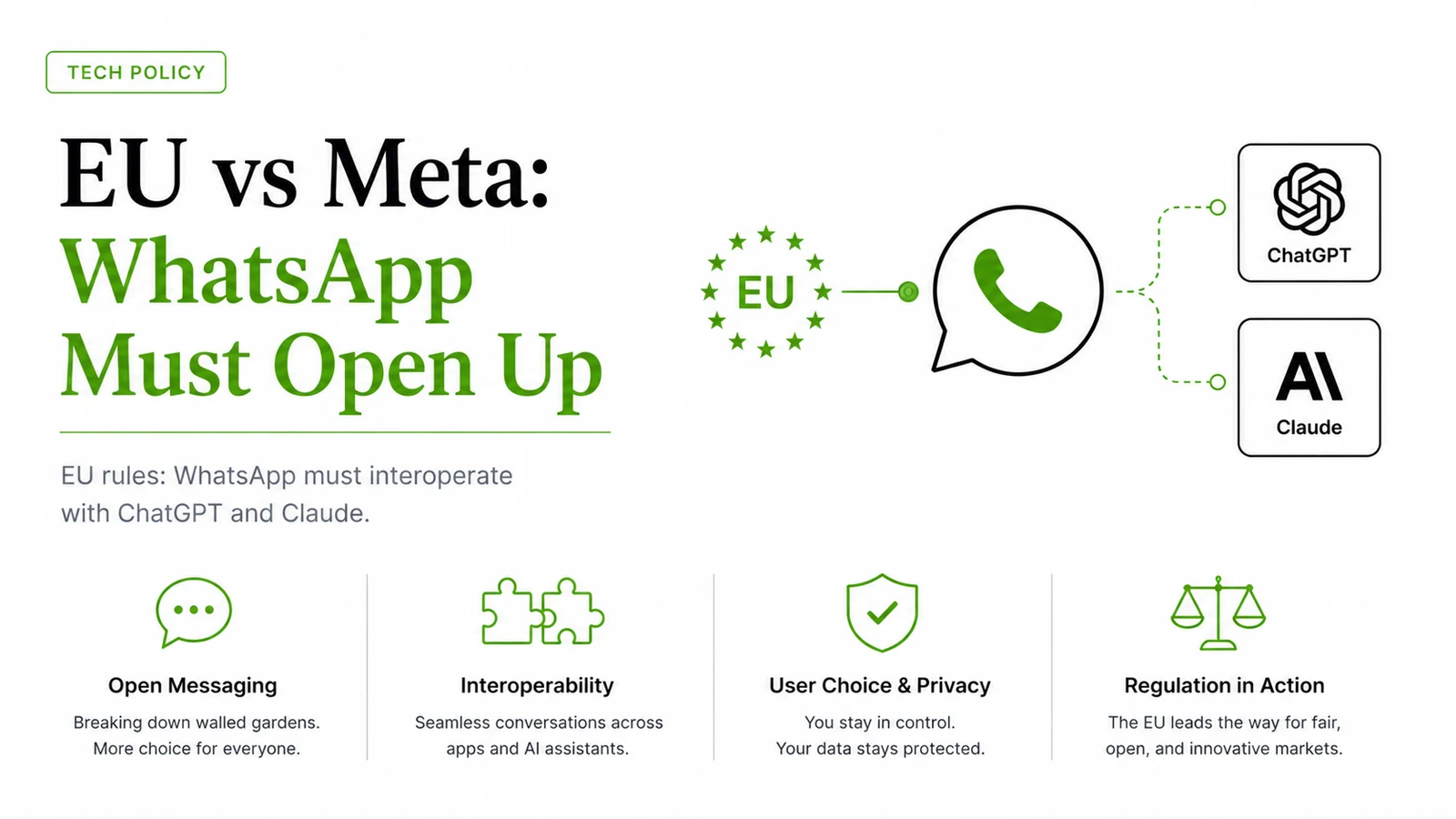

Quick answer: The EU Meta WhatsApp order requires Meta to reopen the WhatsApp Business API to third‑party AI assistants for free within five working days, or risk fines of up to 10 % of its annual revenue.
Answer‑capsule: EU Meta WhatsApp compliance is now mandatory for Meta; the European Commission has given the company five days to restore free access to its Business API for rival AI chatbots, or face a penalty equal to 10 % of global turnover. This decisive step aims to keep the European AI market open and competitive.
What does the EU Meta WhatsApp order require?
On 9 June 2026 the European Commission adopted interim measures under Article 102 TFEU, demanding that Meta restore free access to the WhatsApp Business API for all general‑purpose AI assistants, just as before the October 2025 restriction 【BBC】.
Key obligations:
| Requirement | Detail |
|---|---|
| Deadline | Five working days from the 9 June 2026 decision |
| Pricing | No per‑message fees for third‑party AI providers |
| Penalty | Fines up to 10 % of global turnover for non‑compliance【Reuters】 |
| Scope | Applies to every AI assistant that uses the WhatsApp Business API, not just named services |
The Commission’s investigation began in December 2025 after Meta blocked third‑party AI assistants from the API 【WhatsApp Privacy Policy – EEA】.
Why is the EU intervening now?
Timeline of the dispute
| Date | Milestone |
|---|---|
| 15 Oct 2025 | Meta disables general‑purpose AI assistants in the Business API |
| 4 Dec 2025 | EU opens antitrust investigation (Article 102) |
| 9 Feb 2026 | Statement of Objections issued |
| 4 Mar 2026 | Meta reopens API but adds a per‑message fee |
| Apr 2026 | Commission signals intent to force free access |
| 9 Jun 2026 | Interim measures adopted (the EU Meta WhatsApp order) |
The per‑message fee introduced in March 2026 was deemed “effectively a ban” because it would be prohibitive for startups and smaller AI firms, breaching EU competition rules.
Legal basis
- Article 102 TFEU (and its EEA counterpart) – treats the WhatsApp Business API as an essential digital service that must be offered on non‑discriminatory terms.
- Not a Digital Markets Act (DMA) case – the Commission is using classic competition law to curb an abuse of dominant position.
Authority citations
- BBC coverage of the order 【BBC】
- Reuters report on the fine potential 【Reuters】
- Politico analysis of the broader EU stance 【Politico】
Which AI assistants are covered?
The order does not target a specific brand; it covers all third‑party general‑purpose AI assistants that connect through the WhatsApp Business API. The Commission explicitly mentioned OpenAI’s ChatGPT, and the wording captures competitors such as Microsoft Copilot, Anthropic’s Claude, and Perplexity AI 【Politico】.
What does this mean for developers and businesses?
For EU‑based users
- AI assistants will reappear in WhatsApp chats without extra charges passed on by the providers.
- End‑users regain the ability to ask ChatGPT‑style bots for translations, reminders, or order tracking directly inside WhatsApp.
For developers
- The pre‑Oct 2025 terms are reinstated – the costly per‑message fee is removed.
- Integration work can focus on functionality rather than cost‑optimization.
Practical compliance checklist
- Review the updated API docs – ensure you are using the latest version of the WhatsApp Business API.
- Remove fee‑related code – strip any logic that calculates or passes on per‑message charges.
- Test in the EU sandbox – Meta provides a sandbox environment for EU developers; validate your bot before full rollout.
- Document compliance – keep records of the changes made to demonstrate good‑faith effort, should the Commission request evidence.
Need a quick compliance blog post? Try our AI Blog Writer for a polished draft in minutes.
The broader EU AI regulatory landscape
The EU Meta WhatsApp decision sits alongside several other EU initiatives designed to keep AI markets open:
| Initiative | Goal |
|---|---|
| Digital Markets Act (DMA) | Prevent gatekeeping by large online platforms. |
| AI Act (proposed) | Set safety and transparency standards for high‑risk AI. |
| EU AI Fund | Provide financing for European AI startups to compete globally. |
By forcing Meta to open a critical communication channel, the Commission signals that dominant platforms can no longer use pricing power to block competition. This mirrors recent actions against Apple’s App Store policies and Google’s search advertising practices.
Potential financial impact on Meta
Meta can face fines of up to 10 % of annual revenue for ignoring the order【Reuters】.
Meta is already appealing a €200 million fine levied under the EU’s Digital Markets Act 【Politico】, illustrating the growing financial pressure from Brussels.
How will the market respond?
Start‑up opportunities
Removing the per‑message fee lowers the barrier to entry for AI startups seeking to reach WhatsApp’s two‑billion‑user base. Early‑stage firms can now prototype conversational services without worrying about prohibitive marginal costs.
Established AI players
Large providers like OpenAI and Microsoft will likely accelerate integration roadmaps to capture European market share, potentially offering localized language models to comply with EU data‑privacy rules.
Frequently asked questions
Q: What is the exact deadline for Meta to comply?
A: Meta must restore free API access within five working days of the 9 June 2026 decision, or risk fines up to 10 % of its global turnover.
Q: Does the order affect only EU users?
A: The interim measures apply to the European Economic Area. Meta may choose to implement the same terms globally, but the legal obligation is limited to the EEA.
Q: Can Meta appeal the decision?
A: Yes, Meta can appeal the antitrust ruling, but the interim measures remain binding throughout the appeal process.
Q: How will this decision influence AI startups?
A: By eliminating the per‑message fee, the order makes it financially viable for startups to build WhatsApp‑based chatbots, expanding their reach to billions of potential users.
Q: Where can I read the official EU documentation?
A: Detailed information is available in the European Commission’s press release and the Reuters article covering the interim measures【Reuters】.
Author
Jordan Patel – Senior Tech Analyst at RunFreeTools, specializing in EU tech regulation and AI policy.
Frequently asked questions
Meta has five working days from the 9 June 2026 decision to restore free API access, or it faces fines up to 10 % of its annual revenue.
Yes, the order covers any third‑party general‑purpose AI assistant, not just specific products like ChatGPT.
Meta can appeal the antitrust ruling, but the interim measures remain binding during the appeal process.
By removing the prohibitive per‑message fee, the decision lowers entry barriers, allowing startups to reach WhatsApp’s two‑billion‑user base without costly paywalls.
The European Commission’s press release and the Reuters report provide detailed information on the interim measures and legal basis.
Sources
Share this article
Send it to a teammate or save the link for later.
Related articles
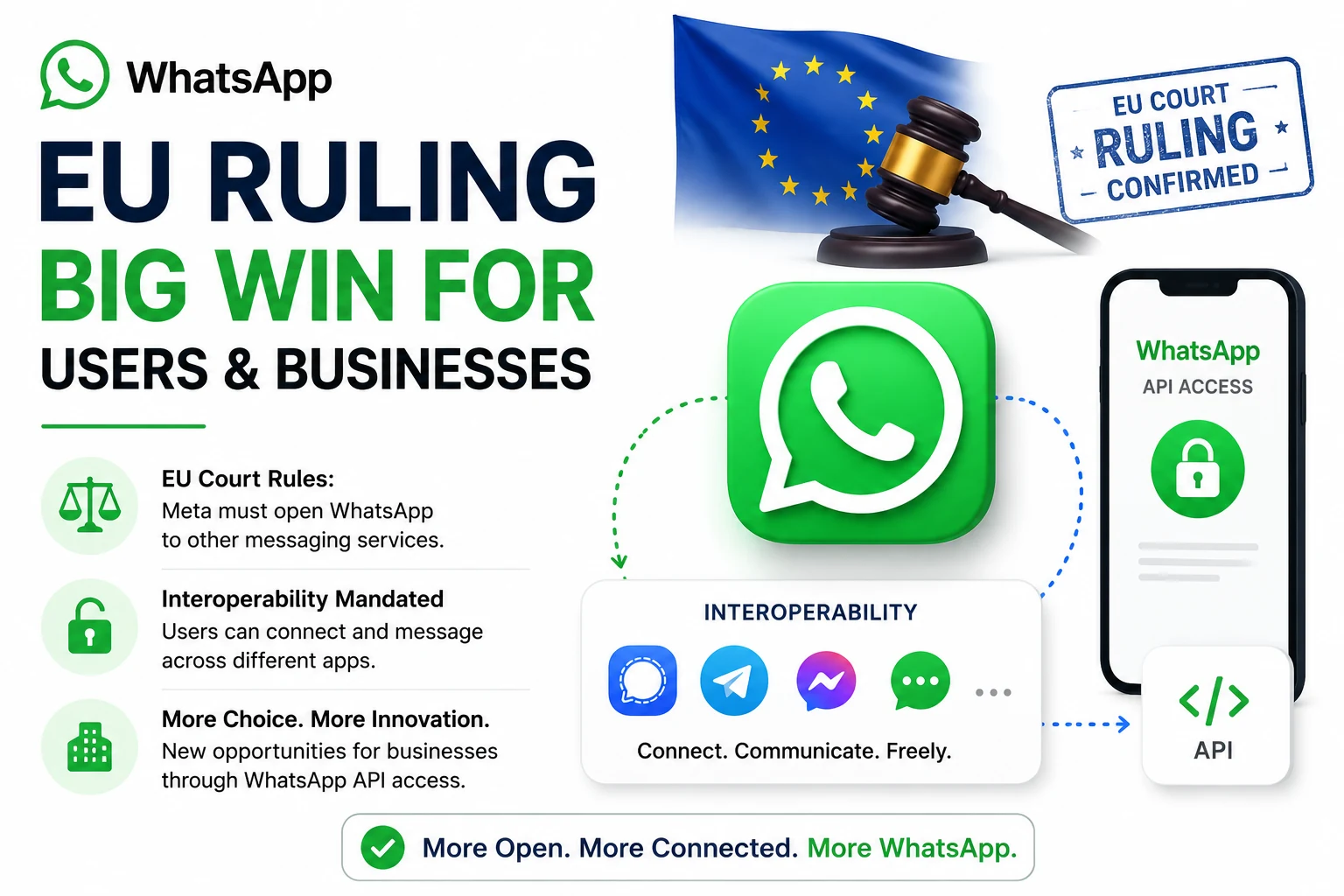
WhatsApp EU ruling: Fast Path to Business API Access
The WhatsApp EU ruling forces Meta to reopen the Business API for rival AI assistants within five days, ensuring access and shaping AI competition in Europe.
Read article
50 AI agents: Ultimate Productivity Boost Guide 2026
Explore 50 AI agents that automate every work stage, cut costs, and sky‑rocket productivity. Learn integration steps with free, secure tools from RunFreeTools.
Read article
AI agent tools: The Best Guide to Boost Productivity
Explore AI agent tools that automate tasks, boost productivity, and transform workflows. Learn key features, selection tips, examples, and start for free today.
Read article