SpaceX IPO Explained: The Historic SPCX Stock Debut
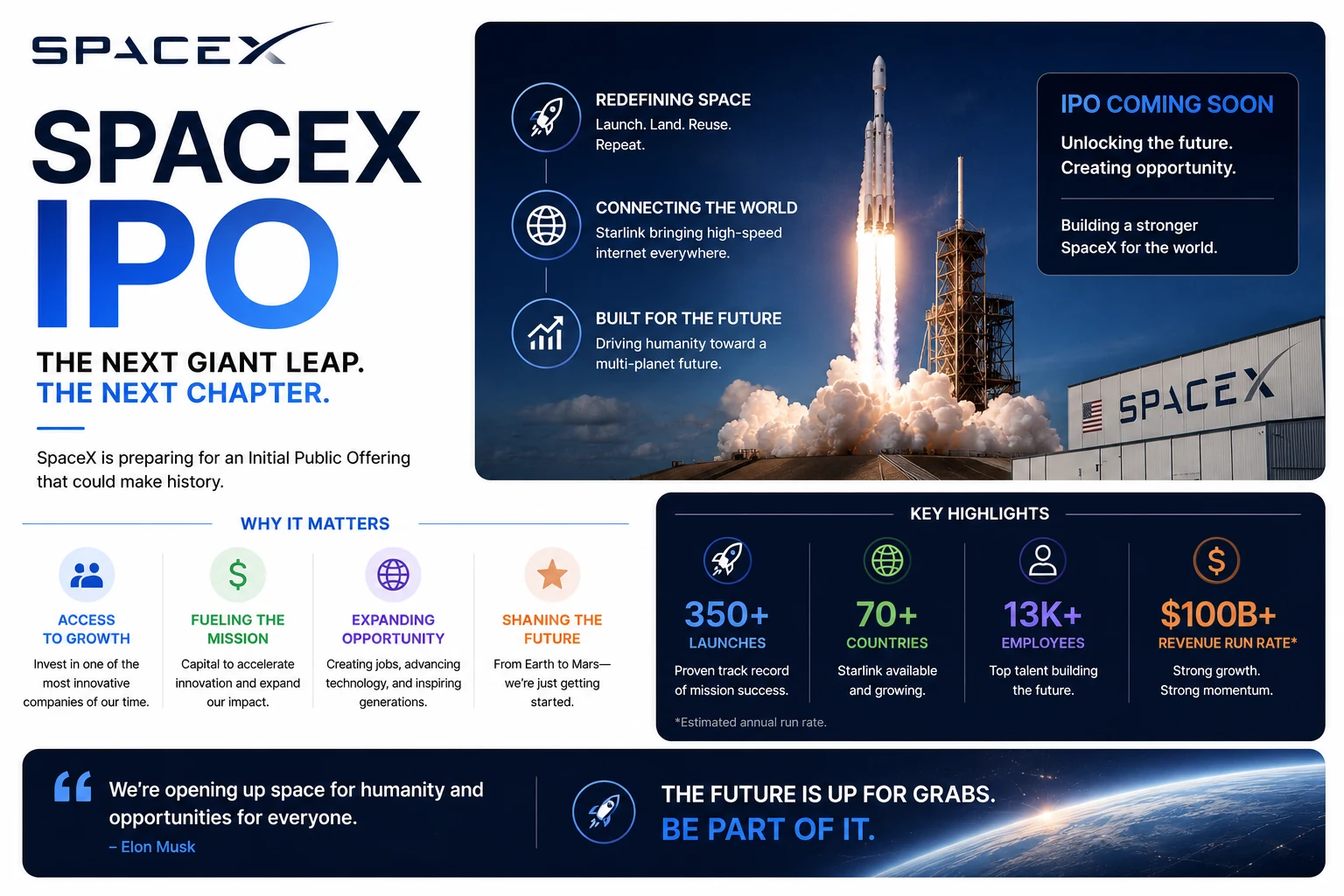
The SpaceX IPO is the biggest stock-market debut ever: SpaceX priced shares at $135.00 in June 2026, raised about $75 billion, and listed on Nasdaq as SPCX. Here is what happened, the bull case, and the risks — not investment advice.
The numbers are genuinely record-breaking, and the hype around them is loud. But a record IPO is not the same thing as a good investment, and the gap between those two ideas is exactly what this article is about. Below, we walk through the facts confirmed by financial outlets, what SpaceX actually earns, and the questions a careful reader should ask before treating a ticker symbol as an opportunity.
What happened in the SpaceX IPO?
SpaceX priced its initial public offering at $135.00 per share on June 11, 2026, selling about 555.6 million shares to raise roughly $75 billion. According to TechCrunch, that haul makes it officially the largest IPO ever, surpassing Saudi Aramco's 2019 record of about $25 billion. The offering was reported as more than four times oversubscribed.
The stock began trading on the Nasdaq the same week under the ticker SPCX. At the $135 offer price, SpaceX carried an implied valuation of roughly $1.77 trillion — already larger than most companies on Earth on its first day.
What is the SpaceX IPO price, and where does SPCX trade now?
The SpaceX IPO price was set at $135.00 per share. On its debut, the stock opened higher and ran well above that level. Reporting on the first session described an open near $150, an intraday high above $176, and a close around $161 — a gain of roughly 19% over the offer price.
As of the trading day after the debut, Investing.com showed SPCX changing hands at about $160.95, pushing the implied market value toward $2.1 trillion. A few quick reference points:
- Offer price: $135.00 per share
- Shares sold: about 555.6 million
- Capital raised: roughly $75 billion
- First-day close: about $161 (up ~19%)
- Recent price: about $160.95
Prices move constantly, so treat any figure here as a snapshot, not a live quote. Check a current source before drawing conclusions.
What does SpaceX actually do?
Before the ticker, there is a real business. SpaceX designs, builds, and launches rockets — most visibly the reusable Falcon 9, the Falcon Heavy, and the in-development Starship — and it flies cargo and crew for NASA and commercial customers. Reusability is the core advantage: landing and re-flying boosters has driven launch costs down and given SpaceX a dominant share of the orbital launch market.
The faster-growing piece is Starlink, the satellite-internet network beaming broadband to homes, ships, aircraft, and remote regions through thousands of low-Earth-orbit satellites. Starlink is widely viewed as the engine meant to turn launch capability into recurring, consumer-style revenue — the part of the story most investors are really buying.
Why does the SpaceX IPO matter?
It matters because of scale and symbolism. A roughly $75 billion raise and a near-$1.8 trillion valuation reset the ceiling for what a private company can be worth when it finally opens to public shareholders. It also gives ordinary investors their first direct, liquid way to own a slice of a company that was private for more than two decades and raised around $40 billion along the way.
There is a crypto wrinkle, too. SpaceX's S-1 filing disclosed that the company holds 18,712 bitcoin. According to CoinDesk, that stake was valued at about $1.29 billion as of March 31, 2026, bought for roughly $661 million, and described in the filing as a strategic reserve for excess cash. As a public company, SpaceX must now mark that bitcoin to market every quarter — so its reported results will wobble with crypto prices, independent of how the rockets are doing.
The bull case for SPCX stock
Supporters point to a handful of genuinely strong arguments:
- Market dominance — SpaceX launches more mass to orbit than any rival, with a reusable-rocket cost advantage that is hard to copy quickly.
- Starlink growth — a global subscriber base for satellite internet offers recurring revenue with a long runway, including underserved and mobile markets.
- Scale of revenue — the company reportedly generated about $19.3 billion in revenue last year, a serious figure for a space business.
- Optionality — future programs like Starship and lunar or Mars ambitions give bulls a long-dated growth narrative.
In short, the bull case is that SpaceX is two strong businesses — launch and broadband — with room to compound for years.
The risks: no profit, sky-high valuation, lockups, and volatility
The risks are just as concrete, and they deserve equal weight.
- No profit yet — despite roughly $19.3 billion in revenue, SpaceX has not posted a net profit, and Investing.com lists negative earnings per share. Paying a near-$1.8 trillion valuation for an unprofitable company means investors are betting heavily on the future, not the present.
- Extreme valuation — at well over 100 times revenue, SPCX is priced for years of flawless execution. Any stumble can compress that multiple fast.
- Lockups — early employees and insiders are typically barred from selling for a period after an IPO. When those lockups expire, a wave of new shares can hit the market and pressure the price.
- Volatility — a 19% first-day move and a swing from $150 to above $176 in one session show how sharply this stock can travel in both directions.
- Bitcoin exposure — the 18,712-BTC reserve means crypto swings now flow into SpaceX's reported numbers whether shareholders wanted that exposure or not.
- Key-person and regulatory risk — heavy reliance on one founder, plus dependence on government contracts and launch approvals, adds concentration risk.
How should a normal reader think about the SpaceX IPO?
Start by separating the spectacle from the decision. "Biggest IPO ever" describes how much money was raised, not whether the shares are cheap or expensive. A famous name and a first-day pop tell you about demand and hype, not about future returns.
A few neutral habits help. Look at what the company earns and whether it makes a profit, not just what it sells. Ask what valuation you are paying for that future. Remember that recently listed stocks are often volatile and that lockup expirations can change supply. And size any position so that a sharp drop would not derail your finances.
This article is not financial or investment advice. It does not recommend buying or selling SPCX or any security. It is an explainer of public facts, and prices and details change quickly — verify anything time-sensitive against current, primary sources and, if you need guidance, speak with a licensed financial professional.
Frequently asked questions
SpaceX priced its IPO at $135.00 per share on June 11, 2026. On its Nasdaq debut the stock opened near $150 and closed around $161, and it traded near $160.95 the next session — but prices change constantly, so check a live quote.
SpaceX trades on the Nasdaq under the ticker symbol SPCX.
SpaceX sold about 555.6 million shares to raise roughly $75 billion, the largest IPO in history. At the $135 price that implied a valuation near $1.77 trillion; after the first-day jump the market value approached $2.1 trillion.
Yes. SpaceX completed its IPO and began trading publicly on the Nasdaq as SPCX in June 2026, after more than two decades as a private company.
No. SpaceX reportedly generated about $19.3 billion in revenue last year but has not posted a net profit, which is a key risk given its very high valuation.
Share this article
Send it to a teammate or save the link for later.
Related articles
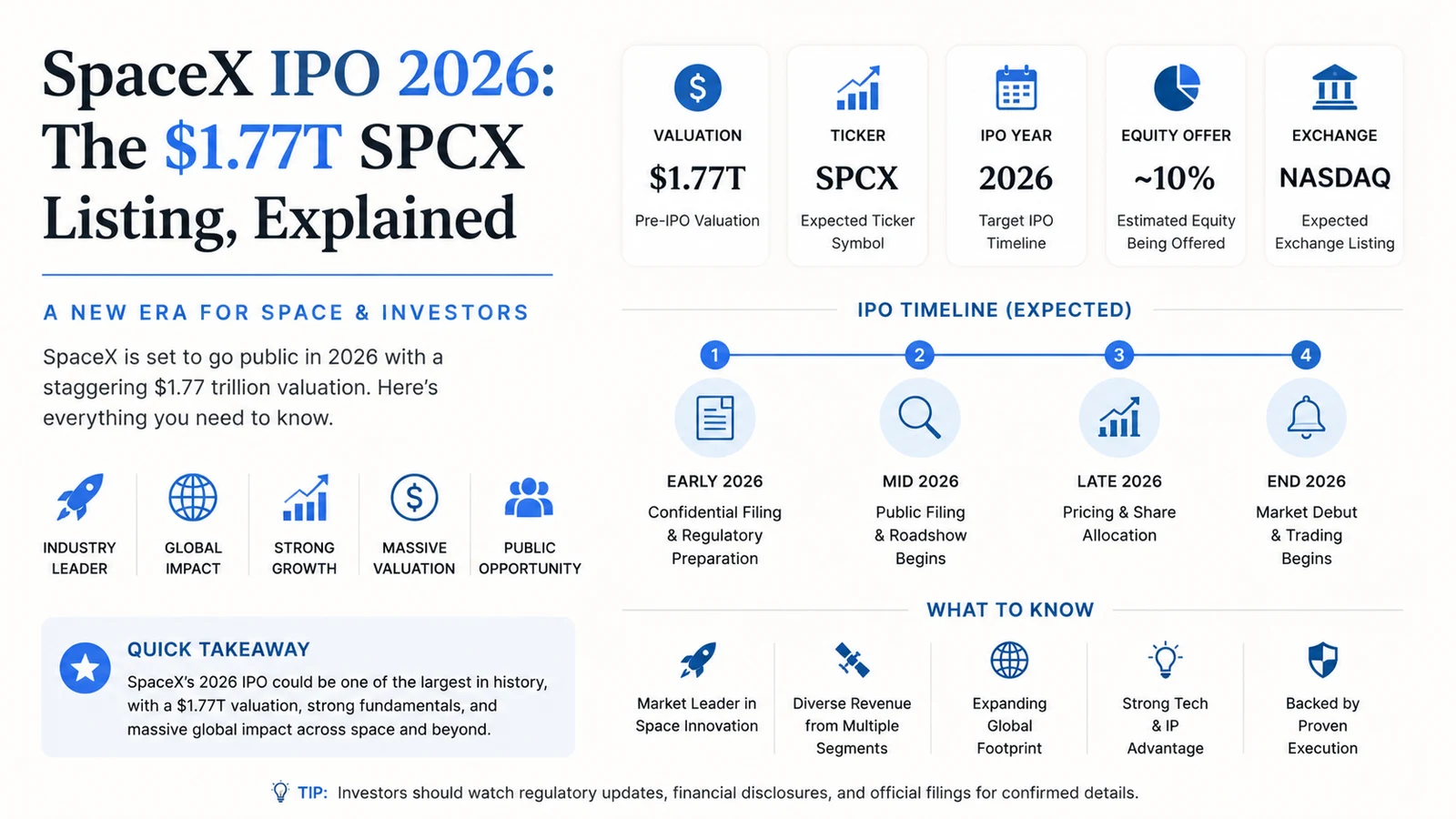
SpaceX IPO Ultimate Guide: $75B Offering Redefines Market
Explore the SpaceX IPO, a $75 billion raise at $135 per share that values the company at $1.77 trillion. Learn about Nasdaq debut, lock‑up periods, pricing
Read articleSpaceX IPO: How the $2 Trillion Debut Broke Records
SpaceX's record-breaking IPO, explained: the ~$75B raise, ~$2T valuation, the SPCX day-one pop, Starlink's profits funding xAI, and Musk's ~85% control.
Read articleIs the AI Bubble Bursting? Big Tech's $725B Reckoning
Is the AI bubble bursting in 2026? Big Tech is set to spend ~$725B on AI as the Magnificent 7 shed $2.3T — the bull and bear case, no hype, no advice.
Read article