SpaceX IPO Ultimate Guide: $75B Offering Redefines Market
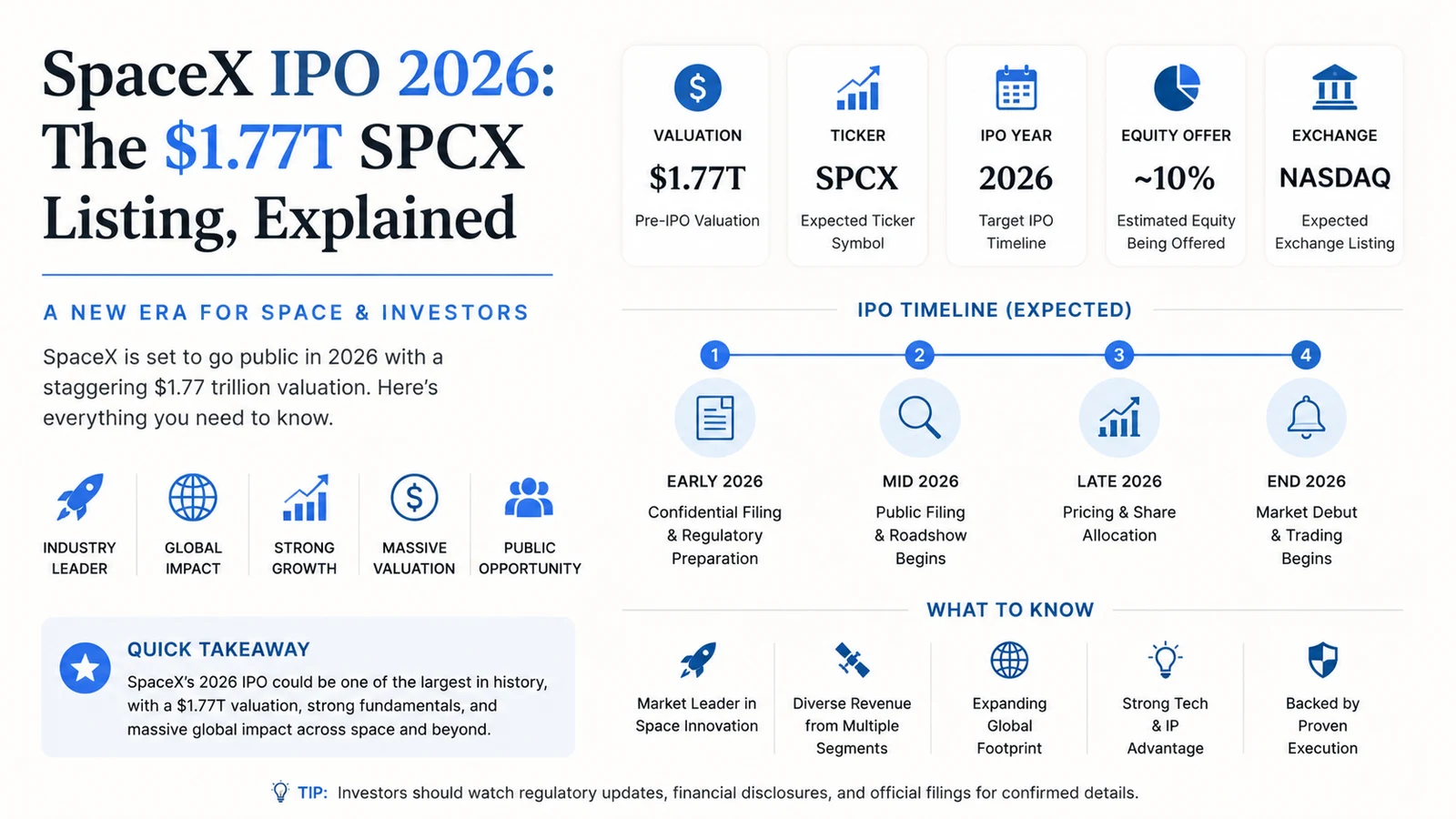
SpaceX IPO marks a historic moment as the aerospace titan raises $75 billion, valuing the company at $1.77 trillion and debuting on Nasdaq at a fixed $135 per share, setting new benchmarks for scale, investor demand, and market impact in 2026.
SpaceX IPO Overview and Key Terms
| Term | Detail |
|---|---|
| Ticker / Exchange | SPCX, Nasdaq |
| Offer price | $135 per share (fixed) |
| Shares offered | ~555.6 million Class A |
| Gross proceeds | ~$75 billion (base) |
| Greenshoe option | Up to |
| Valuation at pricing | ~$1.77 trillion |
| First‑day close | ~$161 (+19%) |
| Lead underwriter | Goldman Sachs |
| Joint book‑runners | Morgan Stanley, BofA, Citigroup, J.P. Morgan |
| Trading debut | 12 June 2026 |
The float represents roughly 4 % of total shares, a deliberately tight supply that amplified the opening‑day surge. If the greenshoe is fully exercised, proceeds could rise to $86 billion, dwarfing any prior public offering.
What Does the SpaceX IPO Mean for Investors?
Investors now have a transparent market price for a company that was previously the domain of private‑equity funds and government contracts. Key implications include:
- Liquidity for employees and early backers. Over 4,400 current and former staff members could become millionaires now that their equity is tradable.
- Capital for growth. The $75 billion war chest will fund Starship production, expand the Starlink satellite constellation, and support deep‑space missions without relying solely on government funding.
- Governance considerations. SpaceX retained a dual‑class structure, keeping voting control with Musk and a small group of insiders, which may limit ordinary shareholder influence.
- Valuation pressure. With a $1.77 trillion price tag, analysts will scrutinize Starlink’s revenue growth, margins, and the profitability of the launch‑services segment.
According to a Fidelity IPO guide, the fixed‑price structure and the size of the raise are expected to generate “significant market impact” and “heightened volatility” in the weeks following the debut.
Quick investor checklist
- Assess Starlink revenue trends. Look for subscriber growth and average revenue per user (ARPU) in quarterly reports.
- Monitor lock‑up expirations. A large share release after 180 days could add supply pressure.
- Track greenshoe exercise. Full utilization signals sustained institutional demand.
- Evaluate Musk’s time allocation. Split focus across SpaceX, Tesla, and xAI may affect execution risk.
How the SpaceX IPO Stacks Up Against Past Record Offerings
The scale of the SpaceX IPO dwarfs previous records. Below are a few benchmarks for context:
| Offering | Year | Proceeds | Valuation at pricing |
|---|---|---|---|
| Saudi Aramco | 2019 | $25.6 B | $1.7 T |
| Alibaba | 2014 | $25 B | $231 B |
| SoftBank Corp. | 2018 | $23.5 B | $73 B |
| Visa | 2008 | $17.9 B | $84 B |
SpaceX’s base proceeds are almost three times the size of the prior global record, and its valuation exceeds that of the world’s most valuable public companies at the time of listing. Reuters reported the IPO price of $135 per share and the targeted $75 billion raise【Reuters source】. The same outlet later confirmed the final pricing and first‑day performance, noting a 19 % pop that briefly lifted the market cap above $2 trillion【Reuters follow‑up】.
What Are the Main Risks of the SpaceX IPO?
Potential investors should weigh several risk factors that could affect long‑term returns:
- Regulatory uncertainty. Spectrum allocations, orbital‑debris mitigation rules, and export‑control restrictions could limit Starlink expansion.
- Capital‑intensive growth. Starship development and satellite manufacturing require sustained cash flow; any cost overruns could erode margins.
- Dual‑class voting. Musk’s majority voting control may lead to strategic decisions that favor vision over shareholder value.
- Macro‑economic headwinds. Rising interest rates and a tightening tech‑stock environment could increase discount rates applied to future cash flows.
A CNBC analysis highlighted that the IPO’s sheer size makes it especially sensitive to shifts in global capital markets.
Regulatory Landscape and Government Partnerships
SpaceX’s operations are tightly intertwined with U.S. government agencies. Understanding this ecosystem is crucial for assessing long‑term risk:
- Federal Aviation Administration (FAA). The FAA issues launch licenses; any delay or revocation could stall Starship schedules.
- National Oceanic and Atmospheric Administration (NOAA). NOAA governs satellite communications; Starlink’s spectrum holdings depend on continued approvals.
- Department of Defense (DoD). SpaceX secures lucrative contracts for launch services and satellite deployment; budget cuts could affect revenue streams.
According to the U.S. Government Accountability Office (GAO), the commercial space sector contributed $8.5 billion to the U.S. economy in 2023, underscoring the strategic importance of firms like SpaceX. This official data reinforces the argument that regulatory shifts can have material financial impact.
Future Outlook for SPCX
The first‑day pop is a headline, not a guarantee of long‑term performance. Key milestones to watch include:
- Q1 earnings release – Will Starlink meet its projected $30 billion revenue target?
- Starship production ramp‑up – Can the company sustain a launch cadence of 30+ missions per year without cost overruns?
- Regulatory developments – Spectrum allocations and orbital‑debris mitigation rules could affect the scalability of the satellite network.
- Potential secondary offerings – Any future capital raises could further dilute the already thin float, though they would also signal confidence from institutional investors.
Analysts also monitor broader macro factors such as interest‑rate trends and the overall tech‑stock environment, both of which can amplify or dampen SPCX’s volatility.
How to Analyze the SpaceX IPO with Financial Ratios
Applying classic valuation metrics helps cut through hype:
- Price‑to‑Sales (P/S) Ratio: With $30 billion projected Starlink revenue, the IPO implies a P/S of ~59×, far above the 5‑10× range typical for high‑growth tech firms.
- Enterprise‑Value‑to‑EBITDA (EV/EBITDA): Assuming a 15 % EBITDA margin, EV/EBITDA would sit near 120×, indicating a premium that must be justified by sustained launch‑service cash flow.
- Debt‑to‑Equity: SpaceX’s balance sheet shows modest debt relative to equity, but the massive capital outlay for Starship could shift this ratio upward in the next 12‑18 months.
Investors can use the AI Paraphrasing Tool to re‑write analyst notes in plain language, and the AI Grammar Checker to ensure professional presentation of their research.
Tools to Help You Analyze the SpaceX IPO
If you’re building an investment thesis or drafting a research note, the AI Blog Writer can generate concise summaries, while the AI Text Summarizer condenses lengthy SEC filings into digestible bullet points.
Where to Find Reliable SpaceX IPO Data
- SEC filings: The S‑1 registration statement provides the most detailed breakdown of share classes, use‑of‑proceeds, and risk factors.
- Financial news outlets: Reuters, CNBC, and TechCrunch have day‑one coverage with real‑time price charts.
- Market data platforms: Yahoo Finance’s private‑company tracker lists the ticker SPCX and updates market‑cap figures as the stock trades.
By combining these sources with disciplined fundamental analysis, investors can move beyond the hype and evaluate whether the SpaceX IPO offers a compelling risk‑adjusted opportunity.
Frequently asked questions
The SpaceX IPO was priced at a fixed $135 per share and trades on the Nasdaq under the ticker **SPCX**, with trading beginning on 12 June 2026.
SpaceX sold roughly 555.6 million shares at $135 each, raising about **$75 billion**. The underwriters’ greenshoe option could add up to **$11.25 billion**, pushing total proceeds toward $86 billion.
At the $135 offer price, SpaceX was valued at approximately **$1.77 trillion**, and the first‑day surge briefly lifted its market cap above **$2 trillion**.
With $75 billion raised, the SpaceX IPO is nearly three times larger than Saudi Aramco’s $25.6 billion 2019 listing and Alibaba’s $25 billion 2014 IPO, making it the largest IPO in history.
No. The offering was a primary issuance of new shares, and Elon Musk did not sell any holdings, keeping his economic and voting stake unchanged.
Sources
Share this article
Send it to a teammate or save the link for later.
Related articles
SpaceX IPO Explained: The Historic SPCX Stock Debut
SpaceX IPO explained: SPCX priced at $135 for the biggest IPO in history. Get the SpaceX IPO price, SPCX stock moves, valuation, bull case, and the real risks.
Read articleSpaceX IPO: How the $2 Trillion Debut Broke Records
SpaceX's record-breaking IPO, explained: the ~$75B raise, ~$2T valuation, the SPCX day-one pop, Starlink's profits funding xAI, and Musk's ~85% control.
Read articleIs the AI Bubble Bursting? Big Tech's $725B Reckoning
Is the AI bubble bursting in 2026? Big Tech is set to spend ~$725B on AI as the Magnificent 7 shed $2.3T — the bull and bear case, no hype, no advice.
Read article