Sarvam AI: India's $1.5B AI Unicorn Explained (2026 Guide)
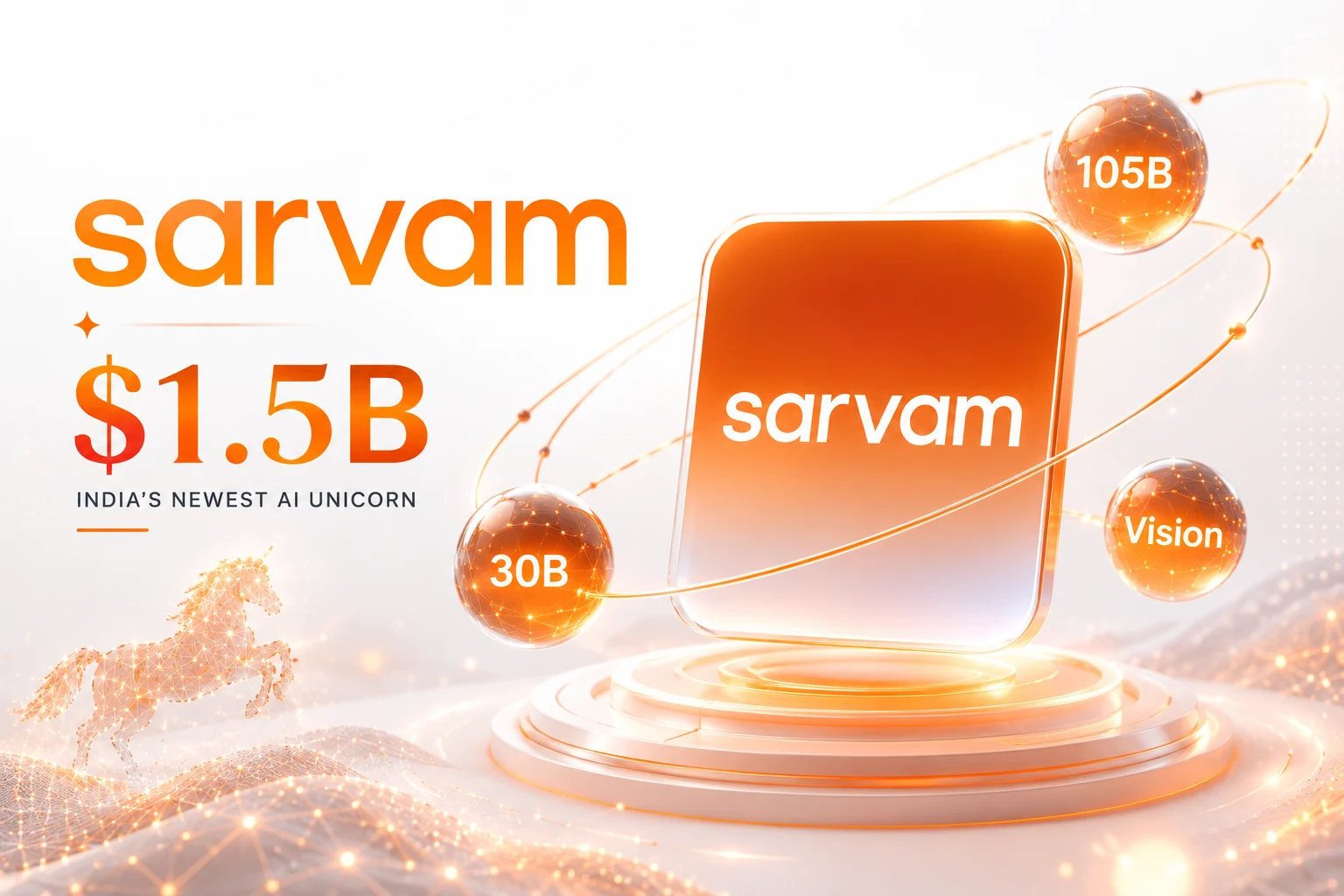
On 15 June 2026, a Bengaluru startup quietly rewrote the script of India's AI story. Sarvam AI closed $234 million in the first tranche of a $300 million Series B round, landing a $1.5 billion valuation — and with it, the title of India's newest AI unicorn. The round was led by IT giant HCLTech, which alone put in $150 million.
If you've been hearing "Sarvam" everywhere this week and want the full picture — what it is, who's behind it, the models, the API, the pricing, and whether the hype is justified — this is the only guide you'll need. Let's get into it.
Quick answer: Sarvam AI is India's full-stack sovereign AI company, building large language models, speech and vision systems trained from scratch for Indian languages. Founded in August 2023 by Dr. Vivek Raghavan and Dr. Pratyush Kumar, it crossed unicorn status (valuation of $1.5 billion) in June 2026 after a $234 million Series B led by HCLTech.
What is Sarvam AI?
Sarvam AI (the word sarvam means "everything" in Sanskrit) is an Indian artificial intelligence company headquartered in Bengaluru, Karnataka. It builds large language models (LLMs), speech recognition, text-to-speech, translation, and vision models — all optimised for India's languages, culture, and context rather than English-first Western use cases.
What makes it different from just "another AI startup" is its positioning as a full-stack sovereign AI platform. That means Sarvam doesn't just ship a chatbot — it operates across the entire AI stack: training and inference infrastructure, frontier model research, and a go-to-market motion that spans enterprises, developers, and the Indian government. Crucially, the whole thing is developed and run inside India, so data stays in India and can even be air-gapped for regulated sectors like banking and defence.
In plain terms: if OpenAI and Anthropic build AI for the world, Sarvam is building AI that actually understands a farmer speaking Marathi-Hindi code-mix on a feature phone with no internet.
The big news: Sarvam AI's $234M Series B and unicorn status
Here's what actually happened on 15 June 2026, and why it matters.
- Amount: $234 million raised in the first close of a $300 million Series B.
- Valuation: $1.5 billion post-money — officially making Sarvam India's newest AI unicorn.
- Lead investor: HCLTech, the IT subsidiary of the HCL Group, investing $150 million as the lead strategic partner.
- Also participating: Bessemer Venture Partners, plus existing backers Khosla Ventures and Peak XV Partners.
- Where the money goes: training Sarvam's next frontier model — aimed specifically at agentic, coding, and cybersecurity use cases — plus securing compute at scale.
The HCLTech tie-up is the part analysts are watching most closely. It's not just a cheque; it's distribution. HCLTech brings trusted global enterprise relationships, engineering depth, and software IP — exactly the channel Sarvam needs to sell sovereign AI to large companies and governments.
"We are clear that research-led innovation to create AI that works at India's scale is a very large opportunity. That means models that understand our voices, read our documents, and serve intelligence at a cost every enterprise and government can afford." — Pratyush Kumar, Co-Founder & CEO, Sarvam AI
For context, this is a massive leap from Sarvam's December 2023 seed-plus-Series-A round of roughly $41 million, led by Lightspeed Venture Partners. In about two and a half years, the company has gone from an 18-person team to a billion-dollar national AI champion.
(Sources: Sarvam's official Series B announcement, TechCrunch.)
Who founded Sarvam AI? Meet Vivek Raghavan and Pratyush Kumar
Sarvam's credibility starts with its founders — and neither is a first-time founder chasing a trend.
Dr. Pratyush Kumar (Co-Founder & CEO) is an IIT Bombay graduate (B.Tech, Electrical & Electronics) with a PhD in Computer Engineering. He worked as a research scientist at IBM Research, spent time at Microsoft Research, and served as faculty at IIT Madras. Before Sarvam, he co-founded One Fourth Labs and was a key force behind AI4Bharat, the open-source Indian-language AI initiative.
Dr. Vivek Raghavan (Co-Founder) brings deep-tech and nation-scale infrastructure experience. An IIT Delhi alum with a PhD from Carnegie Mellon University, he spent nearly two decades in chip design (Electronic Design Automation) at firms like Synopsys and Magma. More importantly for Sarvam's mission, he volunteered for almost 12 years with UIDAI on Aadhaar's biometric systems — literally helping build India's population-scale digital public infrastructure — and advised the government's Bhashini language-translation mission.
Both men came out of the AI4Bharat lab at IIT Madras, backed by Nandan Nilekani. That combination — Pratyush's AI research depth plus Vivek's "build for a billion people" infrastructure instinct — is exactly why investors keep calling them one of the highest-calibre AI teams in India.
👉 Want to see how Indian AI stacks up against the latest global frontier models? Read our breakdown of Claude Fable 5 and Mythos 5.
Sarvam AI models explained: 105B, 30B, Vision, and more
This is where Sarvam earns its "everything" name. Its lineup spans text, speech, translation, and vision. Here's the full family.
Sarvam 105B — the flagship reasoning model
Launched in February 2026 at the India AI Impact Summit (Bharat Mandapam, New Delhi), Sarvam 105B is a Mixture-of-Experts (MoE) model with 10.3 billion active parameters and a 128,000-token context window. It's tuned for complex reasoning, mathematics, coding, and agentic tasks, and ships under the permissive Apache 2.0 licence. Sarvam positions it against OpenAI's GPT-OSS-120B and Alibaba's Qwen-3-Next-80B.
Sarvam 30B — built for the edge
Sarvam 30B is the practical workhorse: a smaller MoE model (~2.4B non-embedding active parameters, 32K context) pre-trained on roughly 16 trillion tokens and optimised to run on consumer hardware. It handles real-time multilingual voice calls and tool calling, and is pitched against Google's Gemma 27B and GPT-OSS-20B. This is the model powering Sarvam's "AI on a ₹2,000 feature phone, offline" demos.
Sarvam Vision — document digitisation & handwriting
A 3-billion-parameter state-space vision-language model built for OCR, handwriting recognition, and Indian-language documents. It's already being used to digitise 35 million-plus pages — everything from insurance forms to legacy land records.
Saaras — speech-to-text (STT)
Sarvam's speech recognition model (latest: Saaras v3) handles 22 Indian languages with low-latency streaming and code-mixed support. It offers multiple output modes: transcribe, translate, verbatim, transliterate, and code-mix.
Bulbul — text-to-speech (TTS)
A natural, expressive, production-ready text-to-speech model covering 11 Indian languages.
Mayura & Sarvam-Translate — translation
Mayura handles colloquial language, code-mixing, and regional expressions. Sarvam-Translate is an open-weights translation model supporting 22 Indian languages for structured, long-form text.
Sarvam-M and Sarvam-1 — the open-weight workhorses
Sarvam-M is a 24-billion-parameter hybrid reasoning LLM (trained across ~10 Indian languages) refined with supervised fine-tuning and reinforcement learning. Sarvam-1, released in October 2024, was India's first homegrown Indic model — a 2B-parameter model pre-trained on 4 trillion tokens across 10 Indic languages, with 2–4× better token efficiency than comparable multilingual models.
OpenHathi — where it all started
OpenHathi was Sarvam's first open-source project: instead of training from scratch, it "bolted" Indian-language skills onto Meta's Llama. It remains freely available on Hugging Face and seeded the entire approach.
Sarvam AI models at a glance
| Model | Type | Key spec | Best for |
|---|---|---|---|
| Sarvam 105B | MoE LLM | 10.3B active params, 128K context, Apache 2.0 | Complex reasoning, coding, agents |
| Sarvam 30B | MoE LLM | ~2.4B active params, 32K context, ~16T tokens | Edge devices, real-time voice |
| Sarvam Vision | Vision-language | 3B params, state-space | OCR, handwriting, documents |
| Saaras (v3) | Speech-to-text | 22 languages, streaming | Transcription, voice apps |
| Bulbul | Text-to-speech | 11 languages, expressive | Voice agents, IVR |
| Mayura | Translation | Colloquial + code-mix | Chat, regional content |
| Sarvam-Translate | Translation | 22 languages, open-weights | Long-form translation |
| Sarvam-M | Hybrid reasoning LLM | 24B params, SFT + RL | General-purpose Indic AI |
| Sarvam-1 | Base LLM | 2B params, 4T tokens | Fine-tuning, edge |
A useful tip: all of Sarvam's open models live on Hugging Face and the government's AIKosh repository.
Sarvam AI products: Samvaad, Studio, Akshar and Arya
Beyond raw models, Sarvam packages its tech into ready-to-use platforms for businesses:
- Samvaad — Conversational AI for building voice and chat agents fluent in Indian languages.
- Studio — Content transformation tools (think translation, dubbing, repurposing at scale).
- Akshar — Document digitisation, powered by Sarvam Vision.
- Arya — "AI for Work," an enterprise assistant for internal workflows.
- Indus — Sarvam's consumer-facing AI agent (
indus.sarvam.ai).
How to use Sarvam AI: API access and pricing
Good news for developers — Sarvam is genuinely easy to start with, and the pricing is in rupees with no foreign-currency or GST reverse-charge headaches.
Getting started:
- Sign up on the Sarvam dashboard and generate an API key.
- Install the Python SDK in one line:
pip install sarvamai - Or hit the clean REST API endpoints directly, or test everything in the browser Playground — no setup needed.
Pricing model: Sarvam uses transparent pay-per-use pricing, and every account starts with free credits (₹1,000 worth at the time of writing, per Sarvam's pricing page) that never expire and work across all APIs. After that you pay only for what you use — STT per audio minute, TTS per character, translation per character, and LLM usage per token.
For Indian teams doing cost comparisons, Sarvam's INR pricing often works out meaningfully cheaper than stitching together OpenAI Whisper + GPT-4o for Indian-language tasks — with better accuracy on regional languages. There's even an /llms.txt index so AI coding agents can read the docs directly.
Building something multilingual? You can prototype Sarvam's translation or text-to-speech for free, then drop in a quick utility from our free AI tools collection to handle the surrounding workflow.
(Full details on the official Sarvam API pricing page and developer docs.)
Why "sovereign AI" matters — and the IndiaAI Mission connection
You'll see the phrase sovereign AI attached to Sarvam constantly. It's not just marketing.
The idea is simple: a nation should be able to own, run, and control its critical AI — the models, the data, and the compute — without depending on foreign companies. For India, with 22 official languages and 1.4 billion people, that's both a strategic and a practical necessity.
This is why the government got involved. Under the IndiaAI Mission — approved in 2024 with an outlay of over ₹10,300 crore over five years — the Ministry of Electronics and IT (MeitY) selected Sarvam in April 2025 as one of the companies to build an indigenous foundational model, complete with access to subsidised GPU compute.
Sarvam's most striking sovereign-AI demo? At the February 2026 summit, it showed its assistant running on a basic "feature" phone via a simple phone call, letting users talk in Indian languages with no internet connection. The company is reportedly working with HMD (Nokia's brand licensee) and Qualcomm to push compact models onto feature phones, cars, and even smart glasses.
Sarvam AI by the numbers: real-world traction
Funding announcements are easy to inflate, so here's what Sarvam says it's actually doing in production today:
- 2 million+ conversations handled per day (usage doubled in two months)
- 10 million+ API calls processed daily on its inference platform (tripled in three months)
- 35 million+ document pages digitised
- 500,000+ hours of audio transcribed every month
- 17 million farmers reached via multilingual voice agents for the Ministry of Agriculture
- 45 million policyholders supported in a nationwide insurance-renewal voice campaign
- A leading fintech runs sales enablement for its 350,000-strong sales force on Sarvam
The focus is deliberately on high-stakes verticals: banking, insurance, gov-tech, and defence.
Sarvam AI vs the competition
Sarvam isn't alone in the race for India's AI stack. Its closest domestic rival is Krutrim (backed by Ola's Bhavish Aggarwal), which is also building Indic LLMs and AI infrastructure. On the global side, Sarvam is openly trying to loosen the grip of OpenAI's ChatGPT, Google's Gemini, and others on the Indian market.
Sarvam's bet is twofold: (1) smaller, efficient, open-weight models that undercut expensive proprietary APIs on cost, and (2) deep India-specific advantages — language coverage, offline/edge deployment, and data sovereignty that Western clouds simply can't match for regulated Indian institutions.
The honest take: what to watch out for
A guide that only cheerleads isn't useful, so here's the balanced view.
Several of Sarvam's headline benchmark claims are, as of mid-2026, largely self-reported and not yet independently verified. The new 105B and 30B models don't yet have an LMArena ranking, and Sarvam hasn't published formal arXiv papers (with methodology and ablations) for them. The main Sarvam model to appear on community leaderboards so far has been the older OpenHathi.
None of this means the models are bad — early-stage labs ship fast and publish later. But if you're making a procurement decision, test on your own data rather than trusting launch-day benchmark slides. The good news: with free credits and an open playground, that's easy to do.
What's next for Sarvam AI?
With $234 million in the bank and HCLTech's enterprise muscle behind it, Sarvam's roadmap is clear: a next-generation frontier model built for agentic, coding, and cybersecurity workloads, far wider compute access, and aggressive expansion into banking, insurance, gov-tech, and defence. The company is also targeting the full $300 million Series B as it keeps the round open.
The bigger story is what Sarvam represents: proof that India can build foundational AI at home, in its own languages, on its own terms. As co-founder Vivek Raghavan put it, the goal is to diffuse AI widely across India — for citizens, small businesses, enterprises, and government alike. Or, in the company's own words: "Building from India, for the world."
The bottom line
Sarvam AI's rise from a 2023 startup to a $1.5 billion unicorn in 2026 is the clearest signal yet that India is serious about building its own AI — not renting it. With HCLTech as a partner, a fast-shipping model lineup, and real production scale across farming, banking, and insurance, Sarvam has gone from "promising" to "national champion" in record time. The benchmarks still need independent verification, but the trajectory is hard to argue with.
If you build products in India, now is the time to spin up a free Sarvam account and test it on your own data — the gap between "interesting" and "indispensable" may be smaller than you think.
Found this useful? Explore more free AI-powered tools and guides on RunFreeTools, or read our deep dive on Claude Fable 5 and Mythos 5.
Frequently asked questions
Sarvam AI is an Indian artificial intelligence company based in Bengaluru that builds full-stack sovereign AI — large language models, speech, translation, and vision systems optimised for Indian languages and trained inside India. It became India's newest AI unicorn in June 2026.
Sarvam AI was founded in August 2023 by Dr. Vivek Raghavan and Dr. Pratyush Kumar, both formerly of the AI4Bharat lab at IIT Madras. Pratyush Kumar is the CEO.
Sarvam AI is valued at $1.5 billion following the first close of its $300 million Series B in June 2026, in which it raised $234 million.
The round was led by HCLTech with a $150 million investment, alongside Bessemer Venture Partners and existing investors Khosla Ventures and Peak XV Partners.
The flagship models are Sarvam 105B (a large reasoning/agentic model) and Sarvam 30B (optimised for edge devices). Other models include Sarvam Vision (OCR/documents), Saaras (speech-to-text), Bulbul (text-to-speech), Mayura and Sarvam-Translate (translation), plus the open-weight Sarvam-M and Sarvam-1.
Sarvam AI offers free credits on signup (₹1,000 worth at the time of writing) that work across all its APIs and never expire. After that, it uses transparent pay-per-use pricing in Indian rupees.
Create an API key on the Sarvam dashboard, install the Python SDK with `pip install sarvamai`, or call the REST API directly. You can also test everything for free in the browser-based Playground.
Sarvam's models support up to 22 Indian languages (including Hindi, Bengali, Tamil, Telugu, Marathi, Kannada, Gujarati, Malayalam, Punjabi, Odia and more), plus English and code-mixed text.
Several Sarvam models are open or open-weight (Sarvam 105B and Sarvam-1 are under permissive licences, and OpenHathi/Sarvam-M are freely available on Hugging Face). Its enterprise platforms and frontier research are commercial.
They serve different needs. ChatGPT is a more mature general-purpose assistant. Sarvam wins on Indian-language accuracy, cost in rupees, offline/edge deployment, and data sovereignty for Indian enterprises and government. For Indian-language and on-device use cases, Sarvam is often the stronger choice.
Sources
Share this article
Send it to a teammate or save the link for later.
Related articles
Is the AI Bubble Bursting? Big Tech's $725B Reckoning
Is the AI bubble bursting in 2026? Big Tech is set to spend ~$725B on AI as the Magnificent 7 shed $2.3T — the bull and bear case, no hype, no advice.
Read articleApple Lost a Major EU Antitrust Fight: What It Means
Apple lost a major EU antitrust ruling on July 8, 2026, upholding DMA rules on the iPhone. What's decided, what's still pending, and what changes for you.
Read articleBest AI Browser 2026: Comet vs Dia vs Chrome (Atlas Dies)
The best AI browser in 2026? Comet is free and cross-platform, Chrome adds Gemini, and ChatGPT Atlas shuts down Aug 9 — plus the safety risks.
Read article