OpenAI IPO 2026: Massive Valuation & Investor Playbook
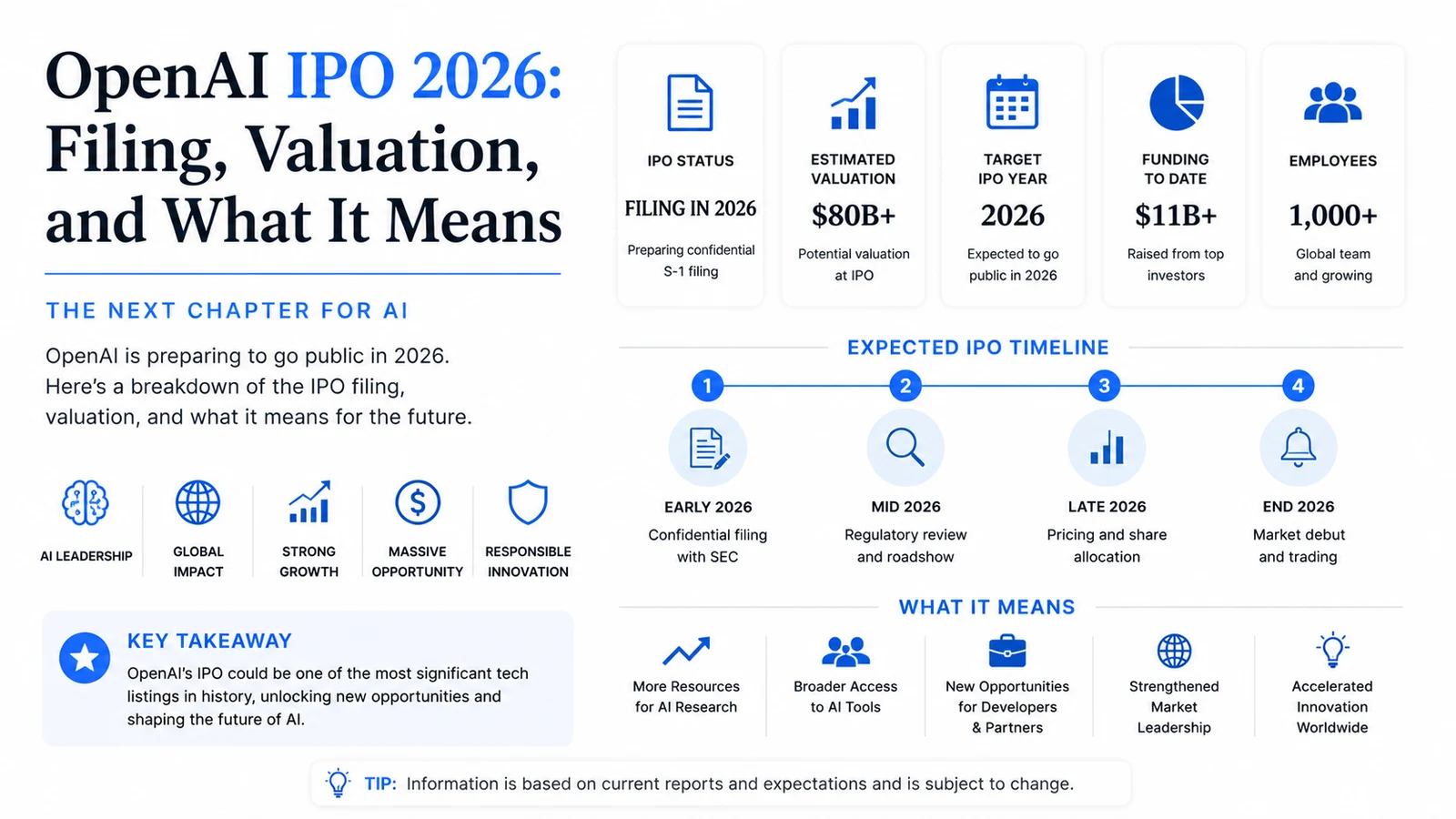

Quick answer: OpenAI IPO 2026 is slated for a fall 2026 debut, with analysts projecting a market‑cap close to $1 trillion after a $852 billion private valuation and a $2 billion monthly revenue run‑rate. Investors should monitor the SEC filing timeline, underwriting syndicate, and the company’s path to profitability.
What is the OpenAI IPO 2026 filing timeline?
OpenAI filed a confidential draft S‑1 on June 8, 2026. A confidential filing lets the company discuss the offering with the SEC while keeping sensitive details private until the public version appears at least 15 days before the roadshow. Most market watchers expect a public filing in late August, followed by a listing window between Labor Day and Thanksgiving 2026techmarketbriefs.com.
Key milestones
| Milestone | Approx. date | What to watch |
|---|---|---|
| Confidential S‑1 submission | 8 Jun 2026 | SEC comments, initial underwriting talks |
| Public S‑1 filing | Late Aug 2026 | Detailed financials, risk factors |
| Roadshow | Early Sep 2026 | Investor sentiment, pricing guidance |
| Pricing & allocation | Mid Sep 2026 | Final market‑cap range |
| NYSE/NASDAQ listing | Late Sep 2026 | Trading debut and ticker symbol (likely “OPENAI”) |
Who is underwriting the OpenAI IPO 2026?
| Lead banks | Role |
|---|---|
| Goldman Sachs | Global co‑lead underwriter |
| Morgan Stanley | Global co‑lead underwriter |
| JPMorgan Chase | Additional book‑runner |
These institutions have led previous mega‑cap AI listings, giving the deal a solid credibility boost.
How big could the OpenAI IPO 2026 be?
Valuation expectations
- Private valuation: $852 billion after a $122 billion round closed March 31, 2026
openai.com.
- Potential IPO market cap: Analysts cite a range up to $1 trillion
tradingview.com.
- Revenue run‑rate: Roughly $2 billion per month (~$25 billion annualized).
- Projected 2026 loss: About $14 billion, reflecting heavy investment in compute, talent, and safety research.
Why the valuation matters
If the public debut validates a near‑trillion‑dollar cap, OpenAI would become the largest tech IPO in U.S. history, resetting expectations for AI‑centric companies and potentially triggering a wave of similar listings.
What are the key risks of the OpenAI IPO 2026?
- Profitability timeline – Turning a $14 billion loss into sustainable margins is unproven.
- Capital‑intensive growth – Ongoing spend on GPUs, data centers, and talent could keep cash burn high for years.
- Regulatory scrutiny – AI safety, data privacy, and antitrust concerns may lead to additional compliance costs.
- Governance model – OpenAI operates as a public‑benefit corporation (PBC) overseen by the nonprofit OpenAI Foundation, a structure that could limit traditional shareholder rights.
- Market sentiment – A broader correction in tech stocks or a slowdown in AI spending would pressure the IPO price.
These risk factors are highlighted in the draft S‑1 and in analyst commentary from CMC Markets and Forge Globalcmcmarkets.com.
How does the OpenAI IPO 2026 compare with its peers?
| Company | Confidential filing | Private valuation | 2025 Revenue (approx.) |
|---|---|---|---|
| OpenAI | 8 Jun 2026 | $852 B | $25 B annual run‑rate |
| Anthropic | 1 Jun 2026 | $965 B | $9 B ARR |
| xAI (Elon Musk) | — | — | — |
Anthropic’s higher valuation despite lower revenue underscores the “future‑growth premium” investors are applying to frontier AI firms.
Investor toolbox: practical resources
- Draft briefing notes quickly with our AI Blog Writer.
- Summarize SEC releases and analyst reports using the AI Text Summarizer.
Market context: the 2026 mega‑IPO wave
The New York Times notes that 2026 could be the year of the mega‑IPO, with several AI and space‑tech firms eyeing public marketsnytimes.com. This environment may create a “halo effect,” where strong demand for high‑growth tech stocks lifts OpenAI’s pricing outlook.
Post‑IPO outlook: what could happen after the listing?
- Liquidity for early employees and investors – A public market provides a clear price discovery mechanism.
- Increased scrutiny – Quarterly earnings, SEC reporting, and shareholder activism become routine.
- Potential secondary offerings – To fund further compute expansion, OpenAI may issue additional shares or convertible debt.
- Strategic M&A – With a public currency, OpenAI could acquire niche AI startups to broaden its product suite.
Bottom line on OpenAI IPO 2026
The confidential S‑1 confirms that OpenAI is serious about a public debut, backed by top‑tier banks and a staggering private valuation. While the headline trillion‑dollar figure is enticing, investors must weigh the substantial loss outlook, capital‑intensive growth model, and unique governance structure. Monitoring SEC filings, underwriting commentary, and macro‑tech sentiment will be essential for anyone looking to participate in what could become the most consequential tech IPO of the decade.
Author: Maya Patel, Senior Tech Analyst at RunFreeTools
Frequently asked questions
When is the expected listing date for OpenAI IPO 2026?
Most analysts point to a late‑September 2026 window, between Labor Day and Thanksgiving, pending SEC clearance and market conditions.
What valuation range are investors discussing?
The last private round valued OpenAI at $852 billion, and market models project an IPO market cap up to $1 trilliontradingview.com.
Which banks are leading the underwriting syndicate?
Goldman Sachs and Morgan Stanley are the global co‑lead underwriters, with JPMorgan Chase serving as an additional book‑runner.
How does OpenAI’s governance differ from a typical tech IPO?
OpenAI is organized as a public‑benefit corporation (PBC) overseen by the nonprofit OpenAI Foundation, a structure that may limit traditional shareholder voting rights and impose mission‑aligned constraints.
Can retail investors buy OpenAI shares before the IPO?
No. Shares remain private until the public S‑1 is filed, the price is set, and the stock begins trading on a U.S. exchange, expected no earlier than fall 2026.
Frequently asked questions
OpenAI confirmed a confidential S‑1 filing on June 8, 2026, initiating the IPO process while keeping detailed financials private until later in the year.
The company’s last private round valued it at $852 billion, and analysts project the IPO could target up to $1 trillion, though the final price will be set after the public filing.
Goldman Sachs and Morgan Stanley are the global co‑lead underwriters, with JPMorgan Chase also participating as an additional book‑runner.
Most reports point to a fall 2026 window, roughly between Labor Day and Thanksgiving, but the exact date will depend on SEC review and market conditions.
No. Shares remain private until the public S‑1 is filed and the IPO is priced, which is anticipated no earlier than the fall of 2026.
Sources
Share this article
Send it to a teammate or save the link for later.
Related articles

Essential AI Unicorns Reshaping Tech Landscape in 2024
Explore the top AI unicorns of 2024, their funding, sector impact, and geographic trends—data‑driven insights for investors and tech professionals.
Read article
AI companies: Ultimate Picks for the Next Billion‑Dollar Wave
Explore AI companies set to become the next billion‑dollar giants. Get sector insights, market stats, and see how free RunFreeTools can accelerate your growth.
Read articleIs the AI Bubble Bursting? Big Tech's $725B Reckoning
Is the AI bubble bursting in 2026? Big Tech is set to spend ~$725B on AI as the Magnificent 7 shed $2.3T — the bull and bear case, no hype, no advice.
Read article