Essential AI Unicorns Reshaping Tech Landscape in 2024

AI unicorns are privately held AI‑focused startups valued at $1 billion or more, and they drive the bulk of today’s rapid AI innovation. In 2024, 144 AI unicorns secured $79 billion in Q2 funding—a 16 % quarter‑over‑quarter rise—showing their outsized influence across every tech vertical.
What are AI unicorns and why do they matter?
An AI unicorn is a startup whose core product revolves around artificial intelligence and whose latest valuation exceeds the $1 billion threshold. Since 2020, more than 140 AI unicorns have emerged, a growth spurt highlighted by market maps that note dozens of 2016‑founded AI firms reaching unicorn status LinkedIn map.
Why they matter:
- R&D powerhouses – Deep pockets fund massive compute clusters and talent pipelines, outpacing traditional tech firms.
- Talent magnets – Top researchers gravitate toward unicorns for equity upside and cutting‑edge projects.
- Capital drivers – Five of six billion‑dollar funding rounds in 2024 went to AI companies, illustrating investor confidence Failory data.
These dynamics make AI unicorns the primary source of breakthrough models, tools, and platforms that other startups and enterprises consume.
How many AI unicorns exist in 2024?
144 AI unicorns were identified across the globe in 2024, according to a comprehensive landscape report NewEconomies. The United States hosts 64 % of them, China 14 %, and the United Kingdom 4 % Tech Nation. This concentration shapes where talent, capital, and compute resources flow.
Sector‑by‑sector breakdown of the leading AI unicorns
Foundational Models
- OpenAI – Creator of GPT‑4 and ChatGPT, powering countless downstream apps.
- Anthropic – Safety‑first large language models (LLMs).
- xAI – Elon Musk’s venture targeting general‑purpose reasoning.
- Safe Superintelligence – Research‑centric firm building alignment‑aware models.
AI Infrastructure
- CoreWeave – GPU cloud specialist enabling high‑throughput training.
- Positron AI – Purpose‑built ASICs for generative workloads.
- Render – Serverless GPU rendering for AI graphics.
- Cloudflare Compute – Edge‑centric AI inference platform scaling to billions of requests.
Generative Content
- Runway – Video‑to‑video AI editing suite reshaping media production.
- Eleven Labs – Real‑time voice synthesis for podcasts and audiobooks.
- Character.AI – Conversational agents that learn from user interaction.
- Cursor – AI‑augmented IDE that writes and refactors code on the fly.
Autonomous Mobility
- Wayve – Reinforcement‑learning fleet that learns driving from real‑world data.
- Motional – Lidar‑fusion with predictive planning for robo‑taxis.
- Zoox – Fully integrated driverless vehicle platform owned by Amazon.
- Cruise – GM‑backed autonomous car service targeting urban mobility.
AI‑Driven Biotech
- Xaira Therapeutics – Deep‑learning for precision oncology.
- BenevolentAI – Drug discovery platform leveraging graph neural networks.
- Bit.bio – Cell‑programming engine creating bespoke therapeutic cells.
- Tempus Labs – AI‑powered clinical data analytics for personalized treatment.
Cybersecurity
- Huntress – Endpoint detection and response powered by anomaly‑based AI.
- CrowdStrike – Cloud‑native threat intelligence with AI‑driven analytics.
- Darktrace – Immune‑system‑inspired AI that auto‑responds to attacks.
Robotics
- Bedrock Robotics – AI‑controlled construction equipment for large‑scale projects.
- Apptronik – Modular humanoid platforms for research and industry.
- Saronic Technologies – Autonomous surface vessels for maritime logistics.
These categories illustrate that AI unicorns are not confined to a single niche; they permeate everything from foundational research to industry‑specific applications.

How AI unicorns are reshaping technology
- Scale through capital – Billion‑dollar valuations allow unicorns to purchase thousands of GPUs and build private datacenters, reducing latency for large‑scale inference.
- Speed of innovation – Product cycles that once took years now compress into months; for example, Cursor released an AI‑code assistant within six months of its seed round.
- Ecosystem effect – APIs from OpenAI, CoreWeave, and Runway power thousands of downstream startups, creating a network effect that amplifies AI adoption across sectors.
- Talent acceleration – Unicorns attract PhDs and engineers who would otherwise join academia, pushing the frontier of model architecture, safety, and interpretability.
- Regulatory influence – With their market weight, unicorns shape policy discussions on AI safety, data privacy, and export controls, often collaborating with governments to set standards.
Collectively, these forces accelerate the overall AI timeline, making technologies like real‑time language translation, autonomous freight, and AI‑guided drug design mainstream within a few years.
Geographic trends and emerging hotspots
The United States still dominates, hosting 64 % of AI unicorns, largely concentrated in Silicon Valley, Seattle, and the Boston corridor. China’s 14 % share is driven by Beijing and Shenzhen, where state‑backed funds prioritize AI chips and autonomous driving. The United Kingdom, while only 4 % of unicorns, is a hotbed for AI‑driven biotech, thanks to strong university pipelines and government incentives.
Emerging hotspots include:
- Toronto – A growing AI research community feeding fintech and healthtech unicorns.
- Paris – EU AI funds have spurred several generative‑content startups.
- Tel Aviv – Known for cybersecurity unicorns like Darktrace, leveraging Israel’s defense tech heritage.
Investors should watch these secondary clusters as they often present lower entry valuations while still benefiting from the global AI boom.
Investment implications for investors and professionals
- Diversify across sectors – Foundational model firms command headlines, but infrastructure and domain‑specific unicorns (e.g., biotech, robotics) often deliver higher multiples due to niche barriers.
- Prioritize U.S. and China – The bulk of capital and talent remains in these regions, yet early‑stage opportunities in Europe and Canada can offer upside with less competition.
- Monitor funding cycles – The Q2 surge to $79 B shows a strong pipeline; however, mega‑rounds ($100 M+) are increasingly concentrated in AI infrastructure, suggesting a shift toward “enabler” unicorns.
- Leverage AI tools for analysis – To synthesize fast‑moving data, use our AI Blog Writer to generate concise research briefs, keeping stakeholders informed without manual slog.
By aligning portfolios with the data‑driven trends outlined here, investors can capture growth while mitigating the volatility inherent in frontier tech markets.
Tools to stay ahead of the AI unicorn wave
The AI landscape evolves weekly. Professionals need real‑time insights without sacrificing privacy. RunFreeTools offers a suite of browser‑based utilities that never upload your data. From rapid note summarization to AI‑enhanced content creation, these tools let you act on the latest unicorn developments instantly and securely.
Frequently asked questions
There are **144 AI unicorns** identified in 2024, according to a comprehensive landscape report from NewEconomies.
The United States leads with **64 %** of all AI unicorns, followed by China at 14 % (Tech Nation).
They span foundational models, AI infrastructure, generative content, autonomous mobility, biotech, cybersecurity, and robotics, each represented by multiple billion‑dollar firms.
Investor confidence in AI’s growth potential drove this concentration, with AI firms capturing the majority of mega‑rounds (Failory data).
Use privacy‑first browser tools like RunFreeTools’ AI Blog Writer and other utilities that process data locally, ensuring your research stays secure.
Sources
Share this article
Send it to a teammate or save the link for later.
Related articles

AI Startups That Could Become the Next OpenAI – Essential
Discover AI startups that could become the next OpenAI, their valuations, tech edge, funding trends.
Read article
AI companies: Ultimate Picks for the Next Billion‑Dollar Wave
Explore AI companies set to become the next billion‑dollar giants. Get sector insights, market stats, and see how free RunFreeTools can accelerate your growth.
Read article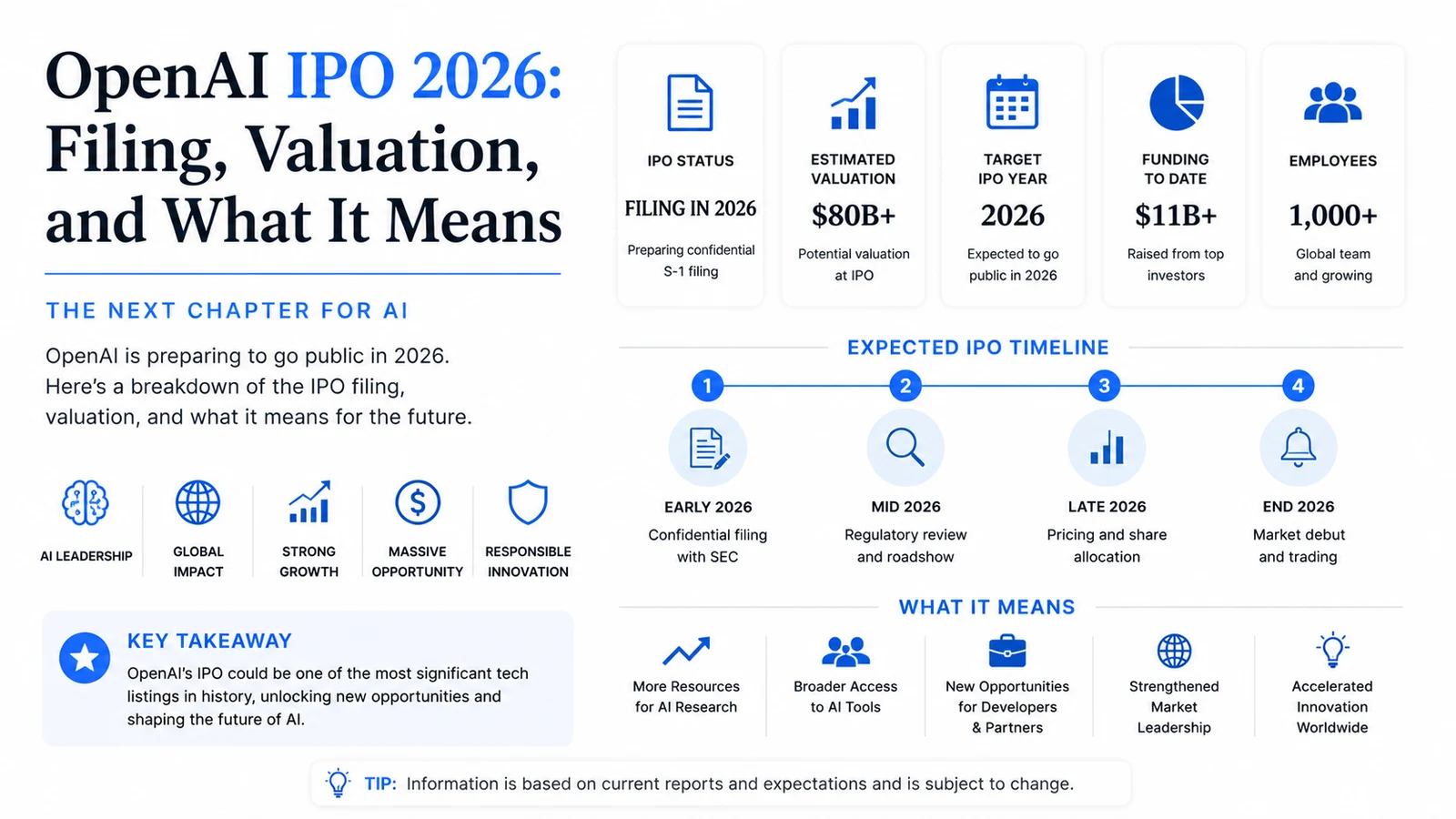
OpenAI IPO 2026: Massive Valuation & Investor Playbook
OpenAI IPO 2026 could debut with a near‑$1 trillion market cap, backed by an $852 billion private valuation and $2 billion monthly revenue. Get key dates, risks, and investor insights.
Read article