GitHub Copilot Pricing 2026 Explained
If your GitHub Copilot bill just exploded, you're not imagining it. On June 1, 2026, GitHub switched from flat monthly pricing to usage-based "AI Credits," and June 30 is when the first full 30-day cycle closes — so the first real metered invoices are landing now, affecting your understanding of github copilot pricing 2026. Developers leaning on agent mode are reporting bills 10× to 50× higher than before.
Here's what changed, why the spikes happen, what's still free, and how to keep your bill under control. For more information on managing costs, consider using tools like ai-cost-calculator or ai-budget-planner to estimate your expenses.
First, the good news: completions are still free
The most important thing to know — and the part most panic posts skip — is that code completions and Next Edit Suggestions are still unlimited and free on every paid plan. They don't touch your credits at all. If you mostly use Copilot for autocomplete, your cost hasn't changed. You can also explore other tools like ai-code-completion for alternative solutions.
Credits are only consumed by the heavier features: agent mode, chat, code review, and the Copilot CLI. To manage these costs, you can use ai-credit-tracker to monitor your usage.
What actually changed
GitHub retired its old "premium request" system and moved to token-metered AI Credits, where 1 credit = $0.01. You're billed for the tokens each request consumes — input, output, and cached — priced per model at published API rates. For a detailed explanation, visit the official GitHub Copilot documentation.
Every paid plan includes a monthly credit allowance:
| Plan | Price | Included AI Credits | $ value |
|---|---|---|---|
| Free | $0 | — (2,000 completions) | — |
| Pro | $10/mo | 1,500 | $15 |
| Pro+ | $39/mo | 7,000 | $70 |
| Max | $100/mo | 20,000 | $200 |
| Business | $19/user/mo | 1,900 pooled | $19 |
| Enterprise | $39/user/mo | 3,900 pooled | $39 |
Once you blow through the included credits, you pay for overage. You can use ai-cost-estimator to predict your expenses.
Why agent mode bills explode
Agentic work is token-hungry by nature. A single "refactor this module" or "review this PR" task can fire thousands of input, cached, and output tokens as the agent reads files, reasons, and writes changes. On a frontier model the token rates are steep — on the order of $5 per million input tokens and $25–$30 per million output tokens for models like GPT-5.5 or Claude Opus 4.8 — and Copilot code review carries a 13× multiplier as of June 1.
Stack that up and a heavy agentic task can cost $0.50–$2.00+ each. Developers have reported projected jumps from $29 to $750/month and $50 to $3,000/month, and one person said they burned 54% of their monthly quota in a single request. These are individual reports, not GitHub's official rates — but they're widespread and consistent. For more information on token pricing, visit Wikipedia's explanation of tokenization.
The trap that causes the worst bills
Here's the single most important setting: by default, GitHub only notifies you at your budget limit — it does not stop usage. To actually cap spending you have to manually enable "Stop usage when budget limit is reached." Most people who got a shock bill never flipped that switch. You can use ai-budget-alert to receive notifications when you're approaching your limit.
How to control your Copilot costs
- Set a hard budget cap. Turn on "stop usage when budget limit is reached" — don't rely on notifications. Consider using ai-budget-planner to plan your expenses.
- Route simple work to cheap models. Lightweight models cost roughly 24× less per token than frontier ones. Reserve GPT-5.5 / Opus-class models for high-value merges, not routine edits. You can explore alternative models using ai-model-comparator.
- Trim context. The more files an agent reads, the more input tokens you pay for. Scope tasks tightly. Use ai-context-trimmer to optimize your tasks.
- Estimate before you commit. Use our free LLM cost calculator to model what a workload costs across models, and our LLM pricing comparison to see per-token rates side by side. You can also visit the official GitHub Copilot pricing page for more information.
Is Copilot still worth it — or should you switch?
For pure autocomplete, Copilot is still a strong, effectively-flat deal. For heavy agentic coding, it's worth comparing alternatives that bundle agent usage differently — tools like Cursor and Claude Code (both around $20/month) or free, bring-your-own-key options like Continue.dev, Cline, and Aider. The right choice depends on how much agent mode you actually run. Consider using ai-alternative-finder to explore other options.
Understanding AI Credits
To better manage your AI Credits, it's essential to understand how they work. Each credit equals $0.01, and you're billed for the tokens each request consumes. You can use ai-credit-explainer to learn more about AI Credits.
Optimizing Your Workflow
To minimize your costs, optimize your workflow by using the right tools for the job. For example, use ai-code-review for code reviews and ai-chatbot for chat tasks. You can also explore other tools like ai-email-writer and ai-instagram-caption-generator to streamline your workflow.
Conclusion
The bottom line: Copilot didn't get more expensive for everyone — it got metered. If you understand where the credits go and cap your budget, the bill shock is avoidable. By using the right tools and optimizing your workflow, you can minimize your costs and get the most out of GitHub Copilot. For more information on optimizing your workflow, visit GitHub's official documentation or Wikipedia's page on workflow optimization.
Frequently asked questions
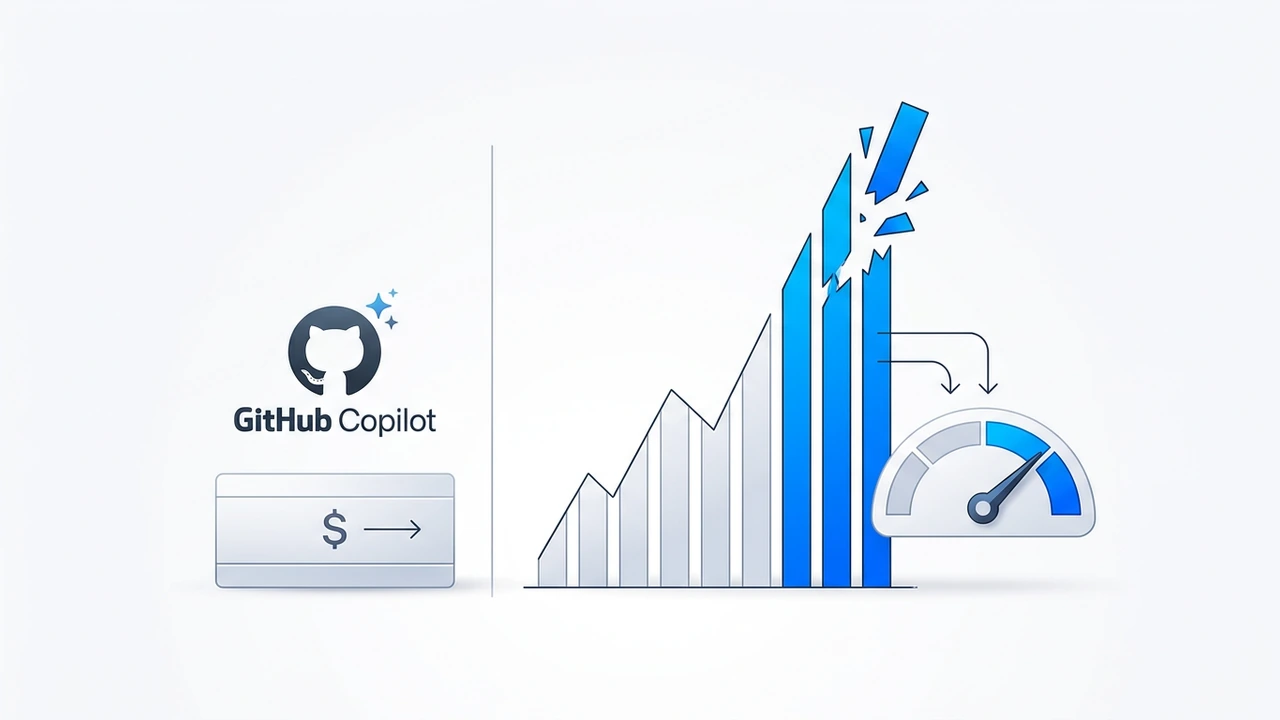
On June 1, 2026, GitHub moved Copilot to usage-based 'AI Credits' billing. June 30 is the close of the first full 30-day cycle, so the first metered invoices are landing now. Heavy users of agent mode, chat, and code review can see bills well above the old flat rate.
Yes. Code completions and Next Edit Suggestions remain unlimited and free on all paid plans and don't consume AI Credits. Only agent mode, chat, code review, and the CLI use credits.
1 credit equals $0.01. You're billed by token consumption (input, output, and cached tokens) at each model's published rate. Plans include a monthly credit allowance — 1,500 for Pro, 7,000 for Pro+, 20,000 for Max — and you pay overage beyond that.
Agentic tasks consume thousands of tokens per request as the agent reads files, reasons, and edits code. Frontier models cost roughly $5 per million input tokens and $25–$30 per million output tokens, and code review adds a 13× multiplier, so a single heavy task can cost $0.50–$2.00 or more.
By default GitHub only notifies you at your budget limit — it doesn't stop usage. Manually enable 'Stop usage when budget limit is reached' to set a hard cap. Also route simple work to cheaper models and keep task context tight.
Base prices are unchanged: Free $0, Pro $10/mo, Pro+ $39/mo, Max $100/mo, Business $19/user/mo, Enterprise $39/user/mo. Each plan includes a monthly AI Credit allowance, after which you pay metered overage.
Popular alternatives include Cursor and Claude Code (around $20/month), Windsurf, and free bring-your-own-key tools like Continue.dev, Cline, Aider, and Tabby. The best fit depends on how heavily you use agent mode versus plain autocomplete.
Use a token-based cost calculator. Our free LLM cost calculator lets you enter input/output tokens and monthly volume to project costs across 300+ models, and our LLM pricing page shows per-token rates side by side.
Share this article
Send it to a teammate or save the link for later.
Related articles
Is the AI Bubble Bursting? Big Tech's $725B Reckoning
Is the AI bubble bursting in 2026? Big Tech is set to spend ~$725B on AI as the Magnificent 7 shed $2.3T — the bull and bear case, no hype, no advice.
Read articleApple Lost a Major EU Antitrust Fight: What It Means
Apple lost a major EU antitrust ruling on July 8, 2026, upholding DMA rules on the iPhone. What's decided, what's still pending, and what changes for you.
Read articleBest AI Browser 2026: Comet vs Dia vs Chrome (Atlas Dies)
The best AI browser in 2026? Comet is free and cross-platform, Chrome adds Gemini, and ChatGPT Atlas shuts down Aug 9 — plus the safety risks.
Read article