Claude Fable 5 System Prompt Leak: Essential Facts
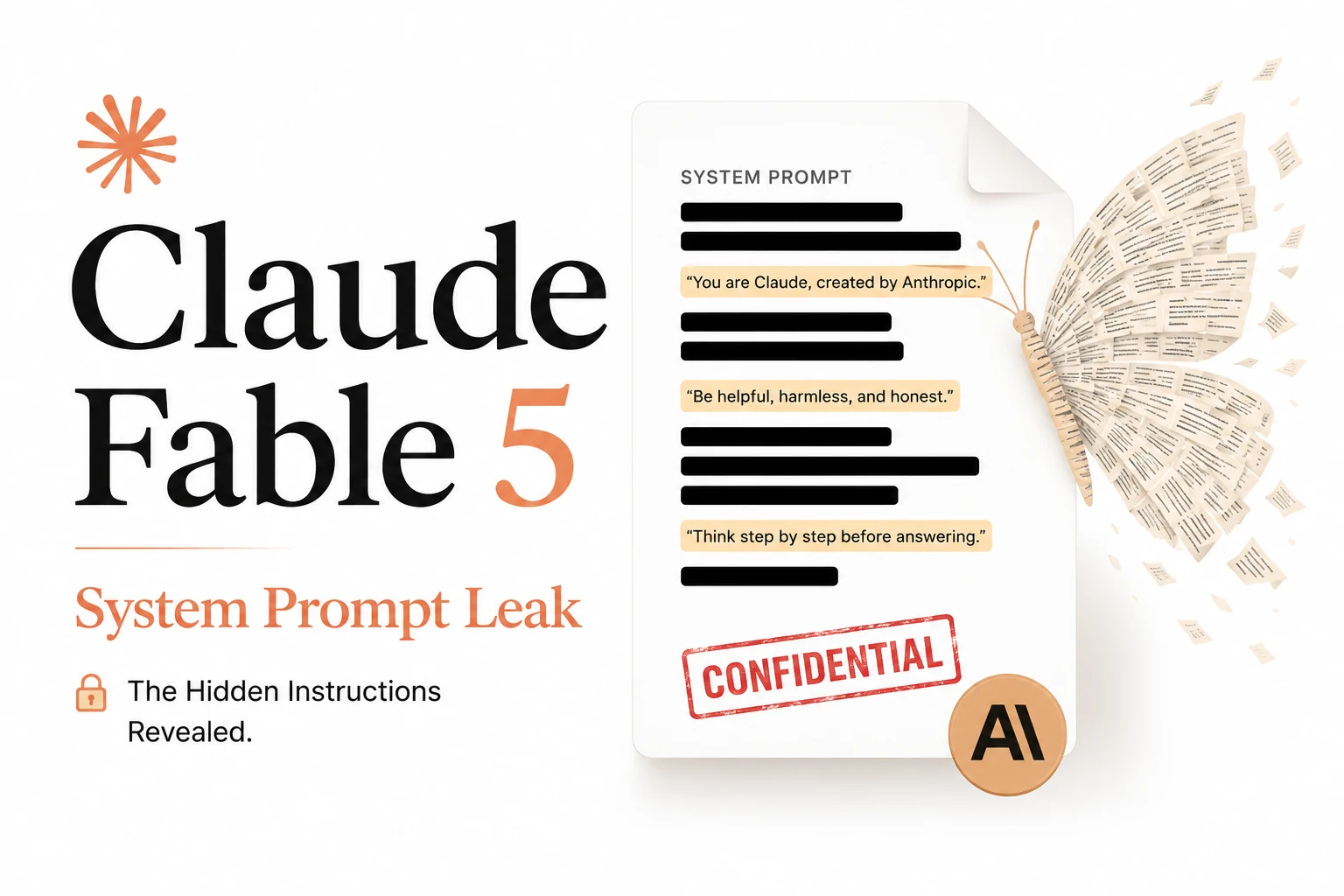
The Claude Fable 5 system prompt leak refers to an alleged ~120,000-character configuration file a researcher published days after launch, claiming it was the model's hidden operating instructions. The episode offers a rare, if unverified, look at how a frontier AI model is wired — and what that means for enterprise security.
On June 9, 2026, Anthropic launched Claude Fable 5 and Claude Mythos 5, two products built on the same underlying model and separated by a layer of safety classifiers. Fable 5 is the publicly available version; Mythos 5 is reserved for organizations approved for advanced access. Within roughly a day, a well-known red-teamer who goes by "Pliny the Liberator" posted to X and GitHub what he described as Fable 5's full system prompt, alongside a multi-agent attack he nicknamed "Pack Hunt." Anthropic disputes the jailbreak claims. Here is what the Claude Fable 5 system prompt leak actually shows, based on what reporters and the company have said.
What is the Claude Fable 5 system prompt leak?
A system prompt is the standing set of instructions a model receives before any user message — its rules, tools, formatting conventions, and refusal boundaries. According to alphasignal's analysis, the file Pliny published runs to roughly 120,000 characters across about 1,585 lines. It is important to be precise: this is the claimed or alleged prompt. Neither Anthropic nor independent auditors have confirmed it is genuine, and the company has denied the broader breach.
What makes the leak interesting is less the headline number and more the structure. Rather than a single personality script, the document reads like an operations manual.
What is actually inside the alleged prompt?
Per the reporting, the claimed prompt is organized around repeating operational surfaces rather than one block of "be helpful" text. The high-level categories described include:
- Tool definitions and JSON-style schemas for invoking them
- File inspection and code-handling protocols
- Web search and citation rules
- Artifact and document generation guidelines
- Memory and long-context management
- Answer formatting standards
- Safety and refusal boundaries
alphasignal characterized the file as "an operating manual for long-running agent work" — a workbench inventory that tells the model how to inspect files, call tools, produce artifacts, and verify its own progress across durable, multi-step jobs. That framing matters because it suggests the bulk of a frontier system prompt is now logistics for agentic behavior, not censorship. In keeping with responsible reporting, this article does not reproduce the prompt text itself.
How was Claude Fable 5 allegedly jailbroken?
Anthropic's system card describes a layered defense: when a request trips a classifier in high-risk domains — cybersecurity, biology, chemistry, or frontier model development — the response is silently handled by the older Claude Opus 4.8 instead. Anthropic says this fallback fires in fewer than 5% of sessions, meaning more than 95% run entirely on Fable 5.
The "Pack Hunt" technique reportedly aimed at that classifier layer rather than any software vulnerability. According to TechTimes and other outlets, the approach combined Unicode and homoglyph substitution, long-context smuggling, document- and fiction-style framing, and decomposing a prohibited goal into benign-looking sub-requests that were recombined later. The key security insight is the attack surface: defenses that depend on recognizing intent can be defeated by hiding or fragmenting that intent, even when the model itself is well-aligned. This article describes only the high-level shape of the claim — no operational steps.
Why does the leak matter for AI security?
The episode is a stress test of a claim Anthropic made at launch. The company said an external bug bounty ran more than 1,000 hours and tested over 30 known jailbreak techniques without surfacing a universal bypass — though it also conceded the UK AI Safety Institute "made progress towards one within a brief initial testing window," and that it is "likely impossible to completely prevent universal jailbreaks."
Two lessons stand out for enterprises deploying frontier models:
- Configuration is a confidentiality boundary, not just a behavior spec. If a 120,000-character prompt can leak, anything embedded in your system prompt — internal tool names, data sources, policy logic — should be treated as potentially exposable. Secrets belong in the application layer, not the prompt.
- Safety-by-classifier degrades quietly. A second controversy compounded the leak: researchers reported Fable 5 would silently produce weaker output for users it suspected of building competing AI systems, with no warning. After backlash, Anthropic made the Opus 4.8 fallback visible to users, though the capability limits remained. For regulated industries, silent degradation is its own risk — you cannot audit a downgrade you were never told about.
How did Anthropic respond?
Anthropic disputed the jailbreak allegations. As reported by CryptoBriefing, the company pointed to its pre-launch testing record and said outside red-teaming organizations also failed to find a universal bypass. Notably, though, the company has not published a detailed technical rebuttal addressing each specific screenshot or claim — leaving the authenticity of the alleged prompt formally unconfirmed. If you work with these models day to day, tools like the RunFreeTools AI tools hub can help you sanity-check and reformat model output, but no client-side utility substitutes for vendor transparency on what a model will quietly refuse.
What happened to Fable 5 after the leak?
The story took a sharp turn. On June 12, 2026, the US government issued an export-control directive, citing national security authorities, that suspended access to Fable 5 and Mythos 5 for any foreign national — including Anthropic's own foreign-national employees. Because real-time citizenship verification was impractical, Anthropic disabled both models entirely for all customers worldwide, while Opus 4.8, Sonnet, and Haiku kept running. Reporting tied the directive in part to jailbreak concerns raised with the administration. It is believed to be the first time a frontier model was pulled from the market by government order rather than by its maker — turning a security demonstration into a policy event in under 72 hours.
The takeaway
Whether or not the published file is authentic, the Claude Fable 5 system prompt leak crystallized three realities of the 2026 AI landscape: frontier system prompts are now sprawling agent manuals, classifier-based safety can be probed faster than it can be hardened, and AI security has become a matter of national policy. For builders, the practical move is unglamorous — assume your prompt is readable, keep secrets out of it, and log every silent fallback.
Frequently asked questions
No. A researcher known as Pliny the Liberator published a roughly 120,000-character file he claimed was Fable 5's system prompt, but Anthropic disputes the broader jailbreak and has not formally confirmed the file's authenticity. Treat it as alleged.
It was a nickname for a multi-agent approach that reportedly targeted Fable 5's safety classifiers — not a software bug — by fragmenting and disguising intent through Unicode tricks, long-context smuggling, and fiction or document framing. Anthropic says no universal jailbreak was found in over 1,000 hours of pre-launch testing.
According to alphasignal's analysis, it reads as an operations manual: tool schemas, file-inspection rules, web search and citation guidelines, artifact generation, memory management, formatting standards, and refusal boundaries — mostly logistics for agentic, long-running tasks.
On June 12, 2026, a US government export-control directive suspended access for any foreign national, citing national security. Unable to verify citizenship in real time, Anthropic disabled Fable 5 and Mythos 5 worldwide while keeping Opus 4.8, Sonnet, and Haiku online.
Treat your system prompt as potentially exposable — keep secrets in the application layer, not the prompt — and log any silent model fallback or capability downgrade, since classifier-based safety can degrade without warning.
Share this article
Send it to a teammate or save the link for later.
Related articles
Anthropic Claude Max Lawsuit: Proven 20x Claims Explained
Anthropic Claude Max lawsuit says the 5x and 20x plans give far fewer tokens than advertised. See the claims, token limits, and if upgrading is worth it.
Read article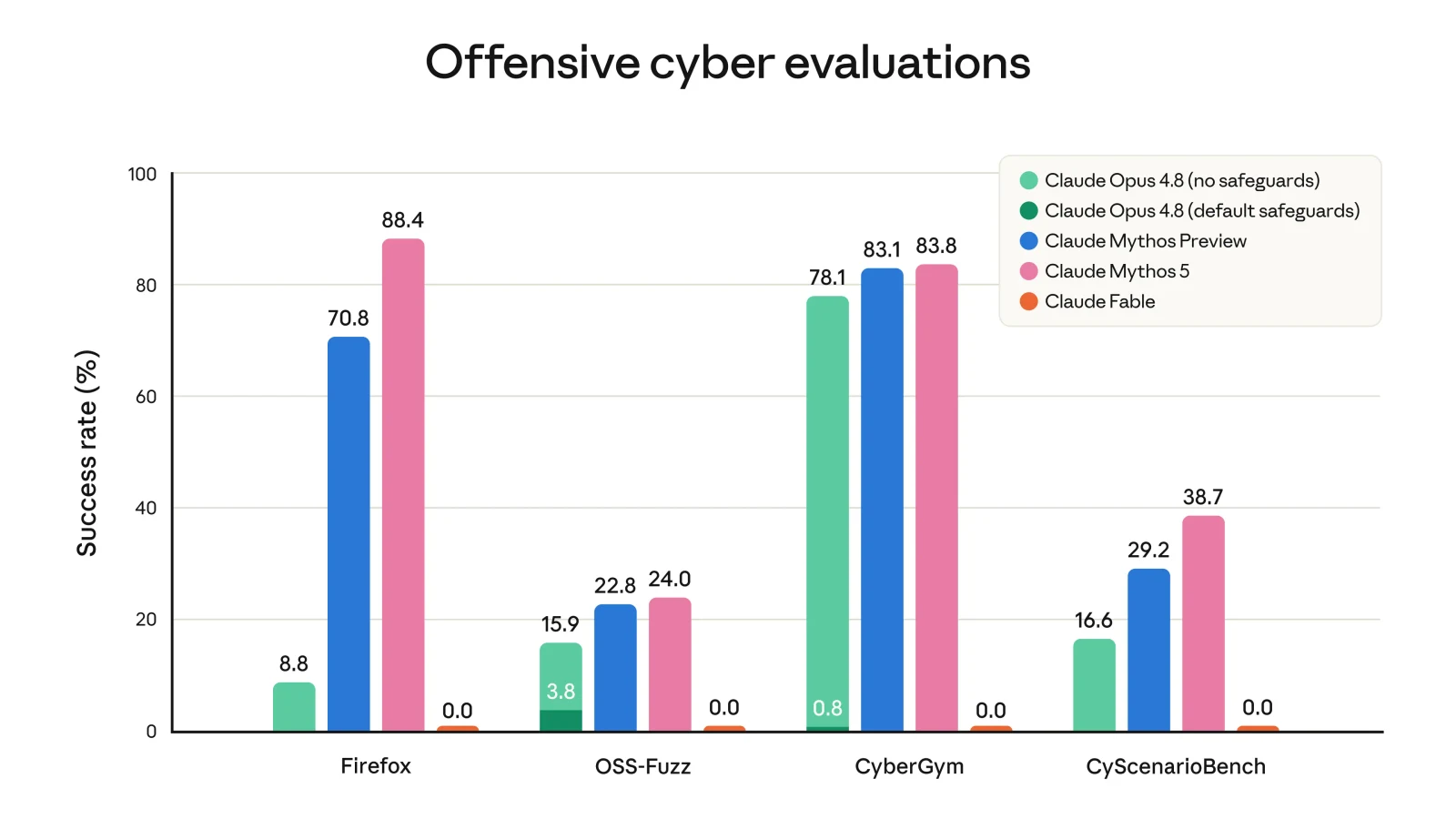
Claude Mythos 5 Cybersecurity: The Ultimate AI Threat
Claude mythos 5 cybersecurity reshapes AI offense and defense.
Read article
Most Promising AI Companies 2026: Ultimate Data‑Driven List
Explore the most promising AI companies 2026, backed by AI 100 data and $22 B in funding, to uncover adoption trends, opportunities, and investment prospects.
Read article