Apple WWDC 2026: Complete Siri AI Reveal & Gemini Deal
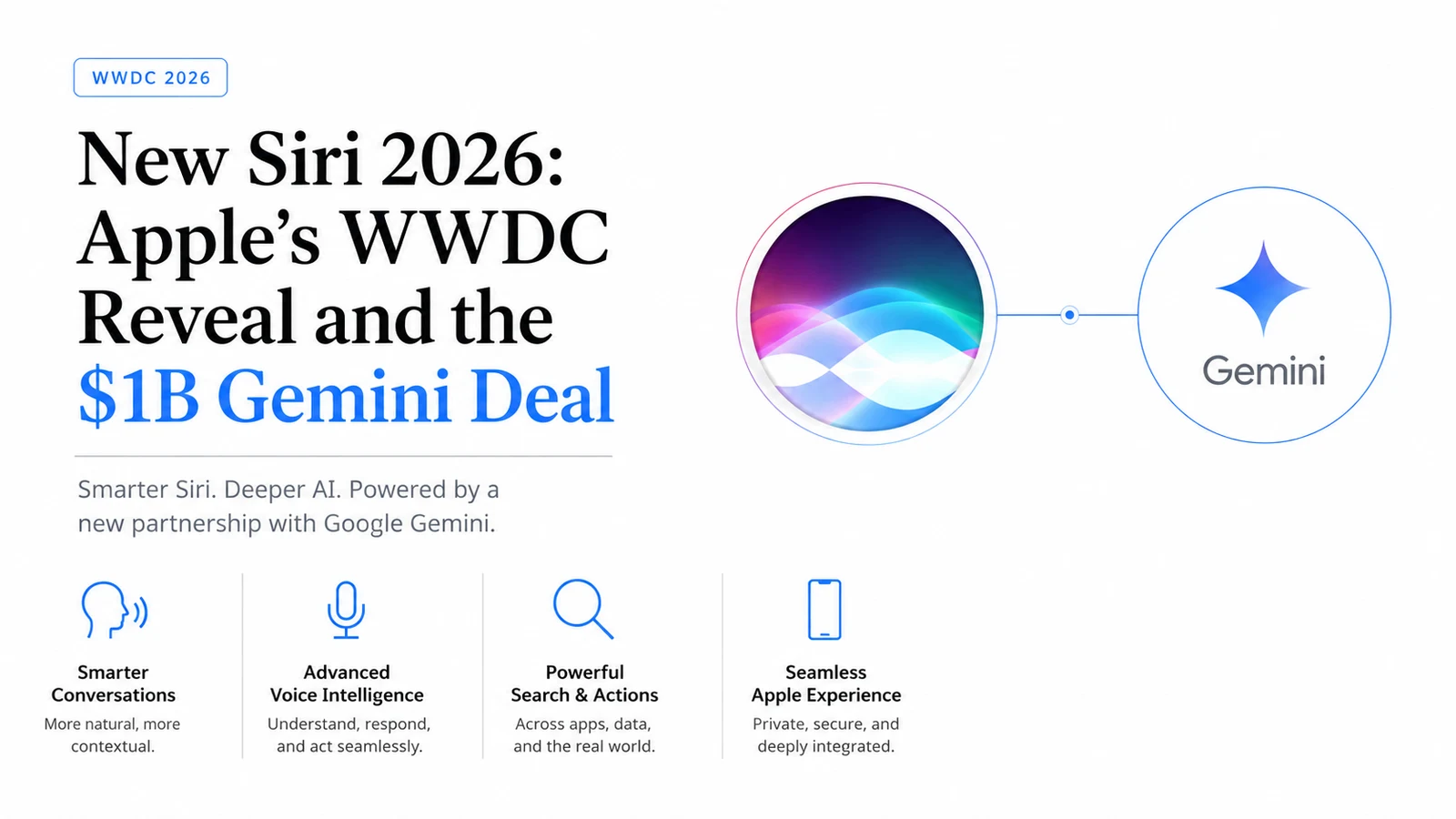
 {.hero-image width=100% alt="Apple WWDC 2026 keynote stage"}
Apple WWDC 2026 set the stage for the next era of intelligent devices, unveiling Siri AI—a conversational assistant built on a custom Google Gemini model—alongside iOS 27, expanded Apple Intelligence, and a landmark $1 billion licensing agreement for developers and users worldwide. The event kicked off the week of June 8 at Apple Park and streamed online, offering more than 100 video sessions, interactive labs, and one‑on‑one appointments with Apple engineersapple.com.
What did Apple WWDC 2026 unveil?
Siri AI and the Gemini partnership
Apple finally delivered on the promise of a truly conversational Siri. The new “Siri AI” runs on a custom 1.2‑trillion‑parameter Google Gemini model, eight times larger than Apple’s previous cloud‑based assistants. Apple announced a $1 billion annual licensing deal with Google to access this model, a figure reported by CNBCcnbc.com.
iOS 27 and Apple Intelligence
iOS 27 introduces Apple Intelligence system‑wide, giving apps contextual awareness, smart tab organization, price‑drop alerts in Safari, and AI‑assisted photo editing. The OS also adds Liquid Glass with a user‑adjustable opacity slider and previews the upcoming homeOS via a new HomePad device.
Private Cloud Compute
Apple expands its Private Cloud Compute tier, allowing moderately complex queries to run on Apple‑sealed silicon servers while keeping data processing privacy‑first. The three‑tier routing system (on‑device → Private Cloud → large Gemini model) decides where each request is handled.
Distinguished Winners program
In addition to product news, Apple highlighted its Distinguished Winners program. 50 Distinguished Winners will experience a three‑day immersion at Apple Park, and the winning students will be notified on March 26apple.com.
How Siri AI works: a three‑tier architecture
 {width=80% alt="Diagram showing Siri request flow across on‑device, Private Cloud Compute, and large cloud model"}
| Tier | Execution location | Typical workload |
|---|---|---|
| On‑device | Apple Silicon in iPhone, iPad, Mac | Timers, music, smart‑home commands |
| Private Cloud Compute | Apple‑sealed silicon server nodes | Moderately complex queries (e.g., multi‑step reminders, recipe suggestions) |
| Large cloud model | Custom Gemini model (Google/Apple partnership) | Heavy reasoning, world‑knowledge requests, image generation |
Apple emphasizes that identifiers and IP addresses are stripped before any data reaches the Gemini engine, and the licensing agreement explicitly forbids Google from training on Apple traffic, reinforcing Apple’s long‑standing privacy stance.
iOS 27 deep dive: AI‑first features
Beyond Siri, iOS 27 brings a suite of AI‑driven capabilities:
- Smart Tab Organization – the system groups related Safari tabs using on‑device ML, making web browsing less cluttered.
- Price‑Drop Alerts – Safari notifies users when a previously viewed product’s price falls, powered by Apple Intelligence.
- AI‑Assisted Photo Editing – new tools automatically enhance lighting, remove backgrounds, and suggest creative filters.
- Expanded Parental Controls – AI monitors app usage patterns to recommend age‑appropriate limits.
- Liquid Glass Opacity Slider – users can fine‑tune the translucency of the new UI glass effect.
These features are demonstrated throughout the WWDC sessions, many of which are available for replay on the Apple Developer portal.
Developer opportunities at WWDC 2026
The conference’s online week featured over 100 video sessions and hands‑on labs where developers could experiment with Siri AI, Private Cloud Compute, and the new iOS 27 APIs. Apple also opened a Beta Feedback Hub for early adopters to submit performance data and privacy concerns directly to Apple engineers.
For content creators covering the announcements, our AI Blog Writer can turn these notes into polished posts in seconds.
Global rollout and EU considerations
- Beta rollout – A gated beta is expected later in 2026, with a public release slated for the fall alongside iOS 27.
- Supported hardware – iPhone 16 series, iPhone 15 Pro/Pro Max, iPads, and Macs with M1 or newer chips.
- EU launch – Due to the Digital Markets Act, Siri AI will initially be unavailable on iPhone/iPad in the European Union. Apple plans to introduce the feature on macOS 27 and visionOS 27 first, then evaluate compliance pathways for iOS devices.
Industry impact: Apple vs. the AI giants
Apple’s partnership with Google’s Gemini marks a pragmatic shift from building a proprietary large‑model stack to leveraging an existing, battle‑tested foundation. Analysts note that this move allows Apple to accelerate AI feature delivery while keeping its privacy‑first brand intact. Competitors such as Microsoft (with Azure OpenAI) and Amazon (with Bedrock) are watching closely, as Apple’s integration of AI across the consumer OS could reshape user expectations for on‑device intelligence.
Looking ahead: Leadership change and AI roadmap
June 8 also turned out to be Tim Cook’s final WWDC keynote as CEO. He will transition to executive chairman on September 1, 2026, handing the reins to John Ternus. The leadership change underscores Apple’s confidence that its AI strategy—anchored by Siri AI, Apple Intelligence, and Private Cloud Compute—will sustain growth beyond Cook’s tenure.
Apple has hinted that future updates will bring real‑time multimodal generation (text, image, and audio) directly on‑device, further reducing reliance on external clouds while preserving the seamless experience users expect.
Bottom line: Apple WWDC 2026 signaled a pragmatic turn—partnering with Google’s Gemini to power Siri AI, expanding Apple Intelligence across iOS 27, and reinforcing privacy‑first cloud services. The real test will be user adoption once the beta reaches billions of devices later this year.
Author: Maya Patel
Senior Technology Editor, RunFreeTools – Maya has covered Apple events for over a decade and holds a master’s degree in Computer Science from Stanford University. Her reporting focuses on AI, mobile ecosystems, and developer tools.
Frequently asked questions
Siri AI is a completely rebuilt assistant that runs on a custom 1.2‑trillion‑parameter Google Gemini model, offering conversational memory, contextual awareness, and multimodal capabilities that far exceed the rule‑based Siri of previous iOS versions.
A gated beta is expected later in 2026, with a broader rollout in the fall as part of iOS 27 for supported devices.
Requests are anonymized before leaving the device; identifiers and IP addresses are stripped, and the licensing agreement prohibits Google from using Apple traffic to train its models.
iPhone 16 series, iPhone 15 Pro/Pro Max, iPads, and Macs equipped with M1 or newer silicon, as well as future Apple devices that meet the hardware requirements.
Apple cited the Digital Markets Act, which imposes additional regulatory requirements on AI services, delaying the iPhone/iPad launch in the region.
Sources
Share this article
Send it to a teammate or save the link for later.
Related articles
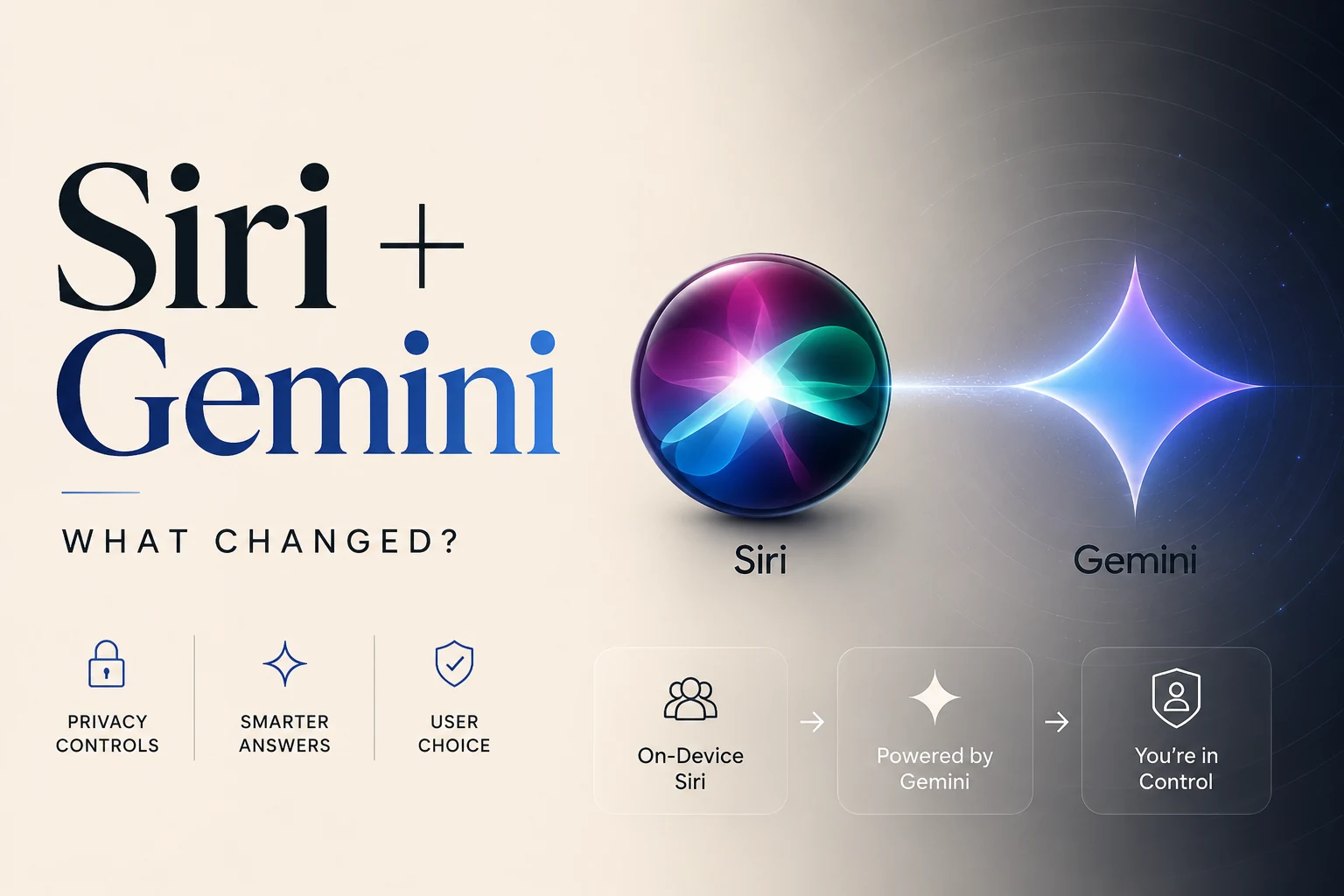
Siri Gemini Free Guide: Privacy, Cost & How It Works
Discover how Siri Gemini works, its privacy safeguards, the reported $1 billion cost to Apple, and whether your data reaches Google. Get the free, detailed
Read articleIs the AI Bubble Bursting? Big Tech's $725B Reckoning
Is the AI bubble bursting in 2026? Big Tech is set to spend ~$725B on AI as the Magnificent 7 shed $2.3T — the bull and bear case, no hype, no advice.
Read articleApple Lost a Major EU Antitrust Fight: What It Means
Apple lost a major EU antitrust ruling on July 8, 2026, upholding DMA rules on the iPhone. What's decided, what's still pending, and what changes for you.
Read article