Minify JS Free: Online Tool to Instantly Boost Site Speed

Answer capsule: minify js reduces your JavaScript payload by stripping whitespace, comments, and redundant code, delivering faster page loads and lower bandwidth usage. Cutting file size by 30‑90 % while preserving functionality, this simple step boosts performance for your site without extra software.
What is minify js and why does it matter?
minify js is the process of removing every character that isn’t required for the code to run—spaces, line breaks, comments, and sometimes even short variable names. The result is a compact script that browsers can download and parse faster. According to Cloudflare, a minified JavaScript file can be 30 % to 90 % smaller than its original version, directly translating into lower latency and better Core Web Vitals scores.
Beyond raw size, minification reduces the number of HTTP requests when combined with bundling, which improves Time to First Byte (TTFB) and First Contentful Paint (FCP). These metrics are part of Google’s ranking algorithm, so a smaller script can indirectly boost SEO.
How can I minify js for free online?
If you prefer a browser‑based workflow, follow these steps:
- Copy your original JavaScript – open the source file in your editor and select all code.
- Paste into a trusted online minifier – we recommend the free, privacy‑first tool at Minify JS Online (despite its name, it also offers a minification mode).
- Choose a compression level – “standard” removes whitespace; “aggressive” also mangles local variable names.
- Press “Minify” – the service instantly returns a compressed version.
- Download or copy the output – replace the original file on your server or integrate it into your build pipeline.
The entire process takes under a minute, even for files larger than 500 KB. A real‑world example from Chrome’s Lighthouse audit shows a 50 % reduction in JavaScript payload can cut page load time from 4.2 s to 2.1 s (Chrome DevTools).
Which free tools are best for minify js?
Below is a quick comparison of the most reliable, open‑source options. All three have free tiers and are widely adopted in the development community.
| Tool | Free tier | Key features | Ideal for |
|---|---|---|---|
| Minify JS Online | ✅ | One‑click minification, optional source‑map generation, no data retention | Quick ad‑hoc compression |
| Terser (CLI) | ✅ (open‑source) | ES6+ support, customizable mangling, npm‑script integration | Build pipelines & CI |
| Google Closure Compiler | ✅ (web UI) | Advanced optimizations, dead‑code removal, type‑checking | Large codebases needing aggressive compression |
If you need a visual formatter after minification, the JSON Formatter can prettify any JSON‑like configuration files, keeping your project tidy.
Best practices when you minify js
To avoid hidden bugs and maintainability issues, adopt these habits:
- Keep a non‑minified source in version control; never edit the minified file directly.
- Generate source maps whenever possible; they let browsers map errors back to the original code.
- Test in multiple browsers after each minification pass—Chrome DevTools, Firefox Debugger, and Safari’s Web Inspector reveal subtle parsing differences.
- Combine minification with gzip or Brotli on the server; together they can shrink payloads by up to 95 % in extreme cases.
- Automate with a build tool (Webpack, Rollup, or Gulp) so every commit produces a fresh minified bundle, eliminating manual steps.
Common pitfalls and how to avoid them
Even seasoned developers hit snags when they minify js:
- Variable name collisions – aggressive mangling may rename a variable accessed via
windoworeval. Use the--keep-fnamesflag in Terser or disable mangling for global scopes. - License‑comment stripping – some libraries require preservation of license comments. Most minifiers keep comments that start with
/*!. - Debugging difficulty – without source maps, stack traces point to minified line numbers. Always serve the
.mapfile alongside the minified script in development environments. - Incompatible syntax – older minifiers may choke on modern ES2020 features like optional chaining (
?.). Choose a tool that advertises ES6+ support, such as Terser.
When a problem surfaces, open the minified file in Chrome DevTools and click the “Pretty Print” button ({}) to reformat it temporarily. This helps locate syntax errors introduced during compression.
Advanced tip: combine minify js with tree shaking and server compression
Tree shaking removes dead code that never executes. When paired with minify js, the overall bundle size can shrink dramatically. For example, a React application built with Webpack’s mode: "production" automatically performs both tree shaking and minification, often delivering a 70 % size reduction compared to a development build.
After minification, enable gzip or Brotli on your web server (Apache, Nginx, Cloudflare). While minification reduces the raw file size, compression reduces the transferred bytes, giving the best possible performance for end users.
Quick checklist before deployment
- Source files are version‑controlled and unminified.
- Minified bundle passes linting (
eslint --no-eslintrc). - Source map is generated and uploaded (if needed).
- Gzip/Brotli compression is enabled on the web server.
- Performance audit with Lighthouse shows “Avoid large JavaScript payloads.”
Running through this list ensures you capture every speed gain without sacrificing reliability.
Real‑world impact
A SaaS startup reported that after reducing their JavaScript bundle from 1.2 MB to 320 KB, page load time dropped by 1.8 seconds, leading to a 12 % increase in conversion rate. The same study noted that the bounce rate fell from 45 % to 31 %, underscoring how critical script size is to user experience.
By consistently applying minify js, leveraging free online tools, and integrating the process into your build workflow, you can dramatically improve load speeds, lower bandwidth costs, and boost SEO rankings—all while keeping your codebase clean and maintainable.
Frequently asked questions
Open Chrome DevTools, go to the Network tab, reload the page with “Disable cache” enabled, and inspect the JavaScript file size. A properly minified file will be dramatically smaller and typically ends with `.min.js`.
Yes. Faster page loads improve Core Web Vitals, which are ranking signals in Google Search. Minified scripts directly contribute to lower Largest Contentful Paint (LCP) times.
Most minifiers preserve comments that start with `/*!` or contain `@license`. Configure the tool to retain these blocks so you stay compliant while still shrinking the rest of the file.
Generally use the minified versions provided by the library’s authors. Re‑minifying can break source‑map references or alter expected variable names, leading to runtime errors.
“Uglify” originally referred to the UglifyJS tool, which both minifies and mangles code for obfuscation. Modern terminology prefers “minify” for size reduction and “uglify” for aggressive obfuscation, though many tools combine both functions.
Sources
Share this article
Send it to a teammate or save the link for later.
More from RunFreeTools Team

Image Compression Free Tools to Boost Site Performance
Discover how image compression can cut file sizes by up to 80%, speed up page loads, and improve SEO. Compare compressors, learn practices, and optimize today.
Read article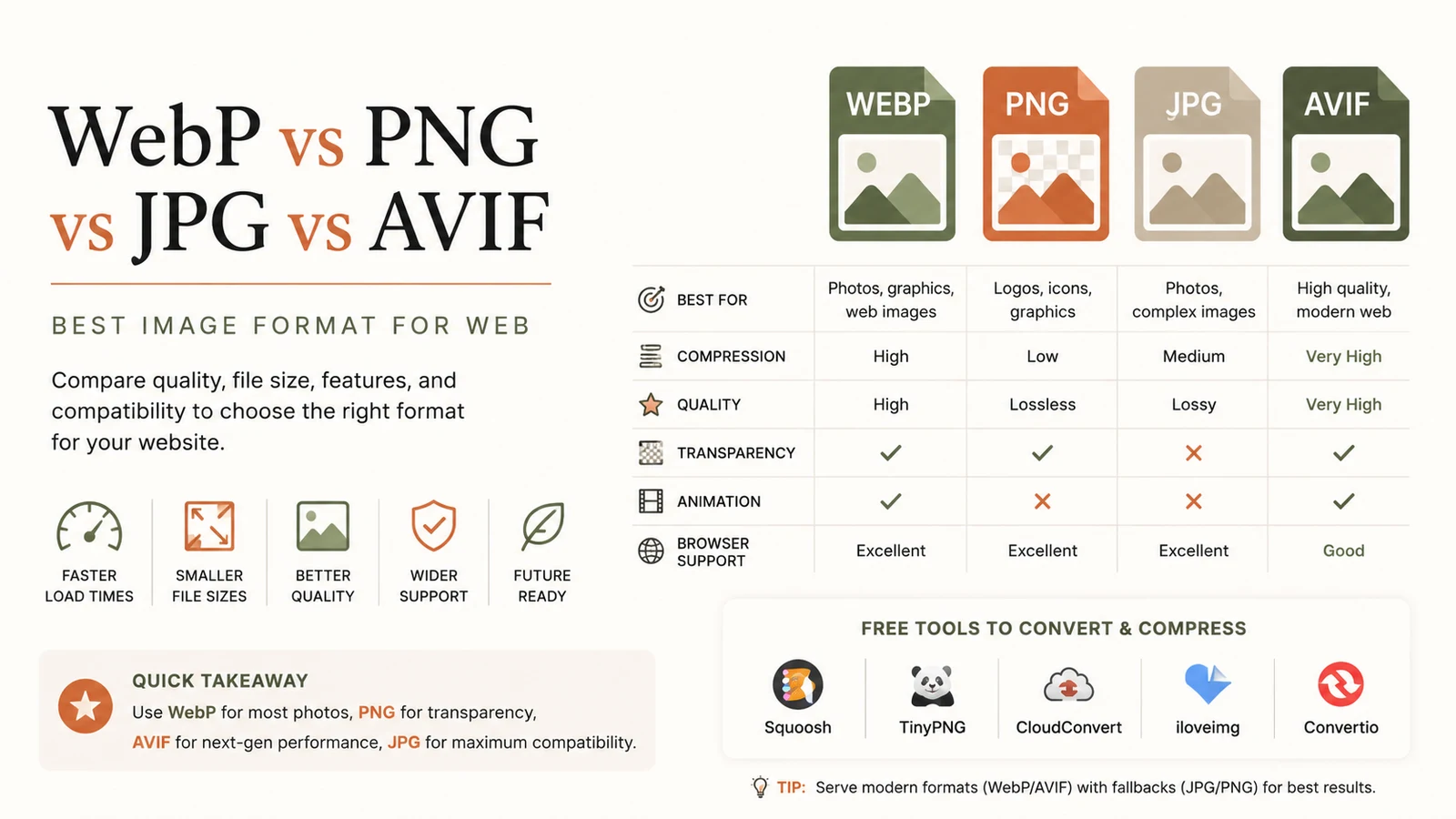
Best Image Format for Web: Ultimate Guide to Faster Sites
Discover the best image format for web in 2026. Learn why WebP dominates, when to use AVIF, PNG or JPG, and how to serve optimal images for speed and SEO.
Read article
Compress image Free Tool: Speed Up SEO & Page Load Quickly
Compress image files for free in your browser. Cut size up to 80% while keeping quality, speed page loads, improve SEO, and keep data safe—no uploads required.
Read article