Trump's 100% Tech Tariff: What It Means for Prices
Trump's 100% Tech Tariff Threat: What It Means for Tech Prices
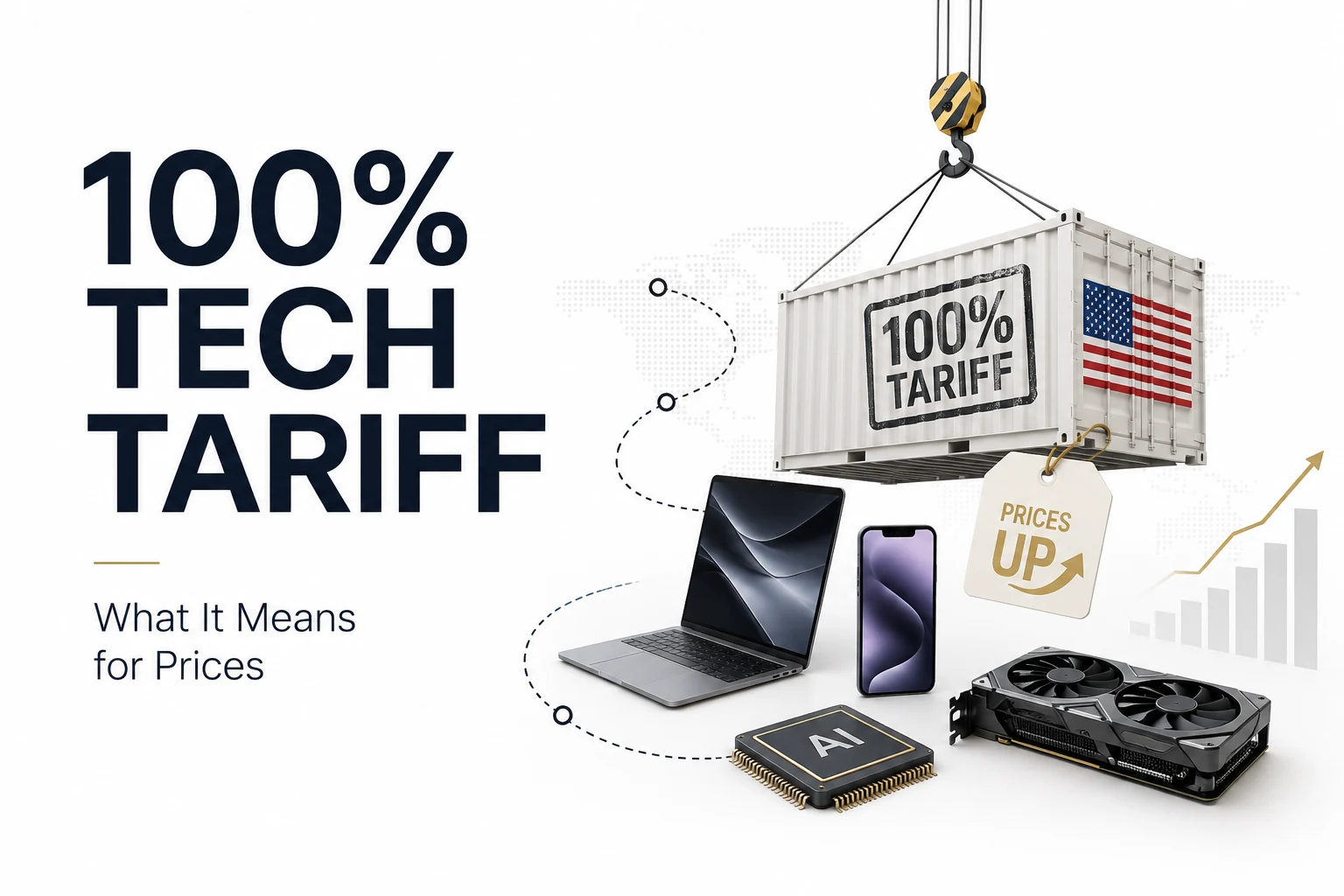
President Trump's "approximately 100%" tariff on imported chips and semiconductors is a threat, not a law. As of late June 2026, the only chip tariff actually in force is a narrower 25% duty on certain advanced AI semiconductors that took effect on January 15, 2026, with a long list of exemptions that spares most consumer electronics. The 100% figure comes from an August 2025 announcement that has not been implemented at that rate. Still, the direction of travel matters for shoppers, because even the 25% version and the broader "Phase 2" tariffs the administration has floated could push up prices on phones, laptops, GPUs, and game consoles. This guide explains exactly what was announced, what is covered today, who is affected, and what you can do about it.
What did Trump actually announce?
There are two separate things people are blending together, and the difference is the whole story.
First, the 100% threat. On August 6, 2025, standing alongside Apple CEO Tim Cook in the Oval Office, Trump said: "We'll be putting a tariff on of approximately 100% on chips and semiconductors... if you're building in the United States of America, there's no charge," as reported by PBS NewsHour. The pitch was a penalty designed to push chipmakers to build factories on US soil, with a carve-out for any company that has committed to domestic production.
Second, the 25% tariff that is real. On January 14, 2026, the administration signed a Section 232 proclamation imposing a 25% tariff on a narrow category of advanced computing chips, effective January 15, as covered by CNBC and confirmed in the White House proclamation. That is the rate currently on the books. The headline-grabbing 100% number was a threat used as leverage during negotiations, and it has not taken effect at that level.
So the accurate framing for a shopper in June 2026 is this: a 100% tariff has been threatened and could still appear in some form, but the tariff actually charged today is 25%, and only on a small slice of chips.
What chips and products are covered right now?
The current 25% tariff is deliberately narrow. It targets high-performance AI accelerators, with the Nvidia H200 and AMD MI325X named as examples, according to Thomson Reuters' trade analysis. These are data-center parts, not the chips in your phone or laptop.
Just as important is what is exempt. The proclamation excludes chips imported for:
- US data center use
- Domestic repairs and replacements
- Research and development
- Startups
- Non-data-center consumer applications
- Non-data-center civil industrial applications
- US public sector use
In other words, the consumer-electronics path is largely carved out for now. There is also a key structural detail that limits the tariff's direct reach. The US imports relatively few loose chips, because most foreign-made semiconductors are already assembled into a finished product, an iPhone, a car, a TV, before they cross the border, as PBS NewsHour explained. A tariff on bare chips does not automatically hit a fully built laptop. That gap is exactly what a broader "Phase 2" tariff on derivative products would try to close.
Who is affected, and who is exempt?
The exemption logic is built around domestic manufacturing commitments. Companies that have pledged to build chip capacity in the US are positioned to avoid the worst of any future tariff. That group includes Intel, Nvidia, Samsung, and Taiwan Semiconductor Manufacturing Company (TSMC), all of which are expanding US fabrication, per PBS NewsHour.
Smaller or more import-dependent players are more exposed. Chipmakers with limited US presence, such as some European and Asian suppliers, face more uncertainty, and Chinese firms like SMIC and Huawei are unlikely to receive relief. Smaller hardware makers have also said they are still waiting for official guidance on what they owe.
Here is a simplified view of where things stand.
| Group | Tariff exposure (as of late June 2026) |
|---|---|
| US-building chipmakers (Intel, TSMC, Samsung, Nvidia) | Largely shielded via domestic commitments |
| Advanced AI accelerators (H200, MI325X) | 25% tariff applies unless an exemption fits |
| Consumer chips (phones, laptops, appliances) | Mostly exempt under current carve-outs |
| China-linked makers (SMIC, Huawei) | Unlikely to be exempted |
Will tech prices go up because of the tariff?
This is where shoppers need to separate two pressures, because conflating them leads to the wrong conclusion.
The honest answer is that prices are already rising in 2026, but the tariff is not the main driver yet. The bigger force is a severe memory shortage. AI data centers are buying up DRAM and NAND capacity, and Gartner forecasts a roughly 130% combined surge in DRAM and SSD prices by the end of 2026, with PC prices up about 17% versus 2025, as reported by Tom's Hardware coverage of the memory crunch. Apple raised prices on most Macs, iPads, and home devices on June 25, 2026, with MacBook Air and Pro models up $200 to $300, and Dell, Lenovo, HP, and Microsoft moved earlier over the same shortage.
The tariff is a separate, additive risk on top of that. If the duty broadens to cover finished goods, the projected hit is significant. A June 24, 2026 analysis from the Information Technology and Innovation Foundation (ITIF) modeled the Section 232 tariffs and found that a 25% tariff would raise information and communications technology prices by 22.6%, while a 50% tariff would raise them 47.6%, per the ITIF report. The Consumer Technology Association has separately warned that broad tariffs could push tech prices up by as much as 70% and cut roughly $69 billion from GDP under aggressive scenarios.
For specific devices, analyst estimates for the next iPhone's price increase range widely, from about $50 (JPMorgan) to as much as $270 (TechInsights), with Counterpoint landing near $150 to $200. Those figures blend tariff and component-cost effects, which is why no single number is reliable. As Adam Segal of the Council on Foreign Relations put it, "It's hard to see how prices are not going to go up across a whole range of goods, consumer goods, big tech and cars," in marketplace coverage of the threat.
How much could specific products rise?
It helps to anchor the projections in prices people have actually seen move, then layer on the modeled tariff risk. The table below mixes real 2026 increases (already on shelves) with potential additional impact if a broader tariff lands. Treat the tariff column as scenario-based, not a promise.
| Product category | Real 2026 movement seen so far | Potential added tariff pressure |
|---|---|---|
| Laptops / PCs | Up ~17% (Gartner PC forecast); MacBooks +$200 to $300 | Higher if derivative tariffs hit finished units |
| Smartphones | Next iPhone est. +$50 to $270 (analyst range) | Tariff could push toward the upper end |
| GPUs / graphics cards | Rising with DRAM and HBM costs | Direct exposure if AI-chip duties broaden |
| Game consoles | PlayStation 5 raised $50, tied to tariffs | Further increases possible under Phase 2 |
| Prebuilt AI PCs | Framework 128GB desktop jumped $460 ($1,999 to $2,459) | Memory plus any tariff stack together |
The single takeaway from this table: the device price increases you are seeing now are mostly memory-driven, and a wider tariff would be an additional layer, not a replacement for it.
What is the timeline, and could the 100% tariff still happen?
The 25% tariff is live now. The bigger question is what comes next, and the proclamation itself lays out the schedule.
By July 1, 2026, the Commerce Secretary must give the President an update on the market for semiconductors used in US data centers, which could trigger a modification to the current tariff, according to the White House proclamation. A separate 90-day report on trade negotiations is also required. And the proclamation outlines a "Phase 2" of broader semiconductor tariffs "at a rate of duty that is significant," paired with a tariff offset program rewarding companies investing in US production.
That Phase 2 is where a much higher rate, potentially approaching the 100% figure, could re-enter the picture, but no date or final rate has been set. As of late June 2026, the path is still being shaped by trade talks. The practical reading: expect more news around early July, and treat any 100% headline as a possible future scenario rather than today's reality.
What can shoppers do right now?
You cannot control trade policy, but you can time and structure purchases sensibly. The current environment rewards buying for need rather than waiting for relief, because the memory shortage alone is not expected to ease meaningfully until late 2027.
- Buy now if you genuinely need it. With memory prices forecast to keep climbing through 2026, waiting is unlikely to save money on RAM-heavy devices like laptops and prebuilt PCs.
- Watch memory configurations. The price pain is concentrated in RAM and storage. Choosing a sensible amount rather than maxing out specs can blunt the increase.
- Consider the used and refurbished market. Secondhand gear sidesteps both new-product price hikes and any future tariff on freshly imported units.
- Lock in big purchases before policy shifts. If a console, GPU, or phone upgrade is already in your plan, the early-July review window is a reasonable trigger to act before any expansion.
- Separate hype from fact. A 100% tariff has not been imposed. Do not panic-buy on the threat alone, but do factor in the real, memory-driven increases that are already here.
Bottom line
The "Trump 100% tech tariff" is a threat and a negotiating lever, not the rate you are paying today. As of late June 2026, the law in force is a 25% tariff on a narrow set of advanced AI chips, with broad exemptions that keep most consumer electronics out of its direct path. The price increases hitting phones, laptops, and consoles right now are driven mostly by an AI-fueled memory shortage, with the tariff sitting on top as an additional, mostly future risk. Watch the early-July review for signs of a broader "Phase 2" expansion. For most buyers, the smartest move is the boring one: purchase what you actually need now, keep an eye on memory configurations and the refurbished market, and do not let a 100% headline that has not happened drive a panicked decision.
Frequently asked questions
No. The 100% figure comes from an August 2025 statement and is a threat, not current law. As of late June 2026, the only chip tariff in force is a 25% duty on a narrow category of advanced AI semiconductors that took effect January 15, 2026.
It targets advanced computing chips used in AI data centers, with the Nvidia H200 and AMD MI325X named as examples. It is not a tariff on the everyday chips inside phones and laptops, and it includes broad exemptions for consumer, research, repair, and startup uses.
Prices are already rising in 2026, but mostly because of an AI-driven memory shortage rather than the tariff. The tariff is an additional risk: ITIF modeled that a 25% tariff could raise tech prices about 22.6% if it broadens, and a 50% tariff about 47.6%.
Analyst estimates for the next iPhone's price increase range widely, from about $50 (JPMorgan) to as much as $270 (TechInsights), with Counterpoint near $150 to $200. These figures blend tariff effects and rising component costs, so no single number is certain.
Companies building or committing to chip manufacturing in the US, including Intel, Nvidia, Samsung, and TSMC, are positioned to avoid the worst of any future tariff. Import-dependent and China-linked makers like SMIC and Huawei are far more exposed.
No date or final rate is set. The administration outlined a Phase 2 of broader semiconductor tariffs at a significant rate, and a Commerce Department review was due by July 1, 2026, which could trigger changes. Watch for news around early July.
Not directly under the current rules. The US imports few loose chips because most are already built into finished products before arriving, so a tariff on bare chips does not automatically hit a fully assembled laptop. A future tariff on derivative products would aim to close that gap.
If you genuinely need it, buying now is reasonable. Memory prices are forecast to keep climbing through 2026 with no meaningful relief expected until late 2027, so waiting is unlikely to save money on RAM-heavy devices, and a broader tariff would only add pressure.
Share this article
Send it to a teammate or save the link for later.
Related articles
Is the AI Bubble Bursting? Big Tech's $725B Reckoning
Is the AI bubble bursting in 2026? Big Tech is set to spend ~$725B on AI as the Magnificent 7 shed $2.3T — the bull and bear case, no hype, no advice.
Read articleApple Lost a Major EU Antitrust Fight: What It Means
Apple lost a major EU antitrust ruling on July 8, 2026, upholding DMA rules on the iPhone. What's decided, what's still pending, and what changes for you.
Read articleBest AI Browser 2026: Comet vs Dia vs Chrome (Atlas Dies)
The best AI browser in 2026? Comet is free and cross-platform, Chrome adds Gemini, and ChatGPT Atlas shuts down Aug 9 — plus the safety risks.
Read article