Quantum computing for developers: Free Practical Guide
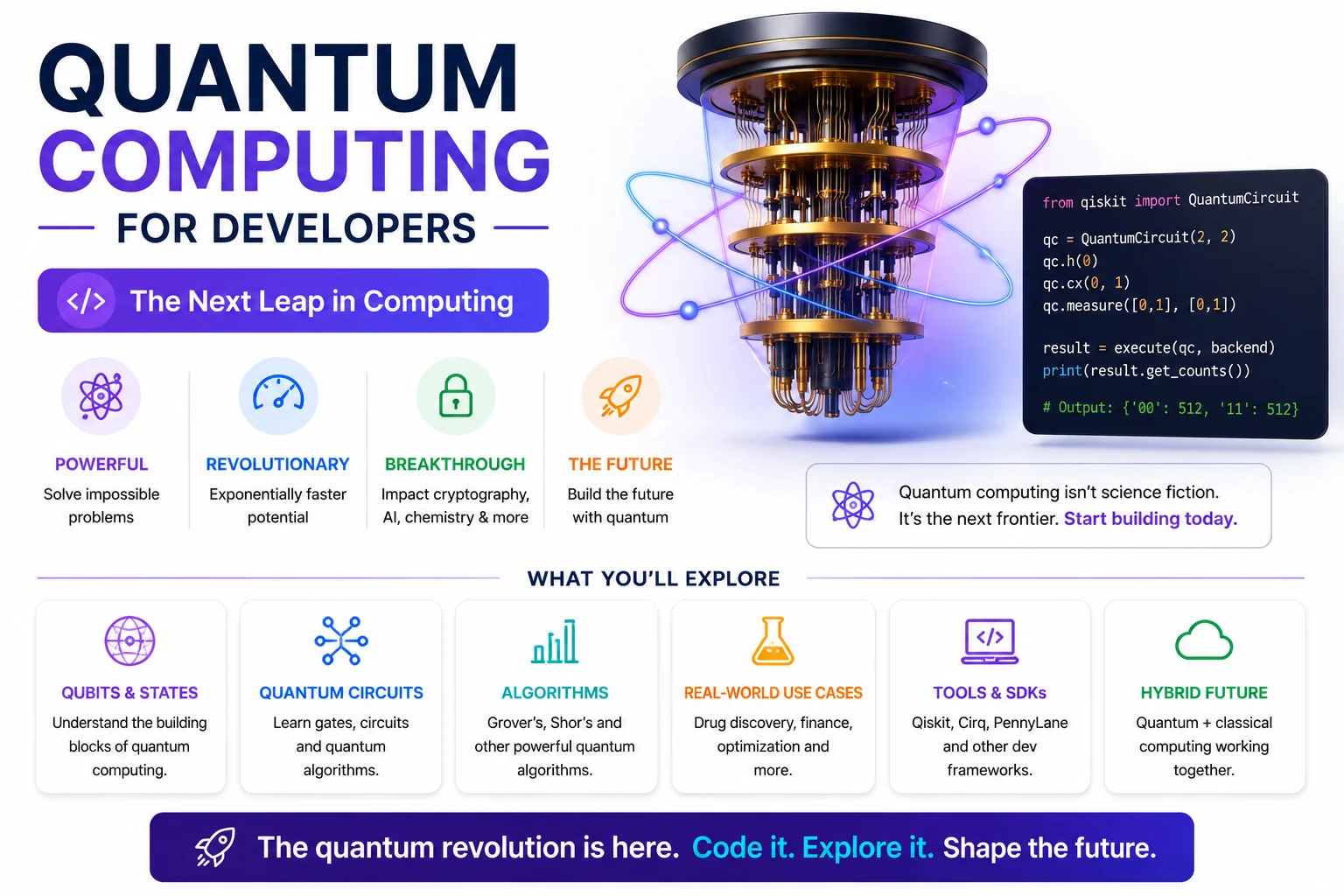
Quantum computing for developers can now be explored on free cloud platforms without any upfront hardware investment. This guide walks you through the essential SDKs, cloud tiers, starter projects, and realistic expectations, giving you a clear path from first‑line code to real‑hardware runs.
Why quantum computing for developers is accessible now
Two breakthroughs have lowered the barrier dramatically. First, open‑source SDKs have matured. Qiskit 2.4.2, released in June 2026, lets you define circuits, operators, and primitives without any hardware‑level jargon IBM docs. Xanadu’s PennyLane and Google’s Cirq provide equally polished alternatives, each compiling Python code to simulators or real QPUs.
Second, cloud‑hosted quantum hardware has become both larger and more affordable. IBM’s Heron r2 processor now offers 156 superconducting qubits and can execute roughly 5,000 two‑qubit gates per circuit—up from 120 hours of runtime on its predecessor to just 2.4 hours, a near 50× speedup Live Science. The same improvements have cut average two‑qubit gate error rates to about 0.7 %, a 30 % reduction year‑over‑year IBM hardware overview.
What can you actually build with quantum computing for developers?
You won’t crack RSA tomorrow, but you can create valuable, hands‑on projects that cement core concepts:
- Circuit visualisation – draw superposition, entanglement, and interference diagrams.
- Standard algorithms – implement Grover’s search, the quantum Fourier transform, and variational quantum eigensolvers.
- Quantum‑machine‑learning prototypes – use PennyLane’s automatic differentiation to train hybrid models.
- Error‑characterisation experiments – benchmark decoherence times and gate fidelities on real hardware versus simulators.
- Cross‑platform benchmarks – compare superconducting, trapped‑ion, and neutral‑atom backends through Amazon Braket’s unified API.
These exercises give you concrete data you can share on GitHub, Stack Overflow, or in a portfolio, demonstrating that you can move from theory to production‑grade code.
How do I start with quantum computing for developers?
The quickest route is the IBM Quantum Open Plan – a free tier that requires no credit card and grants up to 10 minutes of QPU time per 28‑day window. In March 2026 IBM added the high‑performance ibm_kingston backend to the free tier and introduced a promotion: log 20 minutes of compute within 12 months and you unlock 180 minutes for the following year.
First‑week roadmap
- Install the SDK:
pip install qiskit qiskit-ibm-runtime. - Register at the IBM Quantum portal, copy your API token, and store it securely.
- Write a two‑qubit Bell‑state circuit and run it on the local Qiskit Aer simulator.
- Submit the same circuit to a real backend via Qiskit Runtime.
- Visualise both result histograms; notice the noise‑induced deviation on hardware.
Because local simulation is unlimited, you can iterate rapidly offline and reserve precious QPU minutes for the final, polished runs.
Which free tools and SDKs are best for quantum developers?
| Platform | Primary SDK | Free Tier Highlights | Typical Use‑Case |
|---|---|---|---|
| IBM Quantum | Qiskit | 10 min QPU / month, 156‑qubit Heron r2 | General‑purpose circuits, education |
| Amazon Braket | Braket SDK (Python) | Simulator minutes + $15 credits for first‑time users | Multi‑vendor hardware comparison |
| Microsoft Azure Quantum | Q# & Quantum Development Kit | $500 free credits, VS Code extension | Q#‑centric development, Azure integration |
If you prefer a single‑vendor experience, start with IBM. For hardware‑agnostic experimentation, Braket’s unified API is unmatched. Azure shines when you want to dive into Q# or integrate quantum workloads into existing Azure pipelines.
What are the top resources and communities for quantum computing for developers?
- IBM Quantum Learning – step‑by‑step labs and a certification path IBM Learning.
- Qiskit Textbook – free, interactive chapters covering theory and code.
- Quantum Open Source Foundation – curated list of libraries, tutorials, and conferences.
- Stack Exchange Quantum Computing – active Q&A site for troubleshooting.
- GitHub “awesome‑quantum‑computing” – community‑maintained repository of tools and papers.
Quick‑start checklist
- Choose a cloud provider and create a free account.
- Install the corresponding SDK (Qiskit, Braket, or QDK).
- Run the “Hello World” Bell‑state example.
- Explore a textbook algorithm (e.g., Grover).
- Push your code to a public repo and add a README that explains the quantum advantage you’re targeting.
The realistic limits you must keep in mind
Current devices are NISQ (noisy intermediate‑scale quantum) machines. Gate errors, decoherence, and limited qubit connectivity mean that most algorithms require error‑mitigation techniques to produce useful results. Recent breakthroughs—Atom Computing’s multi‑round error correction (June 2026) and Microsoft’s topological‑qubit material advance Azure blog—show progress, but full fault tolerance remains a few years away.
Practical takeaways for developers:
- Scope – focus on problems with known quantum advantage (e.g., small‑scale chemistry, combinatorial optimisation).
- Queue latency – free QPU queues can be busy; schedule runs during off‑peak hours or rely on simulators for most development.
- Skill longevity – quantum concepts you learn today will stay relevant as hardware scales, giving you a career edge in emerging tech sectors.
Should you invest time in quantum programming in 2026?
Absolutely. The entry cost is purely your time, not money. With free cloud tiers, open‑source SDKs, and abundant learning material, you can become proficient without a physics PhD. Mastering linear algebra and Python, then practising on real hardware, positions you for the next wave of quantum‑accelerated applications.
Advanced topics to explore after the basics
- Hybrid quantum‑classical workflows – use Qiskit Runtime primitives to offload sub‑problems to a quantum processor while the classical host handles optimisation loops.
- Error mitigation – techniques such as zero‑noise extrapolation and probabilistic error cancellation can shave 20‑30 % off measured error rates on NISQ devices.
- Variational algorithms – VQE (Variational Quantum Eigensolver) and QAOA (Quantum Approximate Optimisation Algorithm) are the workhorses for chemistry and optimisation research today.
- Quantum networking basics – emerging cloud services now expose entanglement‑distribution APIs; experimenting with them prepares you for future quantum‑internet use‑cases.
Career pathways for quantum‑savvy developers
| Role | Typical Employers | Core Skills | Expected Salary (USD) |
|---|---|---|---|
| Quantum Software Engineer | IBM, Google, Rigetti, startups | Qiskit/PennyLane, Python, error mitigation | $120‑150k |
| Quantum Machine‑Learning Scientist | Pharma, finance, AI labs | Hybrid models, gradient‑based optimisation, data encoding | $130‑160k |
| Quantum Cloud Integration Engineer | AWS, Azure, Oracle | REST/GraphQL APIs, DevOps, security for quantum workloads | $110‑140k |
| Quantum Research Engineer (industry) | Materials, aerospace, energy | Quantum chemistry, VQE, domain‑specific libraries | $115‑145k |
These roles increasingly list “experience with cloud‑based quantum SDKs” as a required qualification, underscoring the value of the hands‑on projects described above.
Example: Formatting circuit data with a developer tool
When exporting a circuit to JSON for API calls, you might need a quick formatter. Run the JSON through our JSON Formatter to ensure proper indentation before posting to a backend.
Frequently asked questions
Yes. IBM Quantum’s Open Plan offers free QPU minutes and unlimited local simulation. AWS Braket provides free simulator time and a modest credit for first‑time users, while Azure Quantum grants $500 in free credits.
Primarily Python—Qiskit, Cirq, and PennyLane are Python libraries that compile to hardware. Microsoft also offers Q#, a dedicated quantum language with a free, open‑source development kit.
No. A solid grasp of linear algebra (vectors, matrices, complex numbers) and comfort with Python are sufficient. Official tutorials walk you through the required quantum concepts from scratch.
Start with **Qiskit** for its extensive documentation, community support, and direct access to IBM’s free hardware. Choose PennyLane for quantum‑machine‑learning projects or Cirq if you plan to work with Google’s ecosystem.
Not yet. Current NISQ devices are too small and noisy to run Shor’s algorithm at scale. They are ideal for learning, research, and prototyping specific problems in chemistry, optimisation, and sampling.
Sources
Share this article
Send it to a teammate or save the link for later.
Related articles
Is the AI Bubble Bursting? Big Tech's $725B Reckoning
Is the AI bubble bursting in 2026? Big Tech is set to spend ~$725B on AI as the Magnificent 7 shed $2.3T — the bull and bear case, no hype, no advice.
Read articleApple Lost a Major EU Antitrust Fight: What It Means
Apple lost a major EU antitrust ruling on July 8, 2026, upholding DMA rules on the iPhone. What's decided, what's still pending, and what changes for you.
Read articleBest AI Browser 2026: Comet vs Dia vs Chrome (Atlas Dies)
The best AI browser in 2026? Comet is free and cross-platform, Chrome adds Gemini, and ChatGPT Atlas shuts down Aug 9 — plus the safety risks.
Read article