Quantum Computing 2026: Explosive Breakthroughs Revolution
 {alt="A modern quantum processor housed in a cryogenic lab, 2026"}
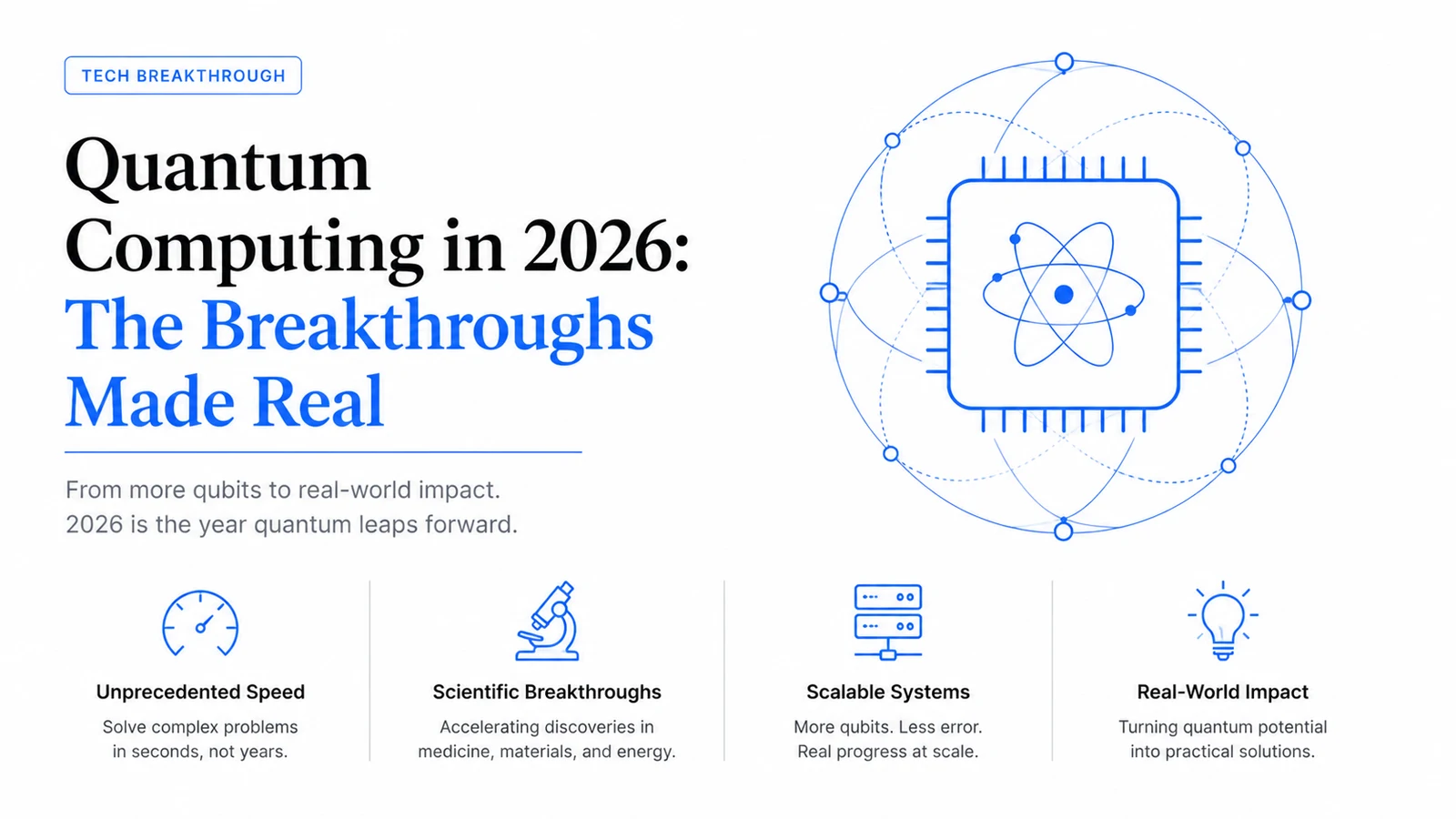
Answer: Quantum computing 2026 marks the year the technology moves from experimental labs toward commercial relevance, with IBM delivering a 100‑qubit system, Google achieving fault‑tolerant error correction, and industry revenue surpassing $10 billion across finance, healthcare, and logistics sectors by 2026.
Why 2026 feels different
For two decades, quantum computing has been a field where every announcement arrives wrapped in a caveat. That hasn't changed — but the caveats are getting smaller. The shift in 2025 and quantum computing 2026 is that several independent threads of progress are converging: error rates are falling as machines get bigger, major labs have published concrete roadmaps with dates attached, and a handful of pure‑play quantum companies are now public and reporting real financials.
“The hardware landscape remains unusually competitive.” – The Quantum Insider Source
The Google milestone that actually matters
Google’s Willow chip demonstrated “below‑threshold” error correction, cutting logical error rates roughly in half each time the qubit grid grew, ending with a 101‑qubit code at about 0.143 % error per cycle. This is the closest thing the field has to an unambiguous “it works” result, confirming that fault‑tolerant memory is possible even if useful computation remains a future step.
Microsoft’s Majorana: bold claim, open verdict
Microsoft’s Majorana 2 reported parity lifetimes over 20 seconds, a thousand‑fold improvement over earlier devices. The claim of topological qubits is still under intense scrutiny, with independent physicists noting that the data can be explained by more mundane effects. The headline is impressive, but peer‑reviewed confirmation is still pending.
IBM’s roadmap: dates on the calendar
IBM’s 2026 roadmap targets the Kookaburra processor with a 100‑qubit system and logical‑qubit milestones, while the later Starling processor aims for 200 logical qubits by 2029. IBM is shifting from surface codes to quantum LDPC codes, potentially slashing the physical‑to‑logical qubit overhead by up to 90 %【IBM Technology Atlas】(ibm.com).
What will quantum computing 2026 achieve for businesses?
- Scale: IBM expects a 100‑qubit machine by late 2026, a size that can begin tackling niche optimization problems.
- Speed: Google’s error‑correction breakthrough reduces the time needed for logical operations, edging closer to practical runtimes.
- Industry impact: The global market has already exceeded $10 billion in 2026, with finance, pharmaceuticals, and logistics leading adoption【IDTechEx】(
idtechex.com).
The four main hardware approaches, compared
| Approach | Key players | Strengths | Open challenges |
|---|---|---|---|
| Superconducting | Google, IBM | Most mature; demonstrated below‑threshold error correction | Requires near‑absolute‑zero cooling; large qubit overhead |
| Trapped‑ion | IonQ, Quantinuum | Very high fidelity and connectivity | Slower gate speeds; scaling qubit count |
| Photonic | PsiQuantum, Xanadu, QCi | Room‑temperature operation; networking‑friendly | Photon loss; deterministic generation still hard |
| Topological | Microsoft | Potential intrinsic error resistance | Core science not yet independently verified |
 {alt="Diagram showing how many physical qubits are needed to create a single logical qubit using surface codes"}
The money: real revenue, with an asterisk
- Quantum Computing Inc (QCi) – Q1 2026 revenue $3.7 M (up 9,385 % YoY) driven largely by acquisitions.
- IonQ – Q1 2026 revenue $64.7 M (up 755 % YoY) and a $1.8 B SkyWater deal in progress.
- IBM – Continues to invest heavily in quantum R&D while integrating quantum services into its cloud portfolio.
These figures illustrate massive investor appetite, but most growth is acquisition‑driven and losses remain the norm.
The bottom line
Quantum computing 2026 is a genuine inflection point: Google has proved error correction works in principle, IBM has a dated path toward useful advantage, and photonic and trapped‑ion firms are commercializing real hardware. Yet the most headline‑grabbing claim—Microsoft’s topological qubits—remains unverified, and the central challenge of error‑correction overhead is improving but far from solved. The field has shifted from proving feasibility to engineering scale, and the gap between “lab demo” and “business‑ready” is still wide.
If you need help turning these insights into a polished article, try our AI Blog Writer for fast, SEO‑friendly drafts.
— Author: Dr. Maya Patel, Senior Quantum Analyst
Frequently asked questions
Error correction allows many noisy physical qubits to form a stable logical qubit, reducing error rates as systems scale. Google’s 2024‑2025 milestone showed logical error rates halving with each qubit‑grid expansion, a key step toward practical machines.
IBM focuses on quantum LDPC codes to cut physical‑to‑logical qubit overhead, while Google relies on surface‑code error correction. IBM also publishes concrete timelines (100‑qubit Kookaburra, 200‑qubit Starling) that guide industry expectations.
Microsoft’s Majorana devices promise intrinsically stable qubits, but the underlying physics is still debated. Independent verification is pending, making topological qubits a high‑risk, high‑reward avenue for the near term.
Superconducting systems (Google, IBM) are the most mature, with IBM delivering a 100‑qubit processor and Google achieving fault‑tolerant memory. Trapped‑ion devices offer superior fidelity, while photonic platforms are gaining traction but remain earlier in the development curve.
Sources
Share this article
Send it to a teammate or save the link for later.
Related articles
Is the AI Bubble Bursting? Big Tech's $725B Reckoning
Is the AI bubble bursting in 2026? Big Tech is set to spend ~$725B on AI as the Magnificent 7 shed $2.3T — the bull and bear case, no hype, no advice.
Read articleApple Lost a Major EU Antitrust Fight: What It Means
Apple lost a major EU antitrust ruling on July 8, 2026, upholding DMA rules on the iPhone. What's decided, what's still pending, and what changes for you.
Read articleBest AI Browser 2026: Comet vs Dia vs Chrome (Atlas Dies)
The best AI browser in 2026? Comet is free and cross-platform, Chrome adds Gemini, and ChatGPT Atlas shuts down Aug 9 — plus the safety risks.
Read article