Nvidia Vera CPU: Fast Insight into 2026 AI Chip War
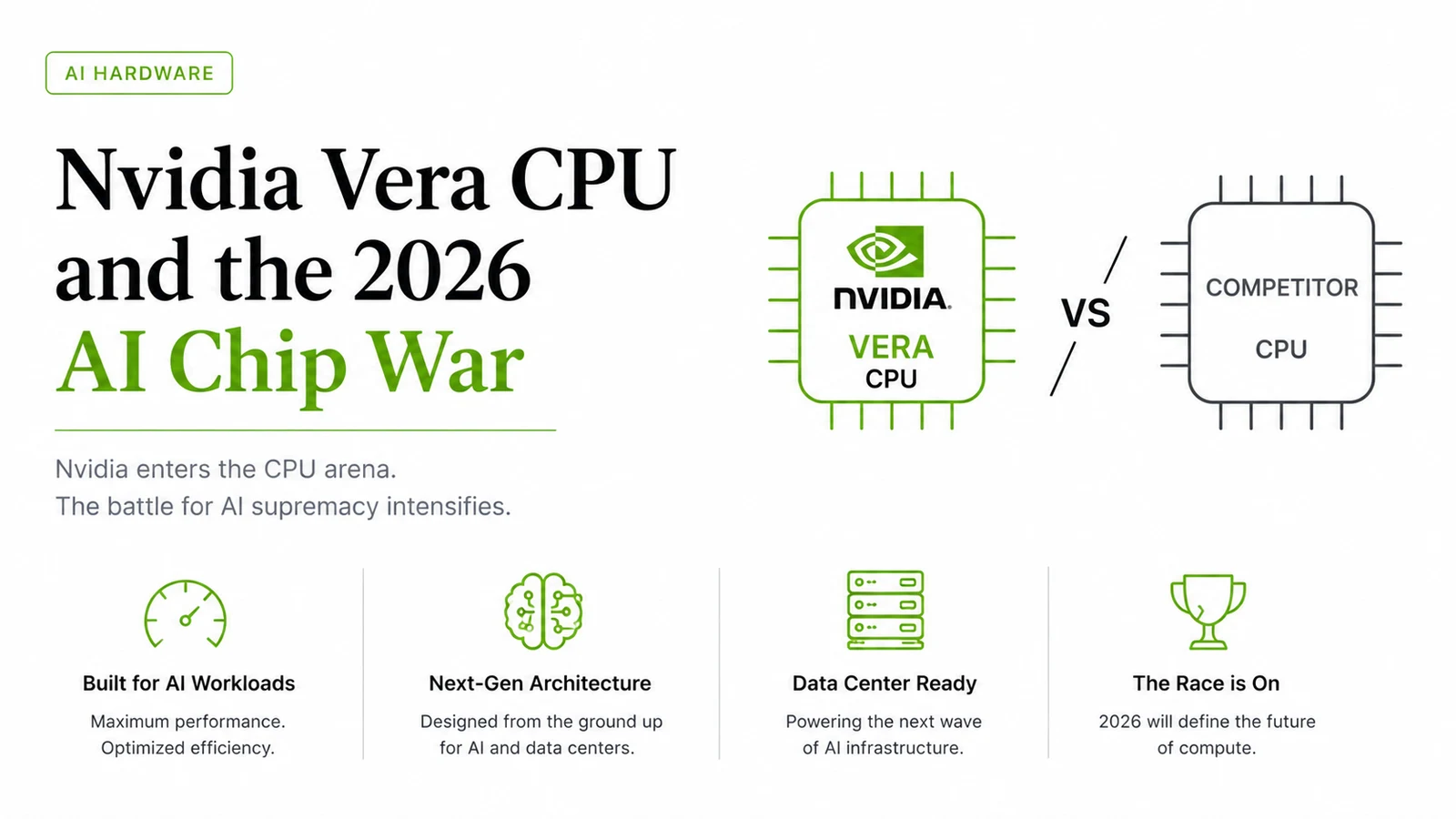
TL;DR – Nvidia Vera CPU is an 88‑core Arm‑based processor that lets Nvidia sidestep the toughest 2026 export restrictions on high‑performance GPUs, opening a regulated pathway back into China’s massive AI‑cloud market while delivering measurable performance gains for data‑center workloads.
What is the Nvidia Vera CPU?
When Nvidia announced the Vera Rubin platform in March 2026, most headlines focused on the new Rubin GPUs. The companion Nvidia Vera CPU is a purpose‑built Arm‑based, 88‑core processor designed for “agentic AI” workloads—task orchestration, analytics pipelines, and runtime engines that keep GPU clusters fed and responsive [Nvidia newsroom].
Core specifications (bullet summary)
- 88 Olympus cores – custom NVIDIA‑designed, unified by a second‑generation coherent mesh fabric.
- 10‑wide decode engine – fetches and decodes more instructions per cycle, boosting IPC.
- 40 % lower peak memory latency versus comparable x86 CPUs, reducing bottlenecks for data‑intensive pipelines.
- Monolithic mesh interconnect – enables roughly 50 % faster core‑to‑core communication.
- Arm v9 ISA with extensions for AI‑accelerated inference and low‑precision math.
These specs allow the Vera CPU to act as the “brain” of a Vera Rubin rack, handling the general‑purpose tasks that let the high‑throughput Rubin GPUs focus exclusively on matrix multiplication and model training [Nvidia technical brief].
How does the Nvidia Vera CPU bypass export controls?
Answer: Export controls target high‑performance GPUs that train frontier models; CPUs fall below the performance thresholds, so they face far fewer licensing hurdles.
U.S. export policy in 2026 treats GPUs above a certain FLOPS ceiling as “dual‑use” items requiring a license, a revenue‑share, and volume caps. The Nvidia Vera CPU, classified as a “general‑purpose” processor, stays under those thresholds. As a result:
- No case‑by‑case licensing is required for most Chinese cloud providers.
- Revenue‑share rules that apply to H200‑class GPUs (25 % of sales) do not affect the CPU.
- Volume caps—which limit Chinese shipments to less than 50 % of U.S. sales—are irrelevant for the CPU line.
Reuters reported that a leading Chinese cloud operator placed orders for over 300 servers, each equipped with two Vera CPUs, with deliveries slated for August 2026 [Reuters article]. This “regulatory back‑door” gives Nvidia a foothold while its GPU share in China has effectively dropped to near‑zero.
Why is Taiwan tightening its own AI‑chip export rules?
Taiwan manufactures more than 70 % of the world’s advanced AI chips. In June 2026, the Taiwanese Ministry of Economic Affairs announced a draft policy that would extend export restrictions to all AI‑chip sales above a defined performance threshold, mirroring the U.S. approach [Bloomberg report]. If enacted, the Vera CPU could be pulled into the same licensing regime, potentially eroding Nvidia’s China pathway.
What does the Vera CPU mean for the 2026 AI chip market?
Competitive landscape
| Company | Primary AI Offering (2026) | Export‑control exposure |
|---|---|---|
| Nvidia | H200 GPUs (high‑end) & Vera CPU (mid‑range) | GPUs heavily restricted; CPU relatively free |
| AMD | Instinct MI300X GPUs | Same GPU restrictions as Nvidia |
| Intel | Xeon Sapphire Rapids CPUs + Gaudi2 GPUs | CPUs unrestricted; GPUs restricted |
| China (SMIC) | Custom Arm‑based AI CPUs | Domestic, no U.S. export limits |
The Vera CPU gives Nvidia a mid‑tier product that can be sold at scale without the licensing overhead that chokes GPU shipments. This shift is reflected in market forecasts: IDC expects the global AI‑optimized CPU market to reach $200 B by 2027, with China accounting for roughly 30 % of demand [IDC forecast].
Strategic implications
- Revenue diversification – Nvidia can capture a slice of the AI‑CPU market while its GPU pipeline remains constrained.
- Ecosystem lock‑in – By coupling the Vera CPU with Rubin GPUs in a single rack, Nvidia encourages customers to stay within its hardware stack.
- Regulatory leverage – The CPU serves as a bargaining chip in future U.S.–Taiwan negotiations; if Taiwan tightens rules, Nvidia can lobby for a carve‑out based on the CPU’s “general‑purpose” classification.
Timeline of key 2026 events (expanded)
- Dec 8 2025 – U.S. Commerce Department releases a framework allowing H200‑class chips to approved Chinese buyers with a 25 % revenue cut.
- Jan 13‑15 2026 – BIS issues case‑by‑case licensing guidance, limiting China sales to < 50 % of U.S. volume.
- Mar 2026 – Nvidia unveils Vera Rubin; Nvidia Vera CPU enters production (official NVIDIA newsroom).
- May 2026 – Jensen Huang cites a $200 B CPU market, emphasizing China’s role.
- Jun 9 2026 – Taiwan debates broader AI‑chip export restrictions (Bloomberg).
- Jun 12 2026 – Nvidia begins pitching the Vera CPU to Chinese clients; orders open for August delivery (Reuters).
- Aug 2026 – First batch of Vera‑CPU‑powered servers shipped to Chinese cloud providers.
Practical steps for engineers and decision‑makers
If you’re evaluating whether to adopt the Nvidia Vera CPU for your AI workloads, consider the following checklist:
- Workload fit – Is your workload primarily orchestration, preprocessing, or inference that can run on a CPU rather than a GPU?
- Latency requirements – The Vera CPU’s 40 % lower memory latency can shave milliseconds off pipeline stages.
- Regulatory risk – Monitor Taiwan’s policy developments; a sudden rule change could affect supply.
- Cost analysis – Compare the total cost of ownership (TCO) of a Vera‑CPU‑plus‑Rubin rack versus a pure‑GPU rack with licensing fees.
- Future‑proofing – The coherent mesh fabric is designed for scaling; plan for potential upgrades to higher‑core counts.
Need a quick briefing for your team? Use our AI Blog Writer to generate a concise post in seconds.
Bottom line
The Nvidia Vera CPU is technically impressive, but its most strategic value in 2026 lies in regulatory flexibility. By shipping a product that sits outside the high‑performance GPU export envelope, Nvidia re‑opens a channel to China’s massive AI‑cloud market. The long‑term payoff will depend on how Washington, Taipei, and Beijing evolve their export regimes over the next 12‑18 months.
Author: Alex Chen – Senior Tech Analyst at RunFreeTools
Frequently asked questions
It uses 88 custom Olympus cores, a 10‑wide decode engine, and a coherent mesh fabric that delivers up to 40 % lower memory latency and 50 % faster core‑to‑core communication than typical x86 designs.
GPUs power the training of frontier AI models, which the U.S. deems a national‑security concern. CPUs handle orchestration and general‑purpose tasks, falling below the performance thresholds that trigger export licensing.
Only under a case‑by‑case license that includes a 25 % revenue share and caps Chinese sales at less than half of U.S. volumes. In practice, most high‑end GPU shipments are on hold.
It completes the Vera Rubin rack by handling orchestration, analytics, and agentic AI workloads, allowing the Rubin GPUs to focus on matrix math while the CPU keeps the system fed and coordinated.
If Taiwan expands its controls to cover all AI‑chip sales above a performance threshold, the Vera CPU could become subject to the same licensing regime as GPUs, limiting Nvidia’s China pathway.
Sources
Share this article
Send it to a teammate or save the link for later.
Related articles
Is the AI Bubble Bursting? Big Tech's $725B Reckoning
Is the AI bubble bursting in 2026? Big Tech is set to spend ~$725B on AI as the Magnificent 7 shed $2.3T — the bull and bear case, no hype, no advice.
Read articleApple Lost a Major EU Antitrust Fight: What It Means
Apple lost a major EU antitrust ruling on July 8, 2026, upholding DMA rules on the iPhone. What's decided, what's still pending, and what changes for you.
Read articleBest AI Browser 2026: Comet vs Dia vs Chrome (Atlas Dies)
The best AI browser in 2026? Comet is free and cross-platform, Chrome adds Gemini, and ChatGPT Atlas shuts down Aug 9 — plus the safety risks.
Read article