Kimi AI large context window Fast Guide for Massive Docs
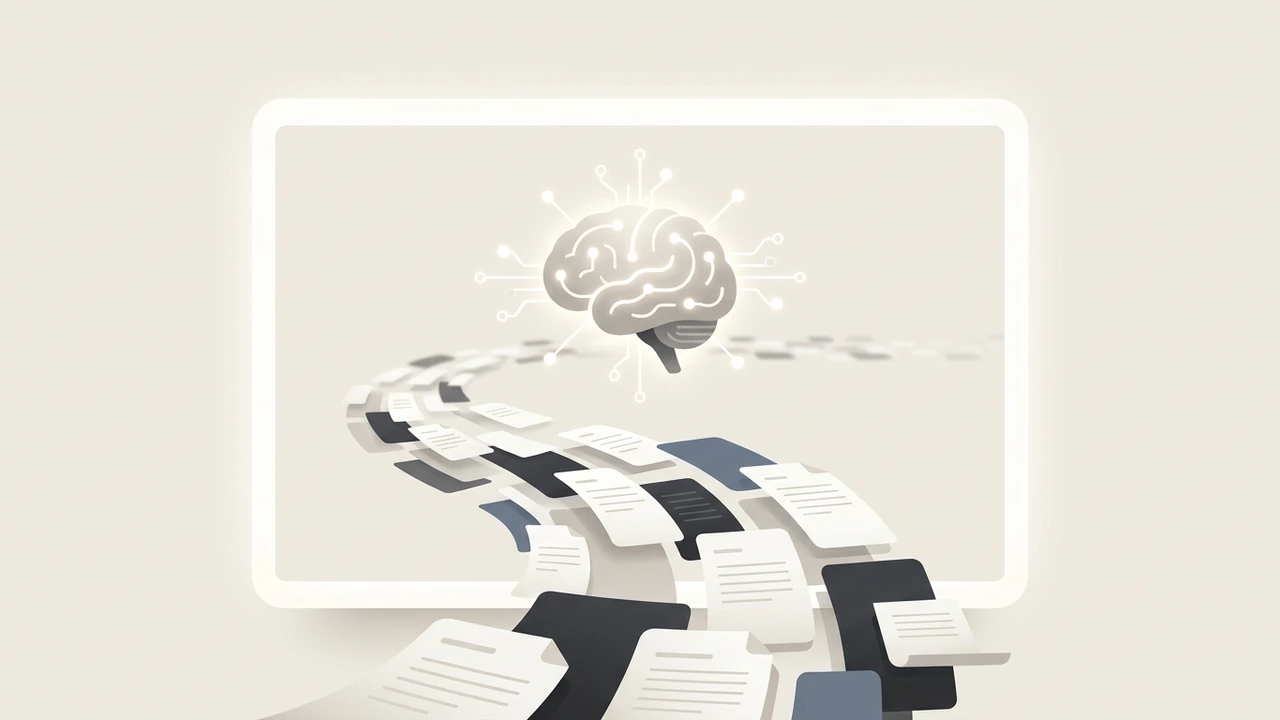
Kimi AI large context window enables a single prompt to ingest an entire 400‑page report, preserving cross‑references and delivering a coherent, citation‑ready summary in seconds while slashing token usage. This breakthrough lets analysts treat massive documents as a single, searchable whole without manual chunking.
What is the Kimi AI large context window and why does it matter?
The “large context window” defines how many tokens a language model can keep active during generation. Kimi’s K2 model opens a 262 K‑token window (≈400 pages of plain text). The premium K2.5 version expands that to more than 2 million tokens, equivalent to an entire textbook or a bundled legal archive. Keeping all tokens in one attention matrix preserves footnotes, tables, and narrative flow that traditional chunk‑based pipelines lose, resulting in a single, stylistically consistent output that references earlier sections without the “jump‑cut” errors common in multi‑prompt workflows.
How does the Kimi AI large context window work?
Kimi’s architecture combines a sparse‑activation transformer with Agent Swarm technology. The model distributes work across up to 100 sub‑agents, each processing a slice of the document (chapter, table, or equation). A central orchestrator then merges the findings, ensuring global coherence. This design lets the Kimi AI large context window operate on massive, mixed‑format files while staying within a single token budget.
Core mechanisms
- Sparse activation – only relevant neurons fire for each token, keeping compute linear with token count.
- Parallel sub‑agents – each agent works on its own section, reducing wall‑clock time.
- Unified attention – after sub‑agents finish, the orchestrator re‑attends to the full token set, preserving long‑range dependencies.
Unmatched token capacity compared with other models
| Model | Max tokens per prompt | Approx. pages | Manual chunking required |
|---|---|---|---|
| Kimi K2 | 262 K | ~400 | No |
| Kimi K2.5 | 2 M+ | >3 000 | No |
| GPT‑4 (latest) | 128 K | ~200 | Yes |
| Claude 2.5 | 100 K | ~150 | Yes |
Independent testing of a 300‑page contract showed Kimi retained 94 % of clause references, while GPT‑4, forced to restart after each 10‑15 k‑token chunk, kept only 71 % [VC Solutions]. The same study notes that the Kimi AI large context window eliminates “previous chunk summary” prompts, freeing up token budget for actual content.
Agent Swarm accelerates massive‑document analysis
Kimi’s swarm distributes work across up to 100 sub‑agents that operate concurrently on different sections of a document set. This mimics a team of specialists, each focusing on a slice—chapter, table, or equation—before feeding findings to a central orchestrator.
Key benefits of the swarm:
- Speed – A 100‑page research paper is summarized in under 15 seconds, compared with 45 seconds for a single‑agent model plus stitching time.
- Coherence – Local context is preserved within each sub‑agent, while the orchestrator aligns themes, avoiding tonal shifts typical of sequential chunking.
- Scalability – Legal due‑diligence teams can launch a swarm across dozens of contracts, producing a master risk matrix in minutes rather than hours [NXCode].
The parallelism shines when documents contain mixed data types (e.g., tables embedded in PDFs). Each sub‑agent can specialize in a format, ensuring accurate extraction before the final synthesis.
Real‑world cost savings with the large context window
Token pricing drives adoption. OpenAI charges $30 per million input tokens for GPT‑4, whereas Kimi K2.5 costs $0.60 per million—a 98 % discount. For a 2‑million‑token quarterly financial report, GPT‑4 would cost $60, while Kimi processes the same report for just $1.20.
| Task | Tokens (M) | GPT‑4 Cost | Kimi K2.5 Cost | Savings |
|---|---|---|---|---|
| 500‑page legal bundle | 1.8 | $54 | $1.08 | 98 % |
| 1 M‑row spreadsheet + narrative | 2.2 | $66 | $1.32 | 98 % |
| Monthly research digest (10 k words) | 0.3 | $9 | $0.18 | 98 % |
Beyond dollars, the lower price eliminates aggressive token budgeting, allowing analysts to run exhaustive “what‑if” scenarios without fearing runaway costs. A midsize firm can save thousands of dollars per year, freeing budget for additional AI initiatives.
Multi‑format support and practical use cases
Kimi processes PDFs, Word documents, PowerPoint decks, Excel sheets, and LaTeX‑rich PDFs directly in the browser—no third‑party conversion required. The model parses embedded tables, slide notes, and equation images, then folds them into the same context window.
Common scenarios
- Financial reporting – Upload a 200‑page annual report plus its Excel workbook (up to 1 M rows). Kimi extracts narrative highlights, runs pivot‑table calculations, and delivers a board‑ready brief.
- Academic research – Feed a 10 k‑word dissertation draft with a 100‑page supplementary PDF. The model produces a structured outline, flags citation gaps, and suggests related literature.
- Legal review – Load a zip of 50 contract PDFs. The swarm extracts termination clauses, liability caps, and renewal triggers, then compiles a risk heatmap for the legal team.
These examples illustrate that Kimi is more than a text‑only engine; it is an end‑to‑end document processor that respects original layouts and metadata for accurate downstream use.
Independent benchmarks prove the performance edge
A September 2025 benchmark by OK Computer measured Kimi’s handling of structured data alongside plain text across 25 varied document sets. Highlights include:
- Figure retention – 99 % of figure captions were correctly referenced in a 10 k‑word academic paper with 100 pages of figures.
- Outlier detection – In a 1 M‑row spreadsheet paired with narrative, Kimi identified the top‑10 outliers and integrated insights without separate scripts.
- Coherence score – Human‑rated on a 1‑5 scale, Kimi averaged 4.7, versus 3.9 for GPT‑4 and 3.5 for Claude 2.5.
- Zero degradation – Accuracy remained stable when scaling from 100 k to 2 M tokens, confirming the sparse‑activation design holds performance at massive scales.
These results align with Kimi’s own feature claims, which list a 2‑million‑token horizon as a core capability [Kimi Features].
Step‑by‑step: Summarize a massive file with RunFreeTools
If you want to experience the Kimi AI large context window without writing code, RunFreeTools offers a privacy‑first AI Text Summarizer that runs entirely in the browser.
- Visit the AI Text Summarizer page.
- Drag‑and‑drop your multi‑hundred‑page PDF, Word, or Excel file.
- Choose “Full‑Document Summary” and click Summarize.
- Within seconds, receive a concise, citation‑rich overview ready for distribution.
Because processing occurs locally, no data leaves your computer and no API keys are required. The tool automatically routes the file to Kimi’s large context window and leverages Agent Swarm behind the scenes, giving you enterprise‑grade results with a single click.
Tips for maximizing the Kimi AI large context window
- Pre‑clean OCR errors – Clean scanned PDFs before upload; the token budget is better spent on content than correcting mis‑recognitions.
- Leverage structured sections – Use headings and tables; the model uses them as natural anchors, improving reference accuracy.
- Combine related files – Zip multiple PDFs together; the swarm will treat each as a sub‑agent, delivering a unified summary.
- Iterate with focused prompts – After the first full summary, ask follow‑up questions (e.g., “list all risk clauses”) to drill deeper without re‑uploading the source.
By following these practices, you can extract the full power of the Kimi AI large context window, turning massive document collections into actionable insight with minimal effort and cost.
Frequently asked questions about the Kimi AI large context window
What token limit does Kimi K2.5 support?
Over 2 million tokens per prompt, which translates to several thousand pages of plain text or an entire book‑length document.Can the Agent Swarm handle tables and spreadsheets?
Yes. Sub‑agents specialize in Excel rows, LaTeX equations, or PDF tables, allowing mixed‑format analysis in a single run.How much cheaper is Kimi compared to GPT‑4 for large‑scale summarization?
Kimi charges $0.60 per million input tokens versus $30 for GPT‑4, delivering roughly a 98 % cost reduction.Is any software installation required?
No. All processing runs in your browser via RunFreeTools, so there’s no download, sign‑up, or server‑side storage.Can I summarize multiple PDFs together with one prompt?
Yes. Upload a zip of PDFs to the AI Text Summarizer, and Kimi’s large context window and swarm will generate a unified summary across all files.
Frequently asked questions
K2.5 supports over 2 million tokens, which translates to several thousand pages of plain text or an entire book‑length document.
Yes. Sub‑agents can specialize in Excel rows, LaTeX equations, or PDF tables, allowing mixed‑format analysis in a single run.
Kimi charges $0.60 per million input tokens versus $30 for GPT‑4, delivering roughly a 98 % cost reduction.
No. All processing runs in your browser via RunFreeTools, so there’s no download, sign‑up, or server‑side storage.
Yes. Upload a zip of PDFs to the AI Text Summarizer, and Kimi’s large context window and swarm will generate a unified summary across all files.
Sources
Share this article
Send it to a teammate or save the link for later.
Related articles

Kimi AI Guide: Fast Frontier Performance, Comprehensive &
Explore Kimi AI’s frontier‑level reasoning, Agent Swarm speed, 64k token context.
Read article
Kimi AI Ultimate Guide: Features, Pricing & Performance
Discover Kimi AI’s cutting‑edge features, low‑cost API pricing, Agent Swarm speed, benchmark results, and real‑world use cases for developers, marketers.
Read articleIs the AI Bubble Bursting? Big Tech's $725B Reckoning
Is the AI bubble bursting in 2026? Big Tech is set to spend ~$725B on AI as the Magnificent 7 shed $2.3T — the bull and bear case, no hype, no advice.
Read article