Which Jobs Is AI Replacing in 2026? Exposure Scores for 40+ Roles

RunFreeTools TeamJun 18, 202615 min read
Which Jobs Is AI Replacing in 2026? Exposure Scores for 40+ Roles

Which jobs is AI replacing in 2026?

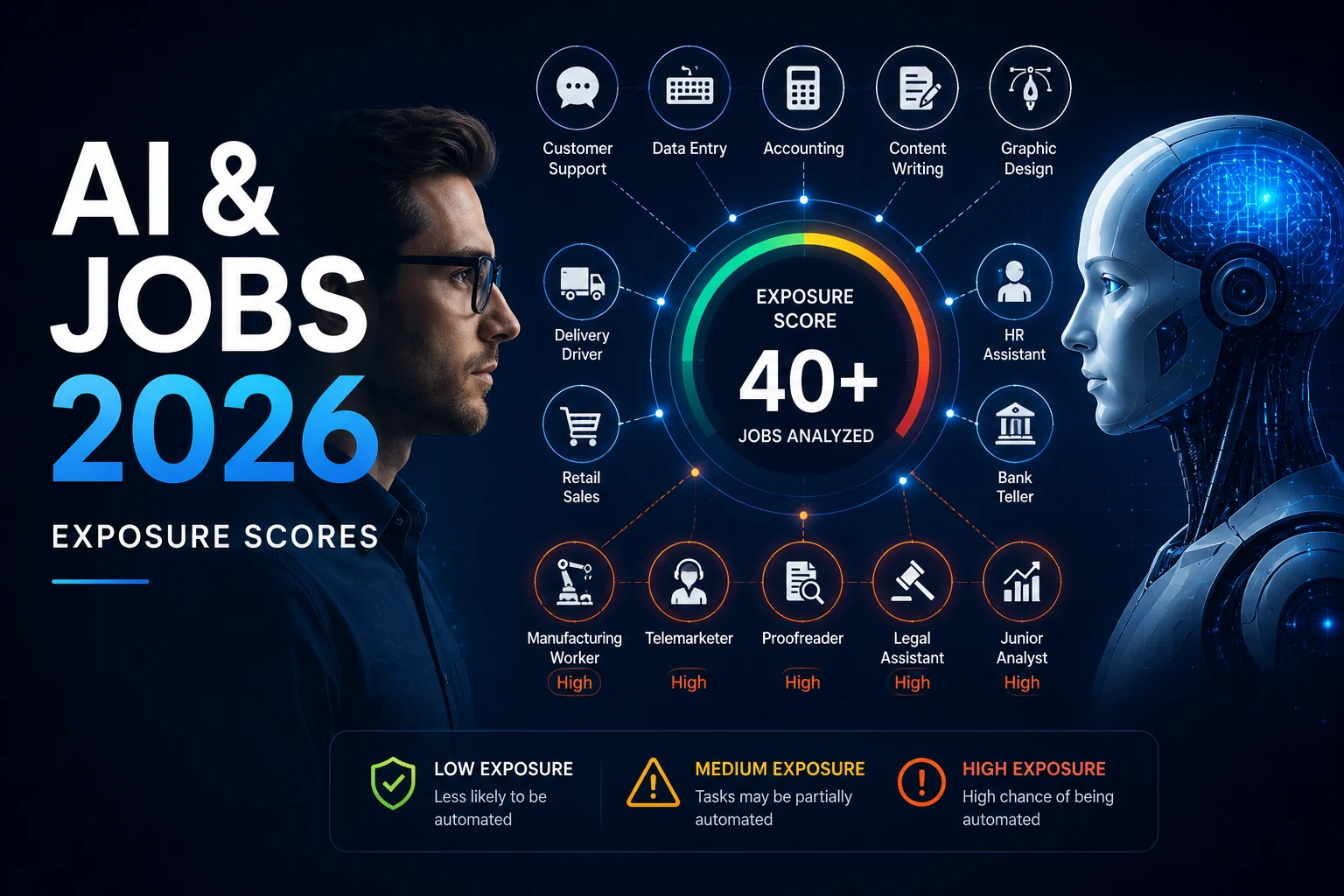
In 2026, AI is replacing tasks faster than whole jobs, and the tasks going first are repetitive screen work: data entry, basic copywriting, first-line customer support, routine bookkeeping, and junior coding. Stanford economists found early-career employment in the most AI-exposed roles fell about 13% since late 2022. Exposure is rising up the skill ladder, not down it.

That last point is what makes mid-2026 different. For most of the industrial era, machines took the routine, low-skill, physical jobs first. Generative AI has inverted that. The roles most exposed today are educated desk jobs that produce text, code, analysis, and decisions on a screen. The International Labour Organization, McKinsey, and Stanford have all landed on a version of the same finding, and it reshuffles who needs to pay attention.

The trigger is pace. The gap between frontier model releases collapsed over 2025 and into 2026. OpenAI shipped GPT-5 in August 2025; Google moved to Gemini 3 in November; Anthropic ran through Opus 4.5, 4.6, and 4.7 before shipping Opus 4.8 in late May 2026, with GPT-5.6 and Gemini 3.5 Pro landing in the same June window. Each release pushed the same direction: longer context, better reasoning, and crucially, agents that act inside everyday apps rather than just chatting in a box. When a model can browse, fill forms, run software, and complete a multi-step workflow, the unit of automation stops being "answer a question" and becomes "do the job." That shift, not any single model, is why the labor conversation got real this year.

This guide does three things. It explains how AI exposure is actually measured, so a score means something. It gives reasoned exposure scores for more than 40 roles, grouped from high-risk to AI-resistant. And it adds an India lens, because the IT services and BPO sector sits at the sharp end of this. The numbers here are grounded in published research, not invented precision, and the most important caveat is up front: exposure is not destiny.

How AI exposure is actually measured

"AI will take your job" is a headline. "47% of your tasks overlap with what current models can do" is a measurement. The difference matters, because credible exposure research scores tasks, not titles, then rolls those tasks up into an occupation. Four factors drive whether a task is exposed.

Task automatability. Can the work be specified clearly enough for a model to do it well? Writing a standard cover letter, reconciling invoices against a ledger, summarizing a contract, or generating boilerplate code are all highly specifiable. Calming a frightened patient or wiring an unfamiliar fuse box is not. The ILO's 2025 index and the Anthropic Economic Index both work bottom-up from tasks, which is why they capture nuance a "is this job safe?" poll never could.

Data availability. Models are strong where there is abundant digital training data and a clear feedback signal. Software, marketing copy, customer-support transcripts, and financial statements are richly represented online. Niche physical craft and tacit, relationship-heavy work are not, so they stay harder to automate even when individual steps look routine.

Regulation, licensing, and accountability. Some work legally requires a human who can be held responsible. A nurse practitioner, a licensed electrician, an auditor signing off, a lawyer of record. AI can draft and assist, but the liability and the license keep a person in the loop. This is one of the strongest moats, and it is institutional rather than technical.

Human trust and physical presence. Care, persuasion, negotiation, hands-on judgment in unpredictable environments. McKinsey's 2025 work is blunt here: social and emotional skills are simultaneously the hardest to automate and the fastest-growing in demand. Jobs that live in the physical world, or that depend on a human being trusting another human being, score low almost regardless of how clever the model gets.

Put those together and you get a spectrum, not a binary. The headline figures are sobering on their own terms. The World Economic Forum's Future of Jobs Report 2025 projects that by 2030, technology will displace roughly 92 million roles while creating about 170 million, a net gain of 78 million but with enormous churn underneath. McKinsey estimates AI agents could technically perform tasks that occupy around 44% of US work hours today. The ILO finds about a quarter of the global workforce sits in roles with measurable generative-AI exposure, though its very highest-exposure tier covers only about 3.3% of jobs. And Anthropic's own usage data shows 49% of jobs have already seen at least a quarter of their tasks touched by Claude.

Two cautions travel with every one of those numbers. First, technical potential is not a forecast. McKinsey is explicit that its figures reflect what could change in what people do, not a prediction of mass unemployment. Second, exposure cuts both ways: a task AI can do is also a task AI can help you do faster. On Anthropic's platform, augmentation (working alongside the model) recently edged ahead of full automation. Read the scores below as a map of pressure, not a countdown.

AI exposure scores for 40+ jobs, from safe to gone

The table groups roles by overall AI exposure, scored High, Medium, or Low on a reasoned basis. Scores reflect the four factors above and the direction of the WEF, ILO, McKinsey, Stanford, and Anthropic findings. They are judgments grounded in that research, not exact percentages, and individual jobs vary by employer, seniority, and how much of the role is routine. Treat the "why" column as the real signal.

Job / role AI exposure Why
Data entry clerk High Core task is reading documents and keying structured data, near-fully specifiable; among the highest-coverage tasks in usage data.
Basic copywriter / content mill writer High Generic SEO and product copy is exactly what language models produce cheaply; volume work is automated first.
First-line customer support agent (chat/email) High Scripted resolutions and FAQ handling map directly to support bots already deployed at scale.
Call-center / voice agent (routine queries) High Speech AI now handles common billing and status calls end-to-end; the sharpest exposure in BPO.
Telemarketer / outbound sales caller High Scripted, high-volume, low-trust outreach automates readily and cheaply.
Bookkeeper (routine) High Categorizing transactions and reconciling ledgers is rule-bound and data-rich.
Proofreader / basic copy editor High Grammar, consistency, and style fixes are a solved model task.
Translator (general, non-specialist) High High-quality machine translation covers most everyday text; specialist and certified work resists longer.
Paralegal / legal document reviewer High Contract review, discovery, and summarization are prime targets; the licensed lawyer stays, the routine review shrinks.
Junior / entry-level software developer High Code generation handles boilerplate; Stanford found early-career dev employment down sharply from its 2022 peak.
Market research analyst (survey/report) High Synthesizing sources into standard reports is squarely in model territory.
Travel agent (standard bookings) High Itinerary search and booking is automatable; complex, bespoke trips less so.
Transcriptionist High Speech-to-text is mature and cheap.
Junior graphic designer (template work) High Logos, social graphics, and template layouts are increasingly generated; brand strategy is not.
Email / inside sales SDR (qualifying) High Drafting, sequencing, and lead qualification are agent-friendly.
Loan / insurance underwriting clerk (rules-based) High Structured-criteria decisions automate well; edge cases and accountability stay human.
Medical coder / billing clerk High Mapping notes to standardized codes is pattern work AI handles.
Accountant / auditor (routine prep) Medium Statement prep and reconciliation are exposed, but sign-off, advisory, and regulated judgment protect the role.
Financial analyst Medium Modeling and memo drafting are assisted heavily; investment judgment and client trust remain human.
Mid-level software engineer Medium Productivity rises but system design, review, and ownership keep humans central; the role changes more than it shrinks.
Paralegal (litigation support, senior) Medium More judgment and client contact than document review; partly insulated.
Marketing manager Medium Execution tasks automate; strategy, brand, and cross-team coordination do not.
Journalist / reporter Medium Routine summaries are automatable; original reporting, sourcing, and accountability are not.
HR generalist / recruiter Medium Screening and scheduling automate; judgment, negotiation, and culture work persist.
Teacher / lecturer Medium AI assists prep and grading, but classroom trust, motivation, and care resist replacement.
Graphic designer (mid-level, brand) Medium Production speeds up; creative direction and client relationships are the durable core.
Project / operations manager Medium Reporting and tracking automate; stakeholder management and judgment do not.
Sales account executive (complex/B2B) Medium Admin and drafting automate; relationship selling and negotiation stay human.
Architect (design) Medium Drafting and iteration are assisted; site judgment, code compliance, and client trust remain.
Radiologist / diagnostic specialist Medium AI augments image reading strongly, but the licensed, accountable diagnosis stays with the physician.
Pharmacist Medium Dispensing logic automates; counseling, safety judgment, and licensing anchor the role.
UX / product designer Medium Mockups and copy are assisted; user research and product judgment are harder to hand off.
Lawyer (advisory/courtroom) Low Drafting is assisted, but advocacy, strategy, judgment, and being the attorney of record require a licensed human.
Registered nurse / nurse practitioner Low Hands-on care, clinical judgment, and patient trust in unpredictable settings resist automation.
Physician / surgeon Low Manual dexterity, complex diagnosis, and accountability keep humans firmly in the loop.
Therapist / counselor / social worker Low Built on human trust and emotional nuance, among the most AI-resistant work there is.
Electrician Low Hands-on work in variable physical environments; UK data puts automation probability near 16%.
Plumber / HVAC technician Low Diagnosis and repair in unpredictable real-world conditions; physical and non-specifiable.
Skilled construction trades (carpenter, welder) Low Dexterity and on-site judgment in changing conditions; hard to automate.
Childcare worker / early educator Low Care, safety, and human bonding cannot be delegated to software.
Elder care / home health aide Low Physical assistance plus trust; one of the fastest-growing and least automatable fields.
Chef / cook (non-fast-food) Low Creativity, taste, and physical execution in a live kitchen.
Emergency responder (firefighter, paramedic) Low Split-second judgment and physical action in chaotic environments.
Mechanic / field repair technician Low Hands-on diagnosis on varied equipment; physical and improvisational.
Senior leader / executive (people-facing) Low Vision, accountability, and trust-based decisions stay human even as analysis is AI-assisted.
Hairstylist / cosmetologist Low Physical skill plus personal trust and conversation.

A pattern jumps out. The high-exposure cluster is overwhelmingly desk work that turns inputs into outputs on a screen with a clear right answer. The low-exposure cluster is physical, licensed, or trust-based, often all three. The medium tier is where most professionals actually sit, and it is the most important group: these jobs are not disappearing, they are being rebuilt around AI, and the people who thrive will be the ones who direct the tools rather than compete with them.

One more honest note on the high-risk list. "High exposure" rarely means a role vanishes overnight. It means headcount stops growing, the easy entry-level rungs get pulled up, and remaining workers are expected to do far more with AI doing the grunt work. That is precisely the pattern Stanford observed: experienced workers in exposed fields held steady or grew, while workers aged 22 to 25 in the same fields saw real declines. The danger is less a sudden firing and more a quietly closing door for newcomers.

The India lens: IT services, BPO, and what stays safe

Nowhere is this more concrete than India, where IT services and business process outsourcing built a generation of middle-class careers on exactly the kind of routine, English-language, screen-based work that AI now does cheaply. India's BPO segment employs on the order of 1.65 million people in voice support, data processing, and back-office tasks. That is a lot of jobs sitting in the high-exposure column.

The signals are already visible. Reporting through 2025 documented Indian call-center workers being laid off and, in some cases, explicitly told AI had taken over their function. Investment bank Jefferies projected that AI adoption could cut Indian call-center revenue by roughly 50% and other back-office functions by about 35% over five years. Startups now pitch bots that handle the bulk of routine customer queries with a fraction of the headcount. Voice support, chat support, data entry, and basic content and SEO production are the most exposed lines of work.

There is a real second half to this story, though, and it is not just consolation. The same forces are creating demand for roles that sit one rung up. Contact centers are hiring for higher-value customer-experience specialists who handle the hard, emotional, or high-stakes cases bots escalate. There is fast-growing demand for AI trainers, prompt and workflow designers, people who build and supervise the automations, and engineers who can stand up AI systems on cloud infrastructure. The WEF data shows technology, data, and AI roles among the fastest-growing globally, and India's young, technical workforce is well placed to capture them if it reskills in time.

Safer bets within the Indian context follow the same logic as everywhere else. Work that requires licensed accountability (chartered accountants doing advisory rather than rote entries, not just bookkeeping), deep client trust (relationship-led sales and account management), genuine engineering depth (cloud, security, AI/ML, systems design over routine application coding), and anything physical or care-based (healthcare, skilled trades, which India also needs at scale). The move that protects an Indian IT or BPO worker is the same move that protects a worker anywhere: get above the routine layer that AI is absorbing, and get fluent in the tools doing the absorbing. For a practical playbook on income paths that lean into AI rather than fight it, see AI side hustles in India for 2026.

How to future-proof yourself

Exposure is a map of where the pressure is. What you do about it is the part you control. A few moves consistently separate people who get squeezed by AI from people who get leverage from it.

Move up the value chain, from tasks to outcomes. AI is brilliant at tasks and weak at owning results. The accountant who only prepares statements is exposed; the one who advises a business owner on what the statements mean is not. The developer who only writes functions is exposed; the one who designs the system and owns whether it ships is not. Ask what part of your job you would still be paid for if the routine 60% were free. Then do more of that.

Get genuinely good at directing AI. The new baseline skill is not "using AI," it is getting strong, reliable work out of it: knowing what to delegate, how to specify it, how to check the output, and where the tools fail. In most fields this is now expected rather than optional. Workers who direct AI well will quietly out-produce those who ignore it, and that gap is widening with every release.

Lean into what scores low. Human trust, physical presence, licensed accountability, creative and strategic judgment. If your current role is high-exposure, build a bridge toward work that has more of these. That can mean moving from production into client-facing or managerial work, picking up a credential that carries legal weight, or developing the relationship and judgment muscles that no model can hold a license to use.

Make your track record legible. When hiring slows in exposed fields, the people who move are the ones who can show concrete results, not just a list of duties. Frame your experience around outcomes you delivered and tools you command. A sharp, achievement-focused resume is the difference between getting filtered out and getting the interview. Our free AI resume builder helps you turn vague responsibilities into specific, quantified wins, and tailor the result to the role you are pivoting toward. If you are applying to programs or roles that ask for written statements, the AI essay writer can help you draft and refine a strong first version.

Stay clear-eyed about the hype. The same companies racing to ship agents have a strong incentive to overstate how much those agents can replace, and some of the "AI does your whole job" messaging is marketing dressed as inevitability. It is worth understanding the persuasion playbook before you panic-pivot; we break down some of those tactics in AI chatbot dark patterns in 2026. Make decisions on the published labor research, not on a product launch livestream.

The honest summary of mid-2026 is this. AI is not coming for "jobs" as a category; it is coming for tasks, and it is coming for them fastest in educated desk work that used to feel safe. That redraws the map, especially for newcomers and for routine roles in places like India's BPO sector. But the WEF still projects net job growth this decade, the ILO and McKinsey still expect transformation rather than wholesale replacement, and the through-line in every serious report is the same. The work that survives is the work that needs a human to be present, accountable, trusted, or genuinely creative. Build toward that, learn to drive the tools instead of racing them, and the pace that feels threatening starts to look like leverage.

Try the tool from this post

AI Resume Builder

ATS-optimized resume in 60 seconds.

Open AI Resume Builder

Frequently asked questions

The most exposed roles are text- and data-heavy desk jobs: data entry, basic copywriting, first-line customer support, routine bookkeeping, paralegal document review, and junior coding tasks. Stanford found early-career software roles fell nearly 20% from their 2022 peak. Repetitive screen work with clear right answers is automated first.

Jobs that combine physical presence, unpredictable environments, licensed accountability, or deep human trust resist automation best. Skilled trades (electricians, plumbers), nurses, therapists, surgeons, teachers, and frontline managers score low on exposure. McKinsey notes social and emotional skills are both the hardest to automate and the fastest-growing in demand.

AI is reshaping coding faster than almost any field, and entry-level developer hiring has dropped sharply. But it is automating tasks, not the whole job. Senior engineers who design systems, review AI output, and own production are still in demand. The squeeze is hardest on junior roles, so the path in has narrowed, not closed.

India's roughly 1.65 million BPO and call-center workers face the sharpest exposure. Analysts at Jefferies projected call-center revenue could fall about 50% and back-office work about 35% over five years as AI agents handle routine queries. Voice support and data entry are most exposed; higher-value CX, cloud, and AI roles are safer.

No. Exposure measures how many of your tasks AI could touch, not whether your role vanishes. The ILO and McKinsey both stress most jobs will be transformed, not eliminated. A high score is a signal to move toward judgment, relationships, and oversight work that AI cannot own, not a layoff notice.

Move up the value chain: own outcomes and judgment, not just tasks. Learn to direct AI tools well, build skills in areas needing human trust or physical presence, and document results clearly. A sharp, achievement-focused resume helps you pivot. Pair durable human skills with fluency in the AI tools your field now expects.

Share this article

Send it to a teammate or save the link for later.

Related tools

Related articles

A mailbox receiving new tools, guides and feature updates

New tools, straight to your inbox

A short note whenever we ship a new free tool or guide. No spam, unsubscribe in one click.

  • No spam
  • Unsubscribe anytime
  • Your email is safe
15min left