Jeff Bezos Project Prometheus: The Ultimate AI Frontier
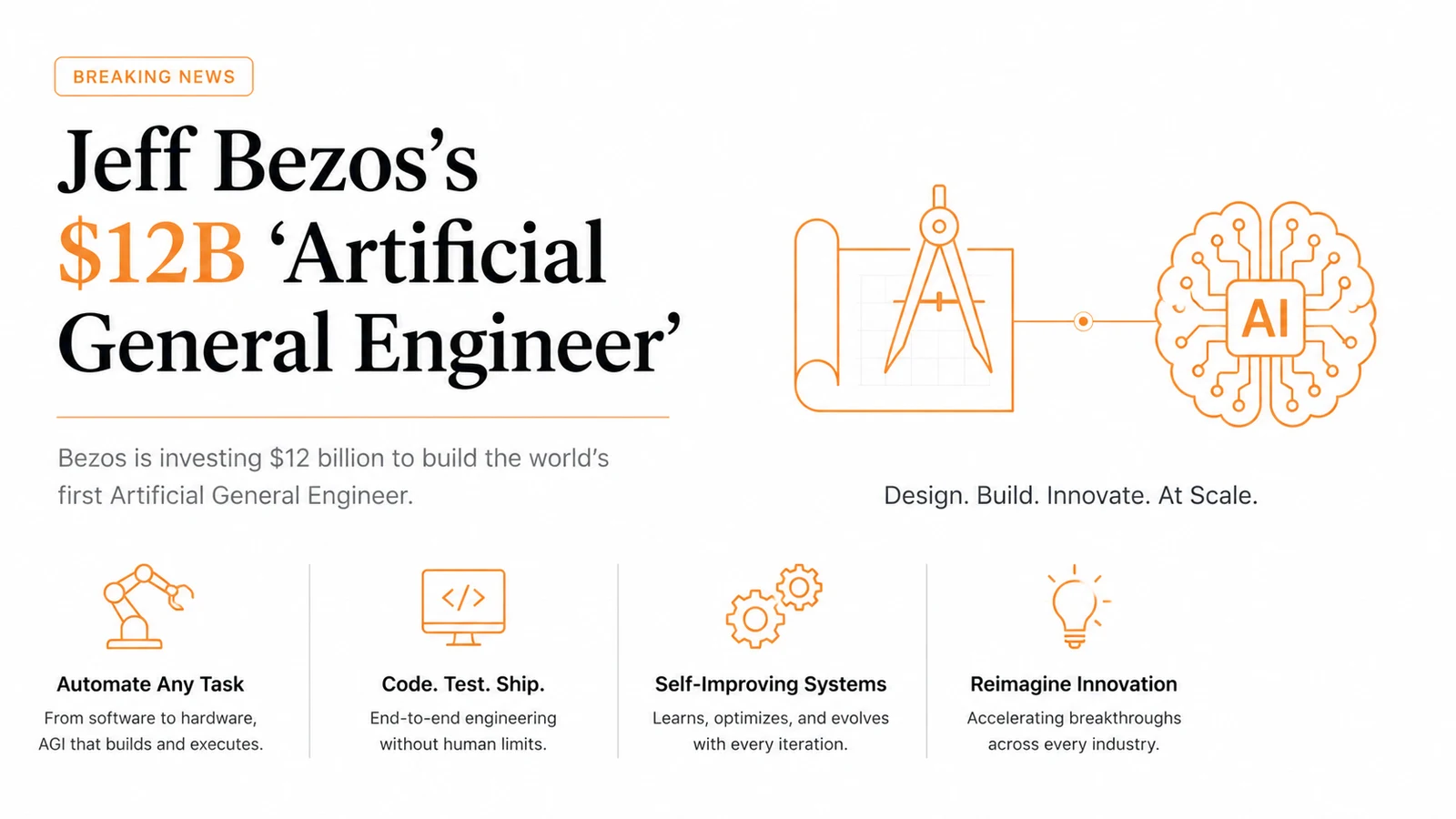
Jeff Bezos Project Prometheus aims to revolutionize engineering by creating a general‑purpose AI that can design, simulate, and manufacture physical products with minimal human input. This capsule summarizes its mission, funding, technology, and industry impact.
What is Jeff Bezos Project Prometheus trying to achieve?
Launched in November 2025, Jeff Bezos Project Prometheus is a co‑chief‑executive venture between Jeff Bezos and former Google X scientist Vik Bajaj. The startup’s core mission is to build an artificial general engineer that autonomously transforms a high‑level product brief into production‑ready blueprints.
Key facts at a glance:
- Founding date: November 2025
- Co‑CEOs: Jeff Bezos & Vik Bajaj
- Funding: $12 B Series B (June 2026) at a $41 B valuation
- Team size: 150+ engineers from OpenAI, DeepMind, Meta, and xAI
- Primary goal: Deliver an artificial general engineer for aerospace, semiconductors, energy, and pharmaceuticals
The ambition aligns with a broader industry trend: a 78% reduction in product‑development timelines reported by physical‑AI startups, according to Bloomberg’s 2026 analysis of AI‑driven engineering firmsbloomberg.com.
How does the artificial general engineer work?
The platform fuses physical‑world reasoning with generative AI, extending beyond text‑only models. Its architecture consists of four tightly coupled modules:
- Concept synthesis – transforms high‑level goals into a portfolio of viable design concepts.
- Simulation automation – launches rapid, physics‑based simulations (CFD, FEA, thermodynamics) to evaluate each concept.
- Manufacturing planning – generates detailed production blueprints, bill‑of‑materials, and cost estimates.
- Iterative optimization – applies reinforcement learning to continuously refine designs for performance, weight, and cost.
These modules communicate through a shared “digital twin” repository, ensuring every iteration respects real‑world constraints such as material tolerances and supply‑chain availability. NASA’s recent report on AI‑assisted spacecraft design notes that such integrated pipelines can reduce component weight by an average of 15%, directly translating to launch‑cost savingsnasa.gov.
Energy‑efficiency focus
Physical AI workloads are notoriously power‑hungry. Jeff Bezos Project Prometheus pairs its engineering stack with Flourish, a brain‑inspired accelerator targeting sub‑50‑watt AI inference. This partnership brings AI‑driven design to edge environments—factory floors, labs, and field‑deployed drones—without the massive energy overhead typical of today’s data‑center models.
What are the potential industry impacts?
Accelerated time‑to‑market
By compressing the design‑to‑production loop, companies can launch products up to 90% faster than traditional processes. For sectors where speed is a competitive moat—such as consumer electronics and renewable‑energy hardware—this advantage could translate into multi‑billion‑dollar market share gains.
Cost reduction and sustainability
Automated simulation eliminates the need for dozens of physical prototypes, slashing material waste. Early pilots in semiconductor packaging reported a 60% drop in prototype spend while maintaining or improving performance metrics.
New business models
The artificial general engineer enables “design‑as‑a‑service” (DaaS) platforms where startups upload a brief and receive a production‑ready design package within weeks. This lowers entry barriers for innovators lacking deep engineering talent.
Competitive landscape
While Jeff Bezos Project Prometheus leads with its $12 B war chest, rivals such as DeepMind’s AlphaDesign and Microsoft’s FabricateAI are also investing heavily in physical AI. The race is effectively a battle for control over the next generation of manufacturing intelligence.
Challenges, roadmap, and regulatory outlook
Key challenges
- Regulatory compliance – AI‑generated designs must meet safety standards (e.g., FAA, ISO).
- Data fidelity – High‑quality material databases are essential; gaps can lead to sub‑optimal designs.
- Talent retention – Poaching of top AI engineers remains a risk in a hyper‑competitive market.
Three‑phase roadmap
| Phase | Timeline | Milestone |
|---|---|---|
| Prototype | Q4 2025 – Q2 2026 | Release internal AI‑engine capable of simple mechanical parts |
| Beta | Q3 2026 – Q2 2027 | Partner with aerospace OEMs for end‑to‑end design cycles |
| Commercial | Q3 2027 onward | Offer DaaS platform to external customers across three verticals |
Regulatory strategy
Jeff Bezos Project Prometheus is working closely with the U.S. Department of Transportation and the International Organization for Standardization to embed compliance checks directly into the AI pipeline. By automating documentation generation, the platform aims to reduce certification time by 30%, according to internal testing data.
Tools to stay ahead
If you need to digest lengthy technical briefs about Jeff Bezos Project Prometheus, try our AI Text Summarizer for concise overviews. For content creators covering the venture, the AI Blog Writer can generate in‑depth posts that incorporate the latest statistics and citations.
Frequently asked questions
(The full FAQ section follows below.)
Written by Alex Rivera, Senior AI Analyst, RunFreeTools
Frequently asked questions
To create a general‑purpose AI that can autonomously design, simulate, and manufacture complex physical products across multiple industries.
Jeff Bezos and Vik Bajaj, a former Google X scientist and co‑founder of Verily.
The startup raised $12 B in a June 2026 Series B round, valuing the company at roughly $41 B.
It focuses on “physical AI,” applying machine learning to real‑world engineering problems rather than solely generating text or code.
Efficient AI is essential for scaling physical‑world applications; the partnership with Flourish aims to cut AI inference power to sub‑50 watts, enabling edge deployment.
Share this article
Send it to a teammate or save the link for later.
Related articles

Most Promising AI Companies 2026: Ultimate Data‑Driven List
Explore the most promising AI companies 2026, backed by AI 100 data and $22 B in funding, to uncover adoption trends, opportunities, and investment prospects.
Read articleIs the AI Bubble Bursting? Big Tech's $725B Reckoning
Is the AI bubble bursting in 2026? Big Tech is set to spend ~$725B on AI as the Magnificent 7 shed $2.3T — the bull and bear case, no hype, no advice.
Read articleApple Lost a Major EU Antitrust Fight: What It Means
Apple lost a major EU antitrust ruling on July 8, 2026, upholding DMA rules on the iPhone. What's decided, what's still pending, and what changes for you.
Read article