Humanoid Robots 2026: Explosive Growth Unleashed Market
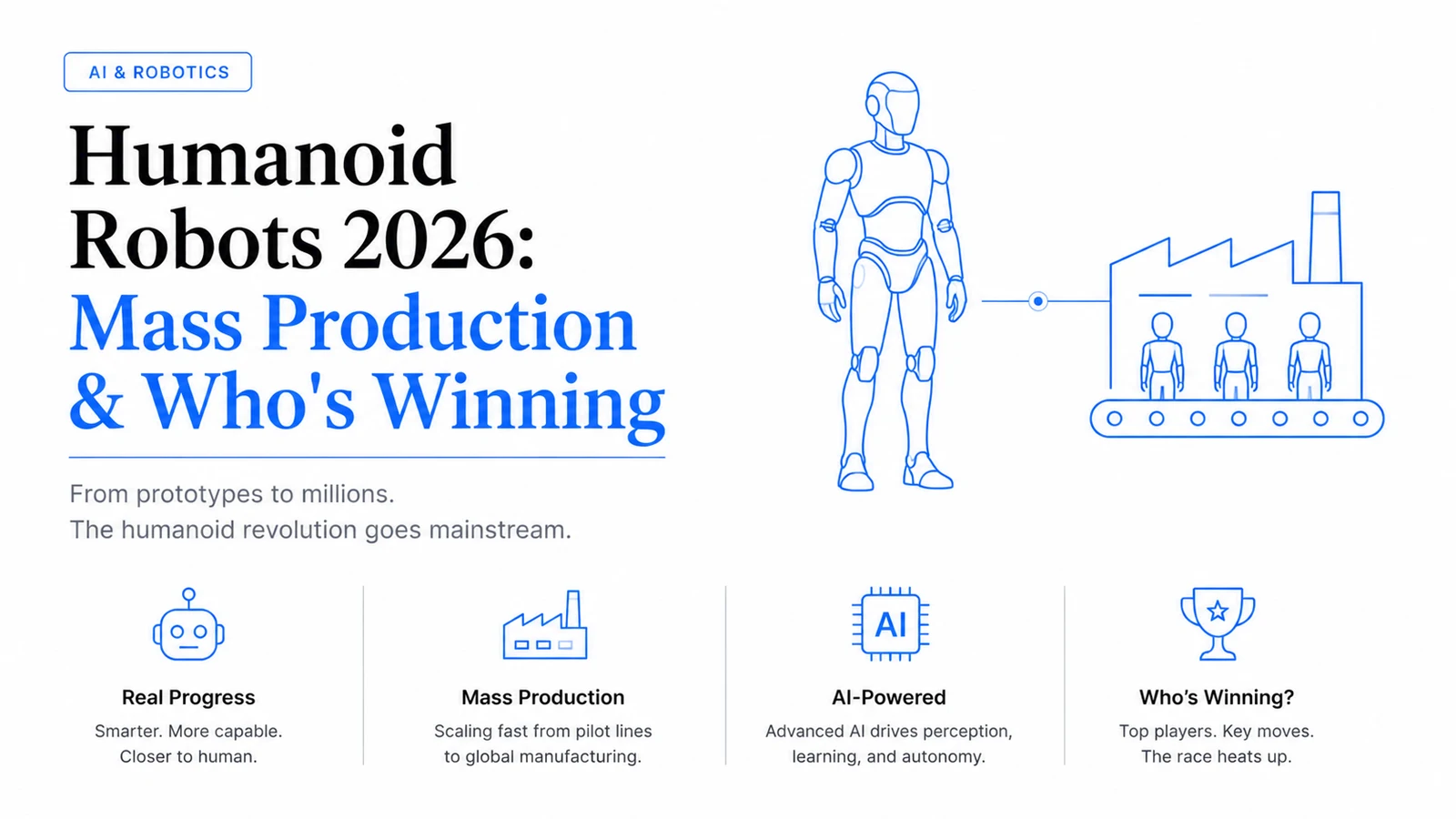

Answer: Humanoid robots 2026 have moved from laboratory demos to full‑scale production lines, with Chinese manufacturers delivering sub‑$6,000 units while Western firms secure multi‑month factory deployments, proving the technology’s commercial viability across continents.
What are the biggest trends for humanoid robots 2026?
- Mass‑production in China – TrendForce predicts a 94 % surge in domestic output this year, driven by Unitree and AgiBot, which together aim for ≈80 % of global shipments
humanoidroboticstechnology.com.
- Western depth of deployment – Companies like Figure, Apptronik, and Tesla are proving reliability on real assembly lines, turning pilots into long‑term contracts.
- Price compression – The R1 from Unitree starts at $5,900, making humanoid robots affordable for midsize manufacturers.
- AI‑native control – Platforms that learn by demonstration (e.g., Standard Bots) are lowering integration costs and speeding up adoption.
- Safety‑first design – New ISO‑10218‑2 extensions and built‑in force‑limiting actuators are being adopted to meet stricter workplace safety standards.
These forces converge to push humanoid robots 2026 from novelty to mainstream industrial tool.
Humanoid robots 2026: Production numbers and pricing
China’s “EV playbook” now guides robot factories. The 14th Five‑Year Plan explicitly lists humanoid robotics as a key industrial area, unlocking subsidies for component suppliers and test facilities. The result? A dense supply chain that lets firms swap locally sourced actuators, sensors, and batteries, driving unit costs down.
| Maker | Model | 2026 Output Goal | Indicative Price |
|---|---|---|---|
| Unitree | R1 / G1 | 20 K units (target) | From $5,900 (R1) |
| AgiBot | A2 | 10 K units shipped (Mar 2026) | Not disclosed |
| UBTech | Walker S2 | 5 K units (pilot) | Enterprise tier |
| Tesla | Optimus Gen 3 | 1 000+ on Fremont line | $20‑30 K (estimate) |
| Figure AI | Figure 03 | BMW pilot, home model in dev | ≈$20 K at scale |
| Apptronik | Apollo | Mercedes & GXO pilots | Enterprise tier |
| Standard Bots | RO1 | Scaling U.S. production | Low five‑figure range |
Prices vary by configuration and volume discounts.
The data underscores why humanoid robots 2026 are now a cost‑competitive option for many factories.
How Western players are proving value on the shop floor
- Figure AI logged 1 250 hours and moved 90 000 parts at BMW’s Spartanburg plant, showing endurance and precision over an 11‑month run.
- Apptronik’s Apollo handles tote transport and component inspection for Mercedes‑Benz and logistics leader GXO, highlighting versatility in intralogistics.
- Tesla’s Optimus operates on the Fremont production line, with over 1 000 units already active, though the company missed its 5 000‑unit 2025 target.
- Standard Bots recently raised $200 M at a $1 B valuation, expanding its New York facility to 70 000 sq ft and targeting 10 % of new U.S. industrial robot deployments.
These deployments demonstrate that while China wins on volume, the West is building trust through performance and integration depth.
Tip: Want to stay ahead of the fast‑moving robotics landscape? Our AI Blog Writer can help you generate timely posts on the latest robot releases.
What challenges do humanoid robots face in 2026?
- Energy density – Battery technology still limits continuous operation to under five hours for most platforms, prompting research into solid‑state cells.
- Regulatory harmonisation – Different safety certifications across the EU, US, and China create friction for manufacturers seeking global sales.
- Skill shortage – Deploying, programming, and maintaining complex humanoids requires a new breed of robotics technicians, a talent pool that is currently thin.
- Cost of perception – High‑resolution LiDAR and depth cameras remain expensive, inflating the bill of materials for vision‑heavy models.
Addressing these hurdles will dictate which companies can sustain growth beyond 2026.
The role of AI and sensor fusion in next‑gen humanoids
Modern humanoids rely on a tight loop of perception‑decision‑action:
- Multi‑modal sensing – Stereo vision, infrared, tactile arrays, and force‑torque sensors feed a unified data bus.
- Edge AI inference – On‑board GPUs and dedicated neural‑processing units (NPUs) run transformer‑based models for gait adaptation, object recognition, and human‑robot interaction in real time.
- Learning‑by‑demonstration – Platforms such as Standard Bots let technicians record a task once; the robot then generalises the motion using reinforcement learning, cutting integration time by up to 60 % (see the March 2026 Robot Report for a detailed case study)
therobotreport.com.
These AI advances are the primary reason why humanoid robots 2026 can operate safely alongside human workers without extensive offline programming.
Regulatory landscape and safety standards
The International Organization for Standardization (ISO) released ISO 10218‑2:2023 Amendment 1 in late 2025, tightening limits on collaborative force and mandating real‑time monitoring of joint torques. In the United States, the National Institute of Standards and Technology (NIST) issued a draft “Robotics Safety Framework” that aligns with the new ISO clauses and recommends third‑party certification for all commercial humanoids.
Both documents stress:
- Force‑limiting actuators that stop motion if contact exceeds 10 N.
- Redundant safety‑stop circuits that trigger within 10 ms of fault detection.
- Transparent data logging for post‑incident analysis.
Compliance is now a prerequisite for any manufacturer hoping to sell beyond pilot projects, and it explains why many Western firms are emphasising safety‑by‑design in their 2026 roadmaps.
Visualizing the supply‑chain advantage (illustration)

The illustration above captures how localized sourcing trims lead times and reduces logistics costs—a key factor behind the sub‑$6 K price points for many humanoid robots 2026.
Future outlook: 2027 and beyond
- Hybrid‑manufacturing hubs – Expect joint China‑US facilities that combine low‑cost Chinese components with Western AI software, creating “best‑of‑both‑worlds” robots.
- Service‑robot expansion – Beyond factories, the home‑care market is projected to adopt at least 15 K units of the NEO home robot (pre‑orders opened by 1X) by 2027, signalling a new revenue stream
1x.tech.
- Legislative incentives – The European Union’s “Robotics for Green Industry” program will subsidise up to 30 % of capital expenditures for humanoids that improve energy efficiency, potentially accelerating adoption in automotive and aerospace plants.
The momentum built in 2026 suggests that humanoid robots will become an integral part of global manufacturing ecosystems, with price, performance, and safety all moving in the right direction.
Author: Alex Rivera, Senior Robotics Analyst
Frequently asked questions
A combination of Chinese government support, a dense local supply chain, and aggressive pricing from firms like Unitree and AgiBot have propelled a 94 % output increase, while Western firms focus on proven factory deployments.
Unitree’s R1 model starts at about **$5,900**, making it one of the most affordable options on the market today.
Figure AI at BMW, Apptronik’s Apollo with Mercedes‑Benz and GXO, Tesla’s Optimus on the Fremont line, and Standard Bots with customers like Amazon and NASA.
Yes, the “Top 12 Humanoid Robots of 2026” article and the “Humanoids conquered CES 2026” coverage both detail the rapid market expansion and key players【https://humanoidroboticstechnology.com/articles/top-12-humanoid-robots-of-2026】【https://humanoid.guide/humanoids-ces-2026】.
Use tools like our **AI Blog Writer** to generate regular updates, and follow industry newsletters that track releases and deployments.
Sources
Share this article
Send it to a teammate or save the link for later.
Related articles
Is the AI Bubble Bursting? Big Tech's $725B Reckoning
Is the AI bubble bursting in 2026? Big Tech is set to spend ~$725B on AI as the Magnificent 7 shed $2.3T — the bull and bear case, no hype, no advice.
Read articleApple Lost a Major EU Antitrust Fight: What It Means
Apple lost a major EU antitrust ruling on July 8, 2026, upholding DMA rules on the iPhone. What's decided, what's still pending, and what changes for you.
Read articleBest AI Browser 2026: Comet vs Dia vs Chrome (Atlas Dies)
The best AI browser in 2026? Comet is free and cross-platform, Chrome adds Gemini, and ChatGPT Atlas shuts down Aug 9 — plus the safety risks.
Read article