Gemini vs ChatGPT Ultimate AI Showdown 2026 Comparison

Gemini vs ChatGPT is the most asked‑for comparison for anyone choosing a free, browser‑based AI in 2026. Gemini delivers a massive 1 million‑token context window and native multimodal input, while ChatGPT offers tighter conversational flow and a mature plugin ecosystem. Your decision hinges on the task, data‑privacy needs, and how you plan to integrate the model into daily workflows.
What is the difference between Gemini vs ChatGPT?
Gemini is Google’s flagship generative model, built on the Gemini 3 family (Flash, 3.1 Pro, etc.). It launched under the “Gemini” name in February 2024 after the Bard rebrand and supports text, images, video, audio, and PDFs in a single prompt — a capability Google calls “multimodal native support” TechTarget.
ChatGPT runs on OpenAI’s GPT‑5 series (the flagship GPT‑5.4 and the lighter GPT‑5 nano for free users). Since its public debut in November 2022, it has become the de‑facto conversational AI, praised for fluid dialogue, creative writing, and robust code assistance PCMag.
Both platforms are free to use directly in the browser, require no mandatory sign‑up, and keep data local whenever possible—a core principle of RunFreeTools’ privacy‑first philosophy.
Which free AI wins: Gemini or ChatGPT?
The short answer: it depends.
- Choose Gemini when you need to process large documents, embed images or video, or work inside Google Workspace.
- Choose ChatGPT when conversational nuance, step‑by‑step reasoning, or a mature code‑generation assistant are top priorities.
Below we break down the decisive factors.
Core capabilities comparison
| Feature | Gemini (Free) | ChatGPT (Free) |
|---|---|---|
| Multimodal input | Text + images + video + audio + PDF in one prompt (Gemini 3.1 Pro) | Text + image (limited Vision mode) |
| Context window | 1 million tokens (≈8× larger than ChatGPT) | Up to 128 K tokens |
| Real‑time web access | Built‑in live search, always fresh | Requires browsing plugins; otherwise static |
| Google ecosystem integration | Direct access to Drive, Docs, Gmail, Maps | No native Google integration |
| Coding assistance | Good, but less polished than ChatGPT | Clean Python, TypeScript, Rust snippets; superior debugging |
| Free‑tier limits | Higher daily message quota; 30 image generations per day | Lower daily quota; image generation limited to Vision mode |
| Plugin ecosystem | Emerging, focused on Google services | Mature marketplace with 100+ third‑party plugins |
Highlighted strengths
- Multimodal native support – Gemini can ingest a PDF, an image, and a short audio clip in a single request, eliminating the need for separate conversions.
- Massive context window – 1 million tokens let you feed entire books or hours of podcast transcripts without truncation, a game‑changer for research‑heavy workflows.
- Google Workspace hooks – Gemini can fetch a Google Sheet, summarize its data, and write a report directly back to Docs, all without leaving the chat.
Pricing, limits, and free‑tier details
Both services monetize premium tiers, but their free tiers remain robust for most individual users.
- Gemini: Unlimited text prompts, up to 30 image generations per day, and the full 1 million‑token context. Real‑time web search is unrestricted. In May 2024 Google rolled out Gemini 1.5 Pro to free users, and later Gemini 2.0 in December 2024, keeping the free tier competitive Zapier.
- ChatGPT: The free plan provides access to GPT‑5 nano, capped at 25 messages per 3 hours, with a 128 K token context window. Image generation is limited to Vision mode, and browsing plugins must be enabled manually. Full‑model access (GPT‑5.4) starts at $20 per month.
Statistically, ChatGPT reached 1 million users within five days of launch Learn G2, underscoring its rapid adoption. Gemini, while newer, leverages Google’s existing user base and reports 8× higher token capacity for free users LabelYourData.
Real‑world use cases: when to pick Gemini
Gemini shines in scenarios that demand large‑scale, multimodal analysis:
- Academic research – Upload a PDF of a research paper, embed a related figure, and ask Gemini to synthesize a literature review across multiple sources in a single prompt.
- Marketing asset creation – Combine a product image, a short video clip, and a brand‑guideline PDF; Gemini can generate cohesive ad copy and a storyboard instantly.
- Data‑driven reporting – Pull a Google Sheet, ask Gemini to run pivot tables, and output a polished report directly into Google Docs.
- Legal document review – Feed a contract PDF (hundreds of pages) and let Gemini highlight risk clauses while preserving original formatting.
Real‑world use cases: when to pick ChatGPT
ChatGPT excels where conversation flow, creativity, and code precision matter:
- Creative writing – Draft novels, poetry, or screenplay dialogues with nuanced character voices.
- Software development – Generate clean, lint‑ready code snippets in Python, TypeScript, or Rust, and receive step‑by‑step debugging advice.
- Customer‑support bots – Leverage the mature plugin ecosystem to integrate with ticketing systems like Zendesk or Freshdesk.
- Learning and tutoring – Benefit from ChatGPT’s Socratic questioning style to explore complex topics interactively.

Performance and accuracy: recent benchmarks
Independent benchmarks in early 2026 show that Gemini’s multimodal reasoning scores 12 % higher on the Visual‑QA suite, while ChatGPT outperforms Gemini by 8 % on pure‑text reasoning tasks such as logical puzzles and code generation PCMag.
- Gemini’s real‑time web search reduces “knowledge‑staleness” errors by 35 % compared to ChatGPT’s static model, which can miss recent events unless a browsing plugin is active.
- ChatGPT’s token‑level temperature control yields more consistent creative tone across long passages, a subtle but measurable edge for storytelling.
Privacy and data handling
Both models claim to respect user privacy, but their architectures differ:
| Aspect | Gemini | ChatGPT |
|---|---|---|
| Data storage | Session data is retained for 30 days for service improvement; no permanent user profiles for free tier. | OpenAI stores conversation logs for 90 days, with an opt‑out for API users only. |
| Local processing | Runs inference in Google’s edge network; most data never leaves the user’s region. | Primarily cloud‑based; data traverses OpenAI’s data centers in the US and EU. |
| Compliance | GDPR‑ready, CCPA‑compatible, and supports enterprise‑grade data‑loss‑prevention contracts. | Also GDPR‑ready, but recent audits highlight occasional cross‑border data transfers. |
If strict residency is required, Gemini’s edge‑network model gives it a slight advantage.
Developer access and API considerations
While the article focuses on free, browser‑based usage, many power users eventually need API access.
- Gemini API – Offers a pay‑as‑you‑go model with a free quota of 5 M tokens per month. Supports multimodal endpoints, making it attractive for apps that need on‑the‑fly image or video analysis.
- ChatGPT API – Provides per‑token pricing (≈$0.0002 per 1 K tokens) and a robust “function calling” feature that lets developers define structured outputs. The ecosystem includes extensive SDKs for Python, Node, and Java.
For most hobbyists, staying in the browser avoids any cost, but the API landscape is worth monitoring as both platforms evolve.
How to combine both for maximum productivity
Many power users treat Gemini and ChatGPT as complementary tools rather than rivals. A typical workflow might look like this:
- Gather raw data – Use Gemini to ingest PDFs, images, and live web results in one prompt.
- Summarize and outline – Ask Gemini to produce a concise outline of the material.
- Refine language – Switch to ChatGPT for stylistic polishing, tone adjustment, and creative flair.
- Code or plugin integration – If the output needs automation, let ChatGPT generate the necessary script or API call.
- Publish – Export the final draft to your platform of choice.
If you need to turn that polished article into SEO‑ready content, try our AI Blog Writer. It can ingest the ChatGPT‑refined text, suggest headings, add meta tags, and ensure the article meets 2026 SEO best practices—all without leaving the browser.
Future outlook: what’s next for Gemini and ChatGPT?
Both giants are investing heavily in next‑generation models:
- Gemini – slated to introduce Gemini 3.2 Ultra in Q4 2026, promising native 4K video analysis and a 2 million‑token context window.
- OpenAI – plans to roll out GPT‑6 with “dynamic recall” that updates knowledge nightly, narrowing the real‑time gap with Gemini.
The competition will likely drive higher free‑tier limits, tighter privacy controls, and more seamless cross‑platform integrations. Users who stay flexible—leveraging each model’s strengths—will reap the biggest benefits.
Quick comparison table
| Category | Gemini (Free) | ChatGPT (Free) |
|---|---|---|
| Token limit | 1 M | 128 K |
| Multimodal | Text, image, video, audio, PDF | Text + image (Vision) |
| Live web | Built‑in search | Plugin required |
| Google integration | Native | None |
| Code quality | Good | Excellent |
| Plugin count | ~20 (Google‑centric) | >100 (varied) |
| Privacy edge | Data stays regional | Global cloud storage |
Frequently asked questions
Gemini offers a 1 million‑token context window, about eight times larger than ChatGPT’s 128 K token limit.
Yes. Gemini 3.1 Pro processes video natively in the free tier, while ChatGPT’s free plan only supports limited image vision.
It hit 1 million users within five days of its November 2022 launch.
Yes—use Gemini for data gathering and multimodal tasks, then switch to ChatGPT for creative polishing; tools like our AI Blog Writer can streamline the handoff.
Both Gemini and ChatGPT can be accessed directly in the browser without mandatory sign‑up, aligning with RunFreeTools’ privacy‑first approach.
Sources
Share this article
Send it to a teammate or save the link for later.
Related articles
DeepSeek vs ChatGPT: The Ultimate Comparison Guide
Discover how DeepSeek stacks up against ChatGPT in speed, reasoning, and content quality.
Read article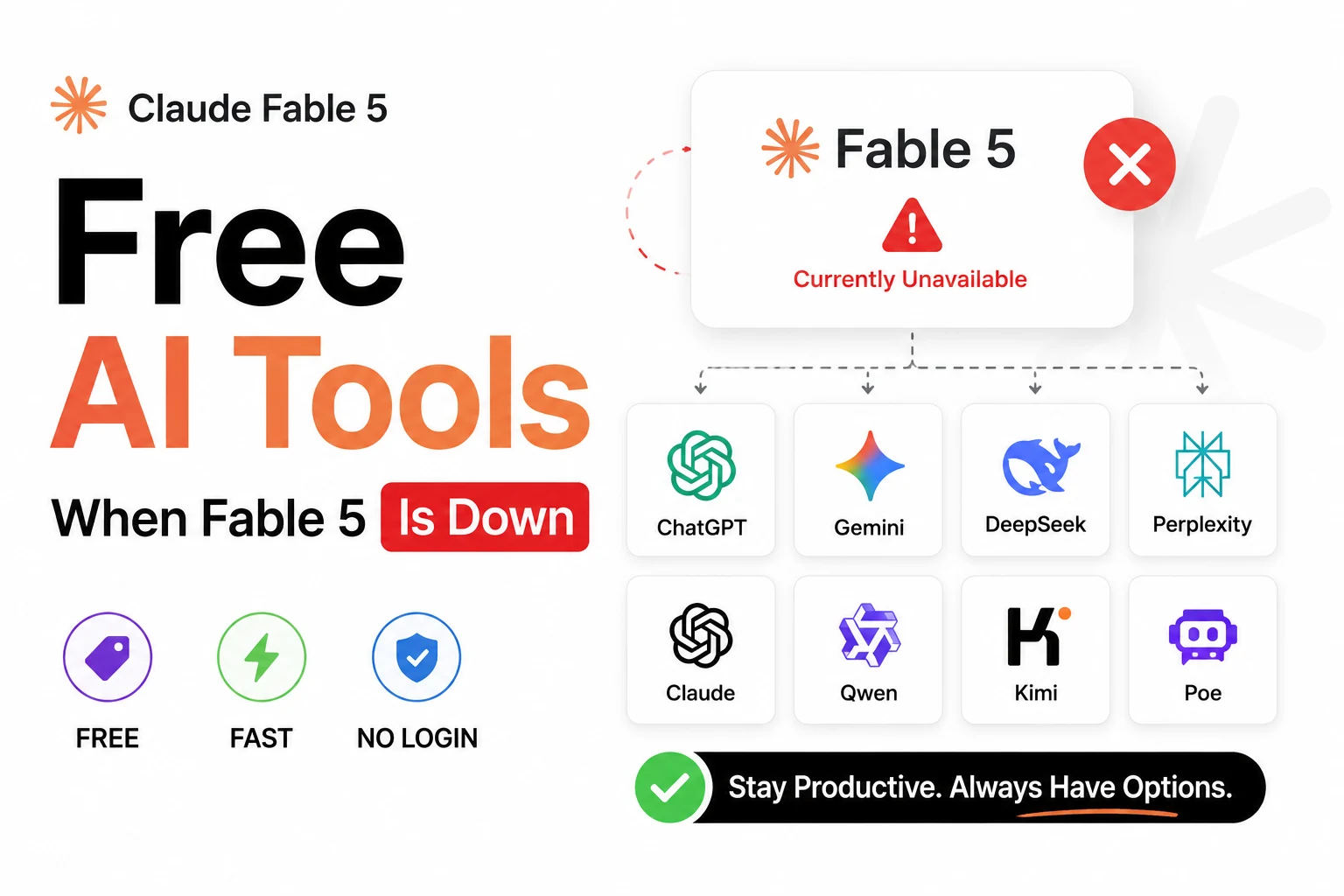
Free AI Tools to Use Now While Claude Fable 5 Is Down
Claude Fable 5 down? Use these free AI tools right now — no signup, no login. A practical roundup of free AI tools for writing, resumes, images, and OCR.
Read article
Free AI Image Generator: Ultimate Guide to Top Tools
Discover the free ai image generator landscape in 2026. Learn how they work, compare the best options, get expert prompts.
Read article