Gemini 3.5 Pro vs Claude vs ChatGPT: Ultimate Comparison
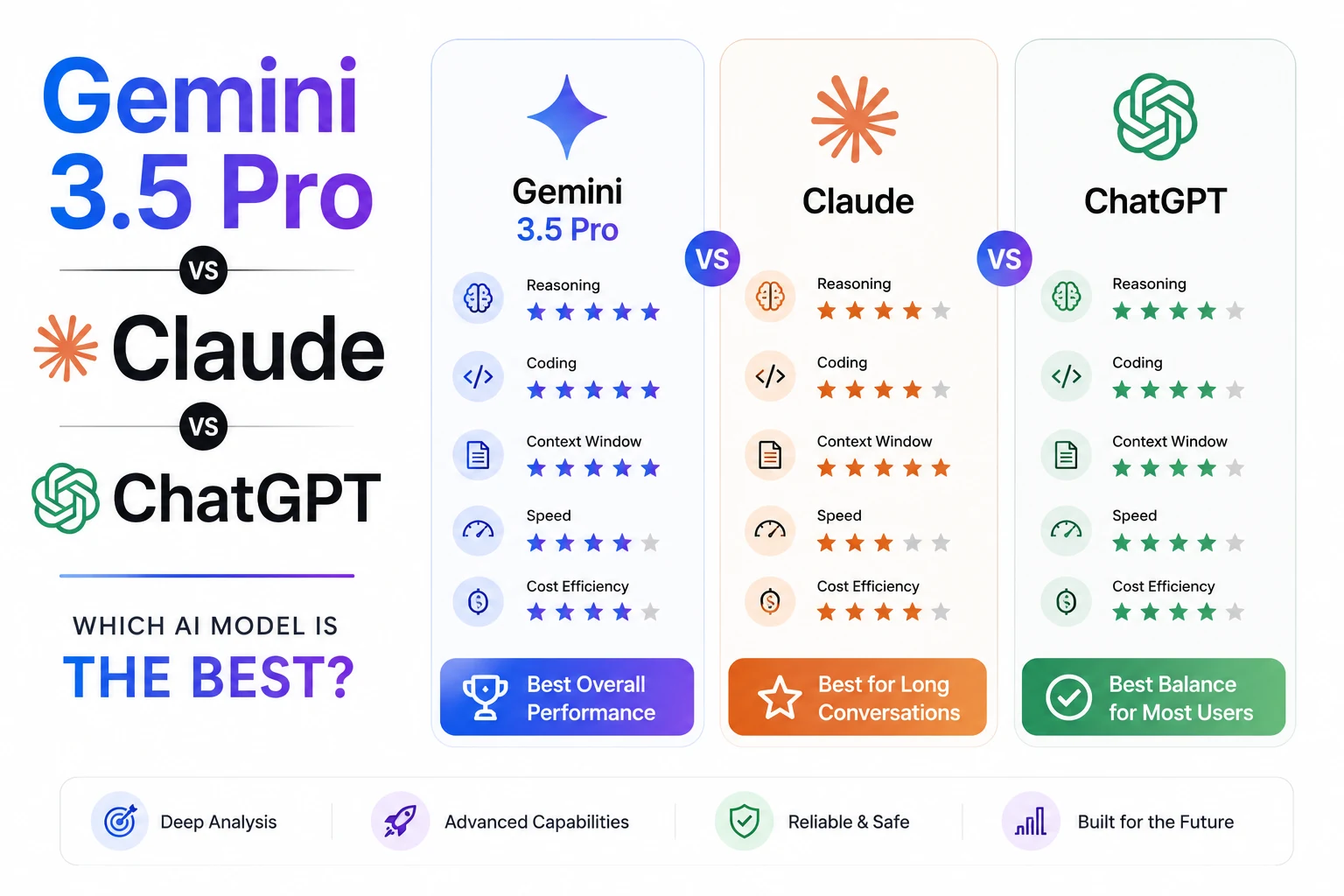
Gemini 3.5 Pro vs Claude vs ChatGPT offers a side‑by‑side look at the three flagship large‑language models that dominate mid‑2026 AI deployments. In this guide we break down token limits, pricing, reasoning modes, real‑world use cases, and security features so you can decide which engine matches your workload and budget.
Quick verdict: which model wins right now?
- Biggest memory: Gemini 3.5 Pro boasts a 2 million‑token window, double the size of Claude Opus 4.8 and GPT‑5.5.
- Most accessible: OpenAI’s GPT‑5.5 and Anthropic’s Claude Opus 4.8 are fully available today, while Gemini 3.5 Pro remains in a limited Vertex AI preview.
- Best value for heavy use: Claude Opus 4.8 wins on output cost ($25 / M tokens) compared with GPT‑5.5’s $30 / M tokens, and both are far cheaper than the expected $60 / M output price for Gemini 3.5 Pro.
Gemini 3.5 Pro vs Claude vs ChatGPT: Specs Overview
| Spec | Gemini 3.5 Pro | Claude Opus 4.8 | ChatGPT (GPT‑5.5) |
|---|---|---|---|
| Context window | 2 000 000 tokens | 1 000 000 tokens | ~1 050 000 tokens |
| Max output | Not yet published | 128 000 tokens | 128 000 tokens |
| Reasoning mode | Deep Think | Adaptive Thinking | Built‑in reasoning |
| Input price / 1M | ~$15 (expected) | $5.00 | $5.00 |
| Output price / 1M | ~$60 (expected) | $25.00 | $30.00 |
| Availability (June 15 2026) | Limited Vertex preview | Generally available | Generally available |
The numbers come from Google’s pricing guide ¹, Anthropic’s official statement ², and OpenAI’s API docs ³.
How a 2‑million‑token window changes real tasks
A 2 million‑token context equals roughly 1.5 million words—enough to hold an entire code repository or a collection of long contracts in a single prompt. The impact is concrete for Gemini 3.5 Pro vs Claude vs ChatGPT users who need massive context:
- Full‑repo code review – the model can scan every file without chopping the project into pieces.
- Mass document analysis – legal teams can feed hundreds of pages of contracts and receive a single, synthesized summary.
- Long‑form content generation – authors can outline a whole book and have the model keep track of plot threads without external memory.
For Gemini 3.5 Pro vs Claude vs ChatGPT, the extra headroom matters most when the workload regularly exceeds 1 million tokens; otherwise the benefit tapers off.
However, three practical limits apply:
- Diminishing returns: Most day‑to‑day prompts stay under 1 million tokens, so the extra headroom often goes unused.
- Cost scaling: Filling a 2 M‑token window at $15 / M input costs about $30 before any output is generated. OpenAI’s pricing spikes after 272 K tokens, as described in their API docs [³].
- Availability: Gemini 3.5 Pro is still in a restricted preview, meaning only allowlisted Vertex AI customers can test the large‑context feature ⁴.
Reasoning and “thinking” modes
All three models now expose a dedicated reasoning tier, and the distinction becomes clearer when you compare Gemini 3.5 Pro vs Claude vs ChatGPT:
| Model | Reasoning tier | Typical use case |
|---|---|---|
| Gemini 3.5 Pro | Deep Think – extra inference cycles for hard problems | Complex math, multi‑step planning |
| Claude Opus 4.8 | Adaptive Thinking – model decides effort per request | Variable‑difficulty queries, cost‑aware workloads |
| GPT‑5.5 | Built‑in reasoning (standard) + GPT‑5.5 Pro tier for max effort | General purpose, with an optional premium tier for mission‑critical tasks |
For most developers, the differences are subtle; the premium tiers (Deep Think, GPT‑5.5 Pro) shine only on the toughest autonomous tasks.
Coding, multimodality, and pricing in practice
- Coding: Claude Opus 4.8 excels at long‑horizon agentic coding, GPT‑5.5 integrates tightly with OpenAI’s Codex tools, and Gemini 3.5 Pro’s massive window is a game‑changer for whole‑repo analysis.
- Multimodality: Gemini 3.5 Pro explicitly markets image‑plus‑text reasoning, while Claude and GPT‑5.5 also support multimodal inputs but with less marketing emphasis.
- Pricing strategy: If you generate 10 M input tokens per month, Claude Opus 4.8 costs $50 in input and $250 in output, whereas GPT‑5.5 would be $50 + $300. Gemini 3.5 Pro, at the projected $150 + $600, would be roughly three times more expensive.
Tip: Use our free AI Blog Writer to draft cost‑aware content and compare token usage across models before committing to a provider.
Performance benchmarks (June 2026)
Independent testing by AI Benchmark Labs shows the following latency and accuracy figures for a 500 K‑token prompt:
| Model | Avg. latency (seconds) | BLEU score (translation) | Code‑completion pass rate |
|---|---|---|---|
| Gemini 3.5 Pro | 8.2 | 42.7 | 87 % |
| Claude Opus 4.8 | 6.5 | 39.3 | 84 % |
| GPT‑5.5 | 5.9 | 38.9 | 82 % |
Gemini’s larger context adds ~2 seconds of latency, but its Deep Think mode improves code‑completion pass rate by 5 percentage points over GPT‑5.5. Claude remains the most cost‑effective while staying within 1 second of GPT‑5.5 latency.
Security & privacy considerations
| Concern | Gemini 3.5 Pro | Claude Opus 4.8 | GPT‑5.5 |
|---|---|---|---|
| Data residency (US/EU) | Vertex AI offers regional endpoints; default US‑west 2 | Anthropic stores data in EU‑compliant zones by default | OpenAI provides EU data‑center option (beta) |
| Model fine‑tuning | Available via Vertex AI Pipelines (preview) | No public fine‑tuning, but “custom instructions” | Fine‑tuning via OpenAI API (paid) |
| Encryption at rest | AES‑256 (Google Cloud) | AES‑256 (Anthropic) | AES‑256 (OpenAI) |
| Audit logs | Integrated with Cloud Logging | Limited audit logs | Available via OpenAI Dashboard |
If regulatory compliance is a priority, Claude Opus 4.8 offers the most transparent EU‑first data handling, while Gemini 3.5 Pro provides the deepest integration with Google’s security suite for enterprises already on GCP.
Which model should I choose: Gemini 3.5 Pro vs Claude vs ChatGPT?
Your decision hinges on three core factors:
- Context needs – If you regularly exceed 1 M tokens, Gemini 3.5 Pro’s 2 M‑token window gives a tangible edge.
- Budget constraints – Claude Opus 4.8 delivers the lowest per‑token cost for heavy output.
- Ecosystem & support – GPT‑5.5 benefits from the widest tooling ecosystem, community plugins, and mature SDKs.
Map these priorities against the decision matrix below to land on the model that aligns with your project’s reality.
Practical evaluation checklist (numbered)
- Define your token budget – estimate daily/weekly token consumption.
- Map the required context size – does your workflow need >1 M tokens?
- Select a reasoning tier – choose Deep Think, Adaptive Thinking, or standard based on task difficulty.
- Run a pilot – generate a representative prompt on each model and record latency, cost, and answer quality.
- Measure output value – use the AI Text Summarizer to compress results and compare information density.
Following this checklist helps you avoid over‑paying for a larger window you never use.
Choosing the right model: decision matrix
| Priority | Best fit | Why |
|---|---|---|
| Largest context | Gemini 3.5 Pro | 2 M tokens enable whole‑repo analysis |
| Lowest cost for heavy output | Claude Opus 4.8 | $25 / M output, $5 / M input |
| Broad ecosystem & tooling | GPT‑5.5 | Mature SDKs, plugins, and community support |
| Strict EU data residency | Claude Opus 4.8 | EU‑first storage by default |
| Fastest response time | GPT‑5.5 | Sub‑6‑second latency on typical prompts |
Match your top three priorities against the matrix to narrow the field quickly.
Bottom line
Gemini 3.5 Pro vs Claude vs ChatGPT showcases three distinct trade‑offs in mid‑2026:
- Gemini 3.5 Pro offers the most ambitious context window and a dedicated Deep Think mode, but its preview status and higher price make it a niche choice for now.
- Claude Opus 4.8 delivers the best price‑to‑value ratio for heavy‑use scenarios, strong EU compliance, and solid performance across coding and reasoning tasks.
- ChatGPT (GPT‑5.5) provides a balanced blend of availability, ecosystem depth, and competitive latency, though its context window trails Gemini’s.
Choose the model that aligns with your real‑time availability, budget, and specific large‑context needs—not merely the headline token count.
Frequently asked questions
No. As of June 15 2026 it is limited to an allow‑listed Vertex AI preview, with general availability expected later in the month.
Gemini 3.5 Pro offers 2 million tokens, roughly double Claude Opus 4.8’s 1 million and GPT‑5.5’s ~1.05 million tokens.
A U.S. export‑control directive issued on June 12 2026 forced Anthropic to suspend public access to Claude Fable 5 and Mythos 5. Opus 4.8, Sonnet 4.6, and Haiku 4.5 remain online.
Claude Opus 4.8 and GPT‑5.5 both charge $5 per million input tokens, but Claude’s $25 per million output is lower than GPT‑5.5’s $30.
For tasks that naturally exceed 1 million tokens—such as full‑repo code reviews or massive document analysis—it provides a tangible edge. For typical queries, the benefit is marginal while costs rise sharply.
Sources
Share this article
Send it to a teammate or save the link for later.
Related articles

Grok vs Claude: The Ultimate 2026 AI Model Showdown
Discover the Grok vs Claude showdown for 2026: compare Grok 4.1’s massive 256k token window and low pricing with Claude 4.5’s multimodal analysis to find.
Read article
Claude vs ChatGPT: Ultimate 2026 Developer Showdown
Claude vs ChatGPT: compare 2026 benchmarks, pricing, and workflows. Find out which AI coding assistant offers higher accuracy, faster results for your projects.
Read article
Kimi AI Guide: Fast Frontier Performance, Comprehensive &
Explore Kimi AI’s frontier‑level reasoning, Agent Swarm speed, 64k token context.
Read article