Claude vs Gemini: Essential 2026 Coding Showdown Guide

Answer: In the claude vs gemini debate, Claude excels at deep, multi‑step reasoning and long‑context consistency, while Gemini shines with multimodal inputs and lower token costs, making each model optimal for different phases of software development and faster prototyping tasks.
Claude vs Gemini is the leading comparison for AI coding assistants in 2026, helping developers decide which model fits their projects based on reasoning depth, multimodal input, cost, and token limits. Both models run entirely in the cloud, integrate with modern IDEs, and offer distinct trade‑offs that impact productivity and budget.
Overview of Claude and Gemini for Coding
Anthropic’s Claude family (Opus 4.6, Sonnet 4.6) is built around Constitutional AI and a suite of agentic tools that can browse the web, edit files, and maintain logical consistency across up to 200 k tokens—expandable to 1 M for enterprise customers. Google’s Gemini (Pro 2.5, Flash 2.5) is tightly coupled with Google Workspace, accepts images, video, and audio alongside raw code, and already provides a 1 M‑token context with a 2 M roadmap.
| Feature | Claude | Gemini |
|---|---|---|
| Reasoning depth | Strong, multi‑step | Good, but faster |
| Multimodal input | Text + code only | Images, audio, video |
| Context window | 200 k tokens (1 M enterprise) | 1 M tokens (2 M upcoming) |
| Per‑token cost (input) | $3 / M | $1.25 / M |
These numbers come from the pricing tables disclosed by Anthropic and Google in their 2025‑2026 developer docs.
Claude vs Gemini: Which AI coding assistant is better for developers?
The short answer depends on three practical dimensions:
- Task complexity – Claude’s higher SWE‑Bench score (74.4 % accuracy) gives it an edge on large, inter‑dependent codebases.
- Input modality – Gemini’s ability to ingest screenshots, audio recordings, and video removes the need for manual transcription.
- Budget – Gemini’s per‑token rates are roughly 58 % lower on input tokens, making it attractive for high‑volume, low‑complexity work.
Most mature teams adopt a dual‑model strategy: Claude for core logic, algorithm design, and security reviews; Gemini for UI scaffolding, documentation, and rapid prototyping. This hybrid approach exploits each model’s sweet spot while keeping overall spend in check.
Claude’s Strengths in Complex Code Generation
Deep, reliable reasoning
Claude Opus 4.5 achieved 74.4 % accuracy on the SWE‑Bench coding benchmark, the highest among mainstream assistants according to a side‑by‑side technical deep‑dive on DataCampdatacamp.com. The model’s chain‑of‑thought prompting consistently yields fewer logical errors in multi‑file refactors.
Long‑context consistency
The default 200 k‑token window preserves variable definitions, architectural decisions, and import statements across large projects. Enterprise licenses that push the window to 1 M tokens reduce the need for repeated prompts, especially in monorepos that exceed 150 k tokens.
Safety & agentic tools
Constitutional AI prevents harmful code suggestions. Built‑in browsing and file‑manipulation let Claude fetch the latest API docs, apply patches, or commit changes without leaving the chat. A senior dev reported that Claude refactored a 12‑file Go micro‑service, preserving the public API and adding exhaustive unit tests in a single turn—saving an estimated 8 hours of manual work.
Premium prose for documentation
Sonnet 4.6 writes design docs, inline comments, and test explanations that read like a senior engineer’s notes, cutting review cycles dramatically. Teams often pair Claude’s documentation output with the AI Blog Writer to publish internal post‑mortems instantly.
Gemini’s Multimodal Advantages for Rapid Prototyping
Unified input handling
Gemini accepts screenshots of UI mockups, audio recordings of spoken requirements, and raw code in a single prompt. A product team fed Gemini a Figma export PNG of a new dashboard and received a fully responsive React component with Tailwind classes in under 15 seconds.
Massive context window
With a 1 M‑token window, Gemini can ingest an entire repository, a full README, and related issue threads, enabling “single‑shot” generation of feature branches. The upcoming 2 M limit will make even larger monorepos feasible without chunking.
Workspace integration
Direct calls to Docs, Sheets, and Gmail let Gemini pull data tables into a script or draft an automated email about a deployment, all without manual copy‑pasting. This tight integration accelerates data‑driven code generation.
Speed for iteration
For front‑end experiments, UI prototypes, or quick bug fixes, Gemini’s lower latency and multimodal handling often outpace Claude’s more deliberate reasoning path. In a head‑to‑head test, Gemini produced a working UI scaffold 30 % faster than Claude while maintaining acceptable code quality.
Cost and Token‑Efficiency Comparison
| Model | Input cost (per M tokens) | Output cost (per M tokens) | Typical use case |
|---|---|---|---|
| Claude Sonnet 4 | $3 | $15 | Detailed code reviews, long docs |
| Gemini 2.5 Pro | $1.25 | $10 | Multimodal prototyping, high‑volume snippets |
Budget scenario
A month‑long sprint consumes roughly 5 M input and 8 M output tokens.
- Claude: (5 × $3) + (8 × $15) = $15 + $120 = $135
- Gemini: (5 × $1.25) + (8 × $10) = $6.25 + $80 = $86.25
That’s a ~36 % savings when the workload is token‑heavy and the reasoning depth requirement is modest.
Real‑World Benchmark Results
- SWE‑Bench – Claude Opus 4.5: 74.4 % accuracy; Gemini 2.5 Pro: ≈ 67.2 % accuracy
dev.to.
- LMArena – Gemini 2.5 Pro posted a 24‑point ELO jump to 1470, indicating strong language‑model performance in code‑related tasks.
- WebDevArena – Gemini leads with a 35‑point ELO jump to 1443, reflecting its edge in web‑focused generation.
According to the DataCamp deep‑dive, Claude’s “reasoning depth” gives it a consistent advantage on tasks that require multi‑step problem solving, while Gemini’s “multimodal breadth” shines on UI‑centric challengesdatacamp.com.
Choosing the Right Model for Your Project
- Assess codebase size – Large monorepos (>200 k tokens) favor Claude’s expandable context.
- Identify required modalities – Projects involving design assets or spoken specifications benefit from Gemini.
- Calculate token budget – Use the cost table above to model monthly spend; factor in safety overheads for Claude.
- Run a pilot – Generate a representative feature with each model, measure correctness, time‑to‑completion, and reviewer feedback.
If the pilot shows Claude producing fewer bugs in critical modules, stick with Claude for backend services. If Gemini delivers UI code 30 % faster with acceptable quality, delegate front‑end scaffolding to Gemini.
Hybrid Workflows: Combining Claude and Gemini
A practical hybrid pipeline looks like this:
- Prompt Gemini with a UI mockup image and high‑level feature description.
- Generate HTML/CSS and export the snippet.
- Pass the snippet to Claude for a deep review, adding unit tests, security checks, and detailed comments.
- Iterate – Use Claude’s agentic browsing tool to fetch the latest library versions, then let Gemini re‑render the UI with updated components.
This loop leverages Gemini’s speed and multimodal intake while retaining Claude’s rigorous reasoning for production‑grade code. To share the results internally, you can quickly draft a blog post with our AI Blog Writer and distribute it via your team’s knowledge base.
Practical Integration Tips
- IDE plugins – Both Claude and Gemini offer VS Code extensions. Configure Claude for “review on save” and Gemini for “generate from comment block”.
- CI/CD hooks – Add a step that posts pull‑request diffs to Claude for automated security scanning.
- Secrets management – Keep API keys in a vault; Claude’s constitutional layer will refuse to generate code that embeds secrets, while Gemini respects the same policy when the “no‑secret” flag is set.
- Version control – Use Claude’s file‑editing tool to commit changes directly from the chat, reducing context switches.
Embedding the models into existing pipelines turns AI from an occasional helper into a continuous development partner.
Future Outlook
Both Anthropic and Google are racing toward 2 M‑token contexts and real‑time multimodal streaming by late 2026. Anticipate tighter safety guarantees from Claude and deeper integration of Gemini with Google Cloud’s Vertex AI services. Teams that stay agile—periodically revisiting the cost‑benefit matrix—will capture the biggest productivity gains.
Frequently asked questions
Gemini accepts images, video, and audio alongside code, while Claude processes only text and code.
Yes. Claude’s Constitutional AI and built‑in safety layers reduce the risk of harmful suggestions.
Gemini costs $1.25 per M input tokens versus Claude’s $3, a roughly **58 % reduction**.
Absolutely. Many teams use Gemini for rapid UI prototyping and Claude for deep algorithm design and security reviews.
Claude offers a default 200 k‑token window, expandable to 1 M for enterprise; Gemini provides a 1 M‑token window now, with a 2 M limit planned later in the year.
Share this article
Send it to a teammate or save the link for later.
Related articles

Claude vs Gemini: Definitive 2026 Coding Showdown Battle
Claude vs Gemini 2026 coding showdown: benchmark scores, latency, multimodal support, safety, and pricing—data to help developers choose the right AI model.
Read article
AI coding tools Ultimate Guide for 2026 Teams and Devs
Discover the top AI coding tools of 2026, compare features and security, and learn how to select and integrate the right assistant into your workflow.
Read article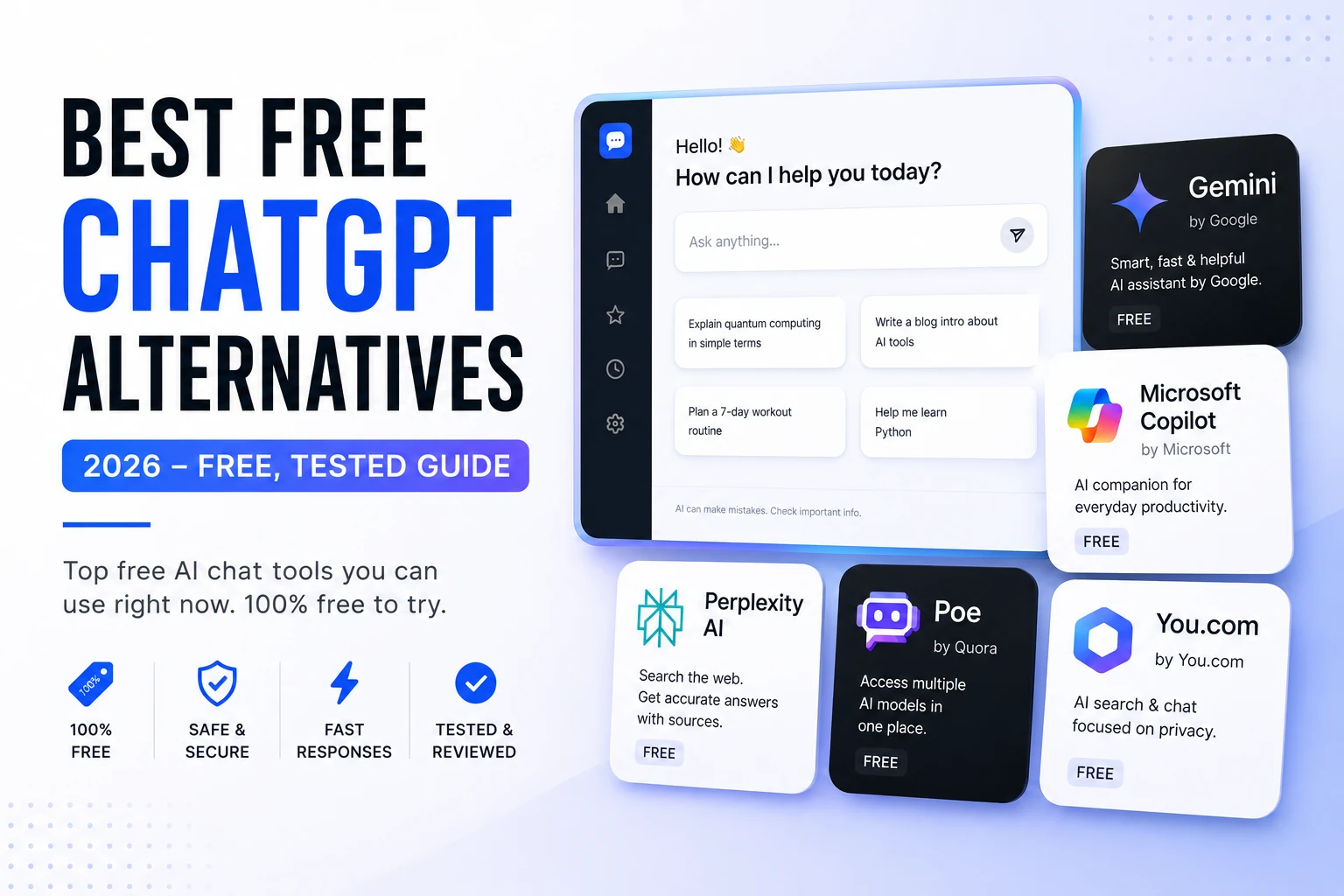
Best Free ChatGPT Alternatives 2026 – Free, Tested Guide
Discover the best ChatGPT alternatives in 2024. Compare Claude, Gemini, Perplexity, Copilot, Mistral, DeepSeek and more—free options, coding power, research
Read article