California AI Job-Loss Tracker: See Which Jobs at Risk
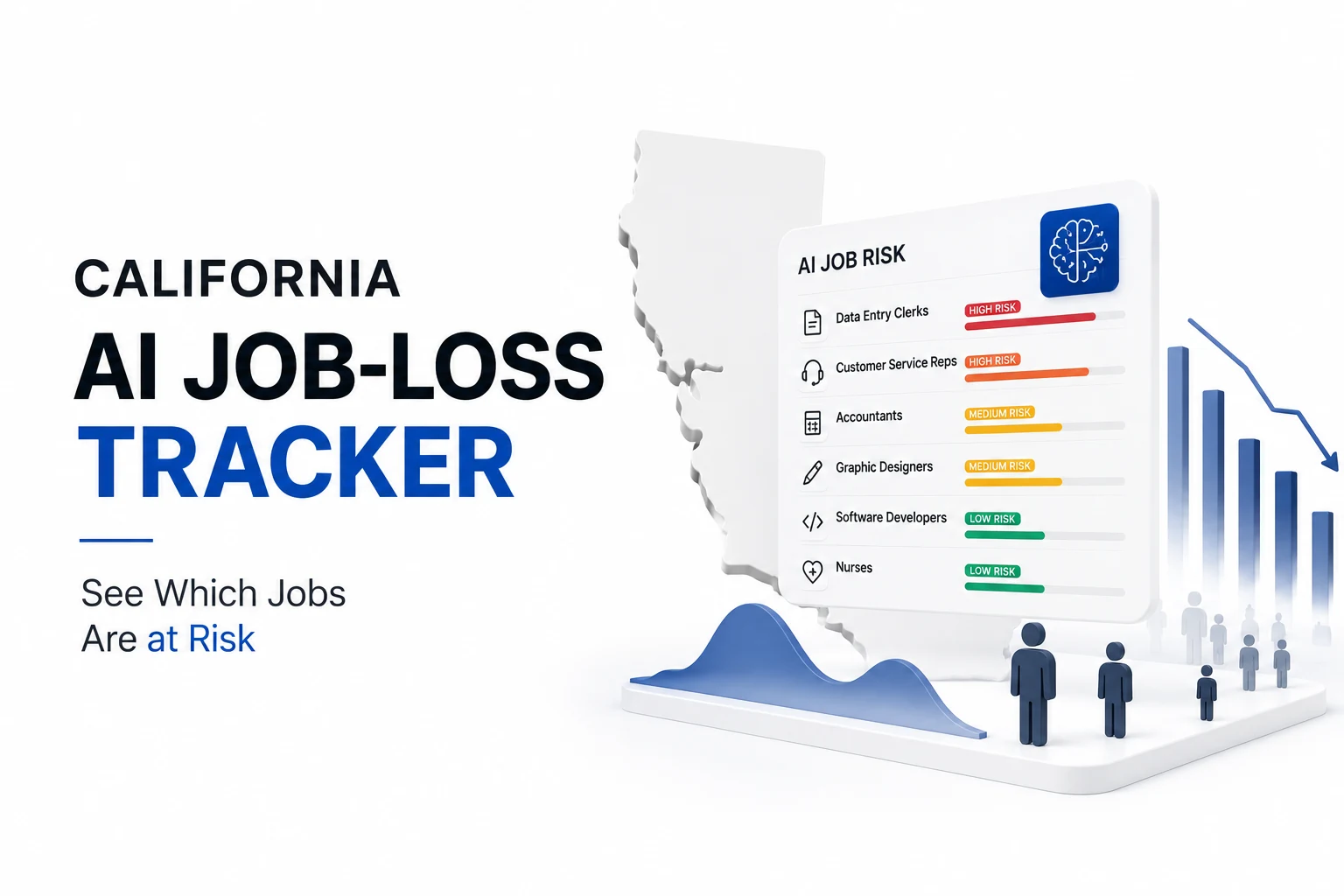
California AI Job-Loss Tracker: See Which Jobs Are at Risk
California just became the first state in the nation to launch a public AI job-loss tracker, an early-warning dashboard that links unemployment claims to how exposed each occupation is to artificial intelligence. Officially called the California AI-Unemployment Tracker (CAIT), it went live on June 25, 2026, and it lets anyone see which jobs, regions, and worker groups are showing the earliest signs of AI-related strain. The short version: there is no statewide jobs collapse yet, but college-educated workers in high-exposure roles and the San Francisco Bay Area are already feeling pressure.
What the California AI Job-Loss Tracker Is
The tracker is a free, public dashboard that monitors California's unemployment data for signs that artificial intelligence is reshaping the labor market. Rather than guessing whether AI is taking jobs, the state now connects real unemployment insurance claims to established research on how "automatable" each occupation is. Governor Gavin Newsom's office calls it a first-in-the-nation tool to "proactively track AI-related job loss trends," framing it as an early-warning system so policymakers and workers are not caught off guard.
Importantly, the dashboard does not claim to prove that AI caused any single layoff. As reporting from CBS Sacramento notes, it shows whether claims are rising among workers in jobs more likely to be affected by AI, not the cause of any individual job loss. That distinction matters, and the researchers behind it are careful to keep "potential" exposure separate from "observed" impact in the data.
Who Built It and Why
CAIT was developed jointly by the California Policy Lab, a nonpartisan research center based at the University of California, and the California Employment Development Department (EDD), which holds the state's unemployment records. The build was part of an executive order Governor Newsom issued in May 2026 directing state agencies, economists, universities, and industry leaders to prepare California's workers and small businesses for AI-driven disruption.
The tone from the people who built it is measured, not alarmist. "Right now, we are not seeing evidence of large-scale AI-related layoffs in California's labor market," said Dr. Ben Hyman, a senior researcher at the California Policy Lab, in the official announcement. UCLA economics professor Till von Wachter framed the goal plainly, telling CBS Sacramento that the tracker "helps replace speculation with evidence." Newsom added that "as AI advances, we aren't just watching from the sidelines; we're reimagining how we prepare."
How the Tracker Measures AI Risk
This is where CAIT gets more rigorous than the typical "robots are coming" headline. The tool pulls from EDD unemployment administrative records covering workers who filed for benefits after layoffs from covered California employers, with data going back to January 2017. It then layers two different measures of how exposed each job is to AI, according to the California Policy Lab:
- Potential AI exposure: whether large language models can cut the time needed to complete a job's tasks by at least 50 percent. This measure comes from research by OpenAI and academic collaborators (Eloundou et al., 2024).
- Observed AI exposure: how often workers actually use an AI assistant to complete real occupational tasks, based on observed usage patterns from Anthropic's Claude platform.
Combining a theoretical measure with a real-usage measure helps separate hype from what is actually happening on the ground. The dashboard then sorts occupations into three tiers: high exposure (top 25 percent), moderate exposure (the middle band), and low exposure (bottom 25 percent).
Which Jobs Are Most at Risk
CAIT does not publish a long ranked list of doomed job titles, and that restraint is a feature, not a flaw. Instead, it groups occupations into exposure tiers and reports which ones it considers most and least exposed. Based on the state's own examples and the broader research it draws on, here is how the picture breaks down.
| Exposure tier | Example occupations | What it means |
|---|---|---|
| High AI exposure (top 25%) | Customer service representatives, software developers | Tasks overlap heavily with what AI tools do well; earliest to show strain |
| Moderate AI exposure | Many office, administrative, and analytical roles | Mixed; some tasks automatable, others not |
| Low AI exposure (bottom 25%) | Heavy and tractor-trailer truck drivers, nursing assistants | Hands-on or physical work AI cannot easily replace |
Two named examples come directly from the state: customer service representatives and software developers sit in the high-exposure tier, while heavy truck drivers and nursing assistants sit in the low-exposure tier. That tracks with the wider job market. Recent Washington Post analysis found that the tasks most overlapping with AI cluster in computer programming, marketing, financial analysis, and customer service, which is why those roles show up at the top of so many risk lists.
Beyond occupations, the tracker flags specific worker groups. According to the official announcement and coverage from abc10, claims from college-educated workers in high-exposure occupations rose after the release of ChatGPT-3.5 in late 2022 and stayed elevated through May 2026. Workers aged 25 to 35 appear most vulnerable, women somewhat more than men, and the San Francisco Bay Area, where high-AI-exposure jobs are concentrated, has seen the most sustained increase in claims.
How to Use the Tracker
The dashboard is public, free, and built so ordinary Californians, not just policymakers, can read it. You can open the California AI-Unemployment Tracker directly from the California Policy Lab's site. Once there, you can slice the data several ways:
- By occupation exposure tier to see how high-, moderate-, and low-exposure groups compare.
- By demographics, including age, education level, gender, and race or ethnicity.
- By industry, using standard NAICS industry categories such as Information and Professional Services.
- By region, across California's 14 regional planning units, so you can check whether your area is trending differently from the state.
The data is updated monthly, so the smartest way to use it is over time. A single snapshot can mislead; a rising trend line in your occupation or region over several months is the signal worth watching. Remember the core caveat from Fast Company's reporting and the state itself: an uptick in claims among AI-exposed workers is a warning sign, not proof that AI is the cause.
What Workers Can Do Right Now
The tracker is meant to inform action, not just anxiety. State officials say the data will help identify where job-search support, retraining, upskilling, and health-coverage guidance are most needed, per CBS Sacramento. Here is how to put that into practice:
- Check your exposure tier. Look up your occupation in the tracker. If you are in a high-exposure role like customer service or software development, treat that as a prompt to act early, not a verdict.
- Move up the value chain. Within exposed fields, the safest work is the judgment-heavy, relationship-driven, and supervisory tasks AI handles poorly. For developers, that means system design and code review over boilerplate; for customer service, complex problem-solving over scripted replies.
- Build AI fluency. Workers who can direct AI tools tend to fare better than those competing against them. Learning to use the same tools reshaping your field is one of the most practical hedges available.
- Tap EDD resources. California's Employment Development Department offers job-search assistance, training referrals, and unemployment benefits if you are displaced. Start at the EDD site if you lose work.
- Watch your region's trend. If you live in a high-exposure area like the Bay Area, monitor the monthly updates so you can plan ahead rather than react.
Bottom Line
California's AI job-loss tracker is the clearest evidence-based read yet on how artificial intelligence is touching the workforce, and the early message is reassuring with an asterisk: there is no statewide jobs crisis, but specific groups, namely younger, college-educated workers in high-exposure roles and Bay Area tech workers, are already showing strain. If your job involves tasks an AI assistant can do in a fraction of the time, do not panic, but do prepare. Look up your occupation in the tracker, lean into the parts of your work that require human judgment, get fluent with AI tools, and know that EDD support exists if you need it. The workers who treat this dashboard as an early warning, rather than a rearview mirror, will be the ones best positioned for whatever comes next.
Frequently asked questions
It is a free public dashboard called the California AI-Unemployment Tracker (CAIT) that links state unemployment claims to how exposed each occupation is to artificial intelligence, giving an early-warning read on AI-related job loss. It launched June 25, 2026.
It was built by the California Policy Lab at the University of California (UCLA) together with the California Employment Development Department (EDD), as part of an executive order Governor Gavin Newsom issued in May 2026 to prepare workers for AI disruption.
The tracker sorts jobs into high, moderate, and low AI exposure tiers. High-exposure examples named by the state include customer service representatives and software developers, while low-exposure jobs include heavy truck drivers and nursing assistants.
Not yet. As of the May 2026 data, there is no evidence of a statewide rise in unemployment claims from AI-exposed occupations, though claims rose for college-educated workers in high-exposure roles and in the San Francisco Bay Area.
Open it on the California Policy Lab website. You can filter the data by occupation exposure tier, age, education, gender, race or ethnicity, industry, and by California region. It updates monthly, so watch trends over time rather than a single snapshot.
No. The state is clear that the tracker shows whether unemployment claims are rising among workers in AI-exposed jobs. It does not prove AI caused any specific layoff, so the data is a warning signal, not direct cause.
Early findings flag college-educated workers, those aged 25 to 35, and women somewhat more than men, especially in the San Francisco Bay Area where high-AI-exposure jobs are concentrated.
Check your exposure tier in the tracker, focus on judgment-heavy and relationship-driven tasks AI handles poorly, build fluency with AI tools, and use EDD resources for job search, retraining, and unemployment benefits if displaced.
Share this article
Send it to a teammate or save the link for later.
Related articles
Is the AI Bubble Bursting? Big Tech's $725B Reckoning
Is the AI bubble bursting in 2026? Big Tech is set to spend ~$725B on AI as the Magnificent 7 shed $2.3T — the bull and bear case, no hype, no advice.
Read articleApple Lost a Major EU Antitrust Fight: What It Means
Apple lost a major EU antitrust ruling on July 8, 2026, upholding DMA rules on the iPhone. What's decided, what's still pending, and what changes for you.
Read articleBest AI Browser 2026: Comet vs Dia vs Chrome (Atlas Dies)
The best AI browser in 2026? Comet is free and cross-platform, Chrome adds Gemini, and ChatGPT Atlas shuts down Aug 9 — plus the safety risks.
Read article