Vibe Coding Security Risks: The Ultimate 2026 Guide
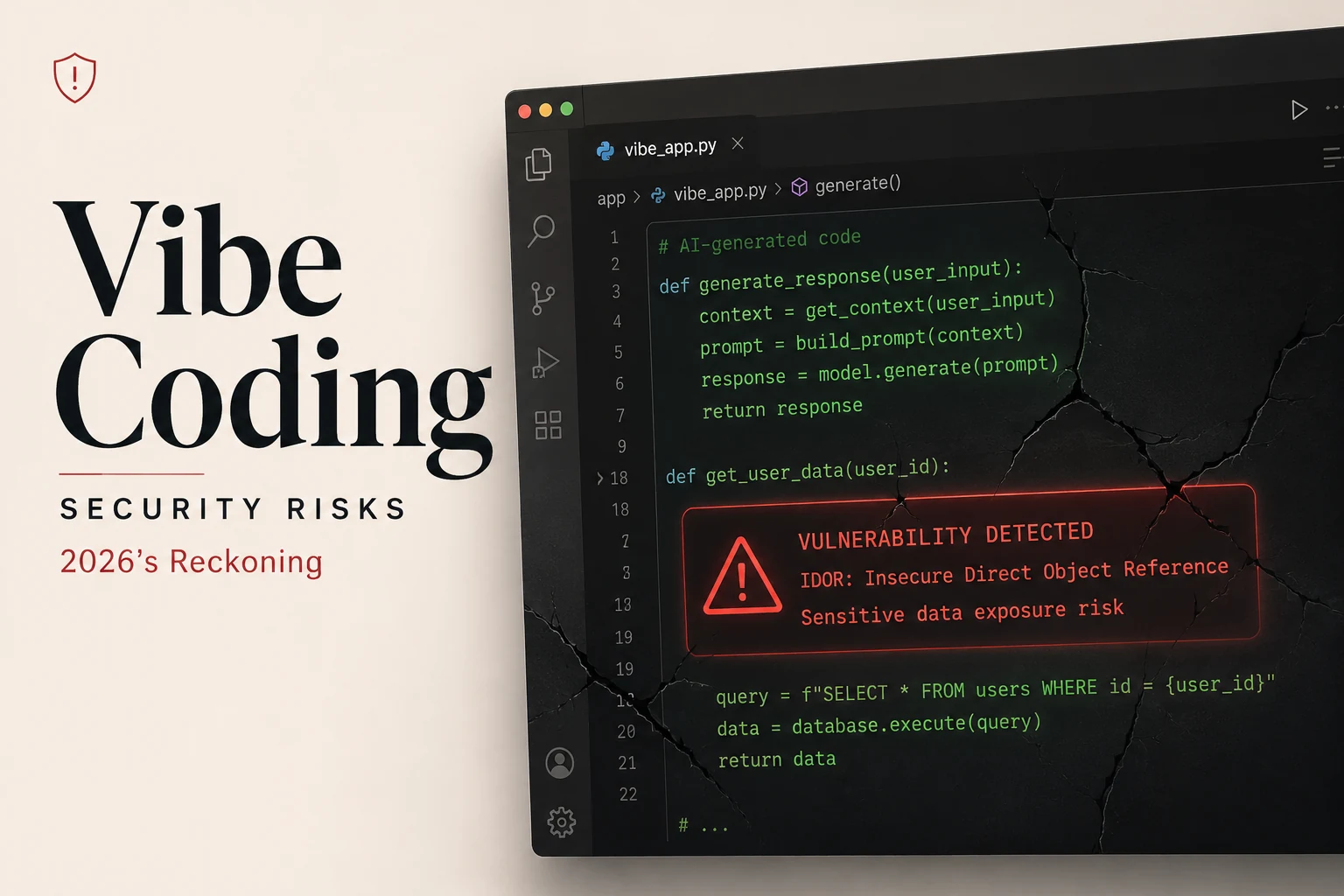
vibe coding security risks are reshaping how developers think about AI‑assisted programming, as hidden flaws turn fast prototypes into breach vectors. This guide breaks down the most common vulnerabilities, real‑world incidents, and a proven checklist to keep your code safe. Understanding vibe coding security risks early helps teams embed safeguards before code reaches production.
Vibe coding security risks, in one sentence
The biggest vibe coding security risks in 2026 are hardcoded secrets, broken access control, injection bugs, and fake “hallucinated” dependencies, because the AI that writes the code optimizes for output that runs, not output that is safe. That gap stopped being theoretical this year. A reported exposure at the AI app‑builder Lovable, peer‑reviewed studies finding that close to half of AI‑generated code contains flaws, and the rise of an attack called “slopsquatting” turned vibe coding from a productivity story into a security one.
Last updated: June 22, 2026
Vibe coding, the practice of building software mostly by describing it to an AI and accepting what it generates, is now mainstream. Surveys put weekly AI‑assistant usage among developers around 75 %. The problem is that speed and security pull in opposite directions, and through the first half of 2026 the bill came due. This is a plain‑English tour of what went wrong, the real risk categories, what slopsquatting actually is, and a checklist for shipping AI‑built code without getting burned. For more developer‑focused guides, browse our developer tools and guides.
What actually went wrong in 2026
Three separate stories collided and made “is vibe coding safe?” a question every founder started asking.
The Lovable incident. In April 2026, security researchers reported that Lovable, a popular tool that generates and hosts full apps from prompts, left sensitive data from older “public” projects readable by anyone who signed up for a free account. According to reporting by The Register, the exposed material reportedly included project source code, AI chat histories, and database credentials. Lovable’s first response was to deny a breach: the company said code visibility on public projects was “intentional behavior” and “consistent by design,” and it pointed at unclear documentation and at the bug‑bounty platform HackerOne. It later issued a fuller statement acknowledging that a February 2026 backend permissions change had accidentally re‑enabled access to chat histories on public projects.
This was not Lovable’s first scare. In 2025, researcher Matt Palmer disclosed CVE‑2025‑48757, a flaw where weak database row‑level security let unauthenticated attackers read and write to the database tables of generated sites. A scan reportedly found inadequate settings across roughly 170 of about 1,645 analyzed projects. The throughline of both episodes: the AI happily wired up a backend, and the security defaults around it were left wide open.
The studies. The standout data point comes from Veracode, whose 2025 GenAI Code Security Report tested more than 100 large language models across 80‑plus coding tasks and found that 45 % of AI‑generated code samples introduced an OWASP Top 10 vulnerability. Cross‑site scripting and log injection were among the worst, failing 86 % and 88 % of the time, and Java was the riskiest language at over 70 %. Veracode’s Spring 2026 update found the picture had barely improved: security pass rates were stuck around 55 % even as newer, larger models got better at writing code that simply works. Separate academic work points the same way: Carnegie Mellon researchers reported that 61 % of AI code functioned correctly but only 10.5 % passed a security review, and a Georgetown study found roughly 48 % of generated snippets contained an insecure‑code bug.
Slopsquatting. Attackers noticed that AI tools confidently invent package names that do not exist, and that the same fake names come back again and again. Registering those names is a brand‑new supply‑chain attack, covered below.
The real vibe coding risk categories
Most AI‑generated security bugs fall into a handful of buckets. Knowing them tells you exactly what to look for in a review.
| Risk | What the AI does | Why it bites you |
|---|---|---|
| Hardcoded secrets | Pastes API keys, DB passwords, and tokens directly into source files | Keys end up in git history and public repos; rotating them is painful |
| Broken authentication / access control | Skips ownership checks and row‑level security | One user can read another user’s data (the core Lovable problem) |
| Injection (SQLi, XSS) | Builds queries via string concatenation; renders unescaped input | Classic, fully preventable bugs that still dominate the OWASP Top 10 |
| Vulnerable dependencies | Pulls in outdated or unvetted packages | You inherit every known CVE in the dependency tree |
| Hallucinated dependencies | Imports packages that do not exist | Opens the door to slopsquatting (see below) |
Hardcoded secrets deserve a special mention because they are the most common and the most quietly destructive. GitGuardian’s State of Secrets Sprawl 2026 report found that 28.65 million new hardcoded secrets were pushed to public GitHub in 2025, a 34 % jump year over year, and that AI‑assisted commits leaked secrets at roughly twice the baseline rate (3.2 % leak rate on AI‑assisted commits versus 1.5 % baseline). GitGuardian was careful to note this is not purely a tool failure, since developers still control what gets pushed, but the pattern is unmistakable: AI makes it easier than ever to commit a live key without noticing.
Slopsquatting and hallucinated dependencies, explained
When an AI assistant writes code, it sometimes tells you to install a package that does not exist. It is not lying on purpose; it is pattern‑matching a plausible‑sounding name. Slopsquatting is the attack built on top of that habit: a malicious actor registers the fake name on a public registry like PyPI or npm, so that the next developer who copy‑pastes the AI’s suggestion installs the attacker’s code instead of a harmless 404. The term was coined by Python Software Foundation developer Seth Larson, blending “AI slop” with “typosquatting.”
The reason this works is consistency. A USENIX Security 2025 paper, “We Have a Package for You!” by Spracklen et al., tested 16 code‑generating models across 576,000 generated samples and found that 19.7 % of recommended packages did not exist. Open‑source models hallucinated far more (≈21.7 %) than commercial ones (≈5.2 %), and across all of them the researchers catalogued more than 205,000 unique fake package names. Critically, 43 % of hallucinated packages reappeared on all 10 runs of the same prompt, so an attacker does not need to scrape anything. They can watch a popular model, write down the names it invents, and register them.
This is not hypothetical. As reported in security coverage of the trend, researchers at Lasso Security demonstrated the idea early when they noticed models repeatedly suggesting a non‑existent Python package, huggingface-cli; an empty placeholder uploaded under that name reportedly drew more than 30,000 downloads in three months. The defense is simple to state and easy to skip: before you install anything an AI suggests, confirm the package actually exists, is widely used, and is the one you meant.
How can I mitigate vibe coding security risks?
Regulators are already reacting. The U.S. National Institute of Standards and Technology (NIST) includes AI‑generated code in its Secure Software Development Framework, urging developers to treat AI output as “untrusted code” and to apply the same hardening steps used for third‑party libraries [NIST SP 800‑53]. The Cybersecurity and Infrastructure Security Agency (CISA) also publishes guidance on supply‑chain attacks that covers hallucinated dependencies [CISA Supply‑Chain Guidance].
Below is a proven checklist that aligns with those recommendations and directly addresses the vibe coding security risks outlined above.
- Treat AI output as a pull request from a junior developer.
- Read every line. If you cannot explain its purpose, flag it.
- Never hardcode secrets.
- Store keys in environment variables or a dedicated secrets manager.
- Generate high‑entropy values with a secure password generator and never commit them.
- Rotate any credential that ever touched source control.
- The Lovable breach showed that chat histories can leak keys; assume compromise and rotate immediately.
- Verify every dependency before installation.
- Search the package registry, check download statistics, and confirm the repository belongs to the expected maintainer.
- Automate dependency scanning.
- Enable Dependabot, Renovate, or Snyk on every pull request; fail the build on critical findings.
- Run static application security testing (SAST) in CI.
- Tools like Semgrep, CodeQL, or Snyk Code catch injection, broken auth, and insecure defaults.
- Add secret‑detection hooks.
- GitLeaks, TruffleHog, or built‑in GitHub secret scanning should run pre‑commit and in CI.
- Validate binary and artifact integrity.
- Compare checksums with a UUID Generator before deployment.
- Document AI prompts and generated artifacts.
- Keeping a log of prompts helps trace the origin of a vulnerable snippet during incident response.
Addressing vibe coding security risks requires a blend of process and tooling; skipping any step re‑opens the door to the same class of bugs.
The regulatory landscape for AI‑generated code
Beyond NIST and CISA, several international bodies have issued standards that indirectly affect vibe coding security risks:
- EU Cybersecurity Act – Requires high‑risk AI systems to undergo conformity assessments, which include code security reviews.
- ISO/IEC 42001 – Provides a framework for AI governance, emphasizing traceability of AI‑generated artifacts.
Adhering to these standards not only reduces risk but also future‑proofs your development pipeline against upcoming compliance audits.
What this means for you
If you are building a quick prototype or a weekend project, vibe coding is fine. The danger arrives the moment that prototype touches real users, real money, or real data, because that is when broken auth and a leaked database key stop being embarrassing and start being a breach.
The practical mindset shift is this: AI moved the bottleneck. Writing code is no longer the slow part; verifying it is. So the time you save by generating a feature in two minutes should be partly reinvested in review and scanning, not pocketed entirely. The teams that get burned in 2026 are the ones treating “it works in the preview” as “it is ready to ship.” The teams that do well bolt automated security checks onto their pipeline once and let them run on every commit forever.
Key takeaways
- Roughly 45 % of AI‑generated code introduces an OWASP Top 10 vulnerability (Veracode, 2025), and AI code carries about 2.74× more flaws than human code.
- The 2026 Lovable episode showed the pattern in the wild: source code, credentials, and chat histories from “public” projects were reportedly readable by anyone, on top of an earlier row‑level‑security flaw (CVE‑2025‑48757) affecting around 170 apps.
- Hardcoded secrets are the most common and most damaging mistake; AI‑assisted commits leak secrets at roughly twice the baseline rate (GitGuardian, 2026).
- Slopsquatting weaponizes hallucinated dependencies: AI invents fake package names predictably (19.7 % of suggestions in a 576 k‑sample study), and attackers register them.
- You can vibe‑code safely by reviewing output, scanning dependencies and secrets, running SAST in CI, verifying every package, and never hardcoding credentials.
By recognizing vibe coding security risks, you can turn AI speed into a competitive advantage without compromising safety.
Frequently asked questions
Vibe coding is not inherently insecure, but research consistently shows AI‑generated code ships with vulnerabilities at a high rate. Veracode’s 2025 GenAI Code Security Report found 45 % of AI‑generated samples introduced an OWASP Top 10 flaw, and Carnegie Mellon researchers reported that while 61 % of AI code worked, only 10.5 % passed a security review. Treat AI output as a first draft from a fast junior developer, then review it, scan it, and never ship it unchecked.
In April 2026, security researchers reported that AI app‑builder Lovable left source code, database credentials, and AI chat histories from older “public” projects readable by anyone with a free account. Lovable initially denied a breach, telling *The Register* the code visibility was “intentional behavior,” before issuing a fuller statement acknowledging it had accidentally re‑enabled access to chat histories during a February 2026 backend change. It followed an earlier 2025 flaw (CVE‑2025‑48757) in which weak database row‑level security exposed data across roughly 170 generated apps.
Slopsquatting is a supply‑chain attack where someone registers a fake package name that AI coding tools repeatedly hallucinate, hoping developers copy‑paste and install it. The term was coined by Python Software Foundation developer Seth Larson. A USENIX Security 2025 study found that across 576 000 AI‑generated code samples, 19.7 % of recommended packages did not exist, producing more than 205 000 unique fake names attackers can simply register and wait for.
Follow a proven checklist: treat AI output as untrusted code, never hardcode secrets, rotate any leaked credentials, verify every dependency, run automated SAST and secret‑detection in CI, and keep a log of prompts. Align your process with NIST and CISA guidance for supply‑chain security.
No. Veracode’s research found AI‑generated code contains roughly **2.74×** more vulnerabilities than human‑written code, and a 2026 GitGuardian report found AI‑assisted commits leaked secrets at about twice the baseline rate of all public GitHub commits. AI is faster, not safer, so human review and automated scanning steps matter more, not less.
Sources
Share this article
Send it to a teammate or save the link for later.
More from RunFreeTools Team
Best Password Manager 2026: 1Password vs Bitwarden
Best password manager 2026: compare 1Password vs Bitwarden vs Dashlane on price, security, free tiers, and passkeys to find the right pick for you.
Read article16 Billion Passwords Leaked? What To Actually Do
The 16 billion passwords leaked story was a recycled infostealer compilation, not a new breach. Here's the calm truth plus a real action checklist.
Read articleNordVPN vs Surfshark: Ultimate VPN Showdown for 2026 Review
nordvpn vs surfshark 2026 showdown: discover which VPN wins on speed, price, device limits, streaming, privacy, and support in a concise, data‑driven expert
Read article