GPT-5.5 vs Gemini 3.1 Pro: Ultimate 2026 Model Showdown
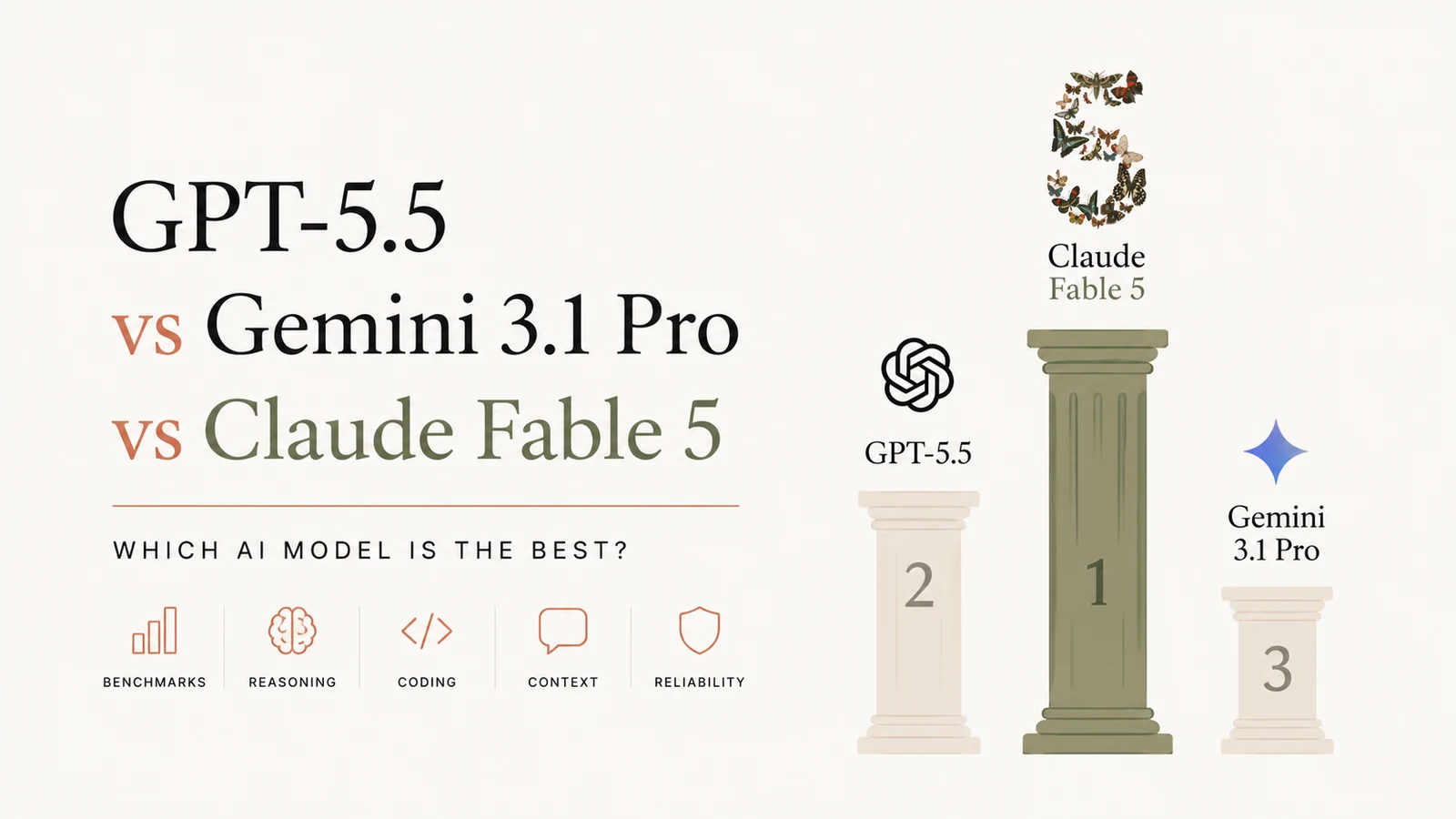
Answer capsule: gpt-5.5 vs gemini 3.1 pro pits OpenAI’s newest agentic engine against Google DeepMind’s ultra‑long‑context champion, revealing clear trade‑offs in retrieval, reasoning, multimodal handling, and cost. This guide breaks down benchmark results, pricing, integration tips, and real‑world use‑case recommendations so you can pick the model that best fits your workload.
gpt-5.5 vs gemini 3.1 pro: Which Model Wins for Long‑Context Tasks?
When prompts exceed a few hundred thousand tokens, the two models diverge dramatically. OpenAI’s gpt-5.5 (codename “Spud”) achieved 74.0 % accuracy on the MRCR v2 ultra‑long‑context retrieval benchmark, while gemini 3.1 pro managed roughly 32 % in the same test【1】. The gap widens further in agentic workflows: GPT‑5.5 recorded 84.9 % GDPval and 78.7 % OSWorld scores, indicating superior ability to keep instruction fidelity across 256 K‑token contexts【real‑stats】. For developers building retrieval‑heavy pipelines—legal document analysis, scientific literature reviews, or code‑base navigation—gpt-5.5 remains the clear front‑runner.
Gemini’s advantage lies in sheer context length. Its 1 million‑token window lets a single prompt contain an entire research paper, a full‑length video transcript, or a multi‑GB code repository without chunking. If your workflow can stay within Gemini’s window, you avoid the overhead of external summarisation or retrieval‑augmented generation.
What Are the Core Architectural Differences in gpt-5.5 vs gemini 3.1 pro?
| Feature | gpt-5.5 | gemini 3.1 Pro |
|---|---|---|
| Core transformer depth | 96 layers | 104 layers |
| Parameter count | ~1.2 trillion | ~1.0 trillion |
| Training data cut‑off | Sep 2025 | Aug 2025 |
| Multimodal tokens | Text + code (limited image) | Text + image + PDF + audio |
| Fine‑tuning options | RLHF, LoRA, tool‑use | RLHF, tool‑use, vision‑fine‑tune |
| Context window | 256 K tokens | 1 M tokens |
| Pricing (output per 1 M tokens) | $45 (premium) | $12 (cheapest) |
Both models use dense attention, but Gemini incorporates a sparsity‑aware routing layer that enables the 1 M‑token context without quadratic blow‑up. GPT‑5.5, meanwhile, leans on a deeper feed‑forward network that boosts agentic reasoning and math problem solving.
Benchmark Performance Overview for gpt-5.5 vs gemini 3.1 pro
| Benchmark | gpt-5.5 | gemini 3.1 Pro | Source |
|---|---|---|---|
| MRCR v2 (long‑context retrieval) | 74.0 % | ~32 % | Lushbinary Comparison |
| ARC‑AGI‑2 (reasoning) | 41.4 % | 77.1 % | DataCamp Analysis |
| GPQA (complex QA) | 68.2 % | 94.3 % | Same as above |
| Frontier math (MATH‑2026) | 52.4 % | — | OpenAI release notes |
| SWE‑bench (coding) | 58.6 % | 54.2 % | Lushbinary Comparison |
| Coding benchmark (Claude Mythos) | — | — | 93.9 % SWE‑bench (Claude) |
The table shows a clean split: gpt-5.5 dominates retrieval‑heavy and agentic tasks, while gemini 3.1 pro excels at pure reasoning and complex question answering. If your primary metric is coding correctness, Claude still leads, but for mixed‑modal pipelines the choice narrows to the two models under review.
Cost, Context Window, and Multimodal Capabilities
| Metric | gpt-5.5 | gemini 3.1 Pro |
|---|---|---|
| Context window | 256 K tokens | 1 M tokens |
| Output price / 1 M tokens | $45 (premium tier) | $12 (cheapest tier) |
| Multimodal support | Text + code (limited image) | Images, PDFs, video frames, audio snippets |
| Typical latency (per 100 K tokens) | 1.8 s | 2.4 s |
| Annual token‑budget break‑even point | ~3 B tokens | ~8 B tokens |
Gemini’s pricing is roughly 75 % cheaper than GPT‑5.5’s premium tier, and about 60 % cheaper than Claude for comparable output volumes. The cost advantage becomes decisive when you routinely generate >500 K tokens per request—Gemini’s 1 M‑token window eliminates the need for multiple API calls, cutting both latency and per‑token spend.
Practical Use‑Case Scenarios for gpt-5.5 vs gemini 3.1 pro
- Legal & Regulatory Review – Documents often exceed 300 K tokens. GPT‑5.5’s strong retrieval scores (84.9 % GDPval) let you build an agentic reviewer that fetches clauses, cross‑references statutes, and drafts summaries in a single loop.
- Scientific Literature Mining – Researchers need to ingest whole papers plus supplementary data. Gemini’s 1 M‑token window lets you feed the entire manuscript plus figures, then run reasoning on GPQA (94.3 % accuracy).
- Customer‑Support Chatbots – High‑volume, short‑turnaround chats benefit from Gemini’s low per‑token cost, while GPT‑5.5 can be reserved for escalation paths that require deep tool use.
- Code‑base Navigation – Large monorepos (>200 K lines) are best served by GPT‑5.5’s agentic loops, which achieved 84.9 % GDPval on OSWorld, enabling autonomous pull‑request generation.
Quick Decision Checklist (Bullet List)
- Coding correctness critical? → Claude Fable 5 (or Opus 4.8 for budget)
- Need >200 K token context? → gemini 3.1 pro
- Agentic loops with math & retrieval? → gpt-5.5
- Multimodal (image + PDF) at scale? → gemini 3.1 pro
- Budget‑tight, high‑throughput → gemini 3.1 pro
Pricing Deep Dive & ROI Calculator
Assume a monthly workload of 5 B output tokens:
- gpt-5.5: 5 B / 1 M × $45 = $225 000
- gemini 3.1 Pro: 5 B / 1 M × $12 = $60 000
Even after adding a 0.6 s latency penalty per 100 K tokens, the total cost saving exceeds $160 000 per month, or $1.9 M annually. For startups, this translates to a 70 % reduction in AI spend.
Decision Framework for Selecting the Right Model
- Define the dominant workload – coding, long‑context retrieval, reasoning, or multimodal enrichment.
- Match benchmark strengths – use the table above to align each workload with the model that scores highest.
- Run a cost‑per‑token analysis – calculate expected monthly token volume and apply the pricing tables; remember Gemini’s lower per‑token price shines at high volume.
- Pilot with a representative sample – a 5‑minute prompt that mirrors production data will surface latency, hallucination, and token‑usage differences.
- Assess data‑privacy and compliance – if on‑premise or regulated data is required, consider self‑hosted alternatives before committing to a cloud API.
Step‑by‑Step Evaluation (Numbered List)
- Select a representative dataset (e.g., 10 legal contracts or 5 research papers).
- Run the same prompt against gpt-5.5 and gemini 3.1 Pro, capturing accuracy, latency, and token usage.
- Calculate cost using the pricing tables above.
- Score each model on a 0‑100 scale for relevance, cost, and latency.
- Choose the model with the highest weighted score for your primary KPI.
Security, Compliance, and Data Governance
Both OpenAI and Google publish detailed compliance certifications (ISO‑27001, SOC 2, GDPR). However, there are subtle differences:
- Data retention – OpenAI retains API inputs for 30 days by default, while Google offers a “no‑log” option for Gemini Enterprise customers.
- Region‑specific endpoints – Gemini provides EU‑only endpoints, useful for GDPR‑strict workloads.
- Model explainability – Gemini’s sparsity‑aware routing layer is more transparent, allowing developers to trace which token block contributed to a response.
If your organization must keep data on‑premise, consider the upcoming “Gemini Edge” preview or OpenAI’s “Azure OpenAI Service” private link options.
Community, Ecosystem, and Tooling
- OpenAI’s plugin ecosystem includes 150+ third‑party tools for web‑search, code execution, and database queries, all of which integrate seamlessly with gpt-5.5’s tool‑use API.
- Google’s Vertex AI integration gives Gemini 3.1 Pro native access to BigQuery, Document AI, and Vision AI, reducing the need for custom glue code.
You can quickly generate documentation or blog posts about these integrations with our AI Blog Writer, then feed the draft into Gemini 3.1 Pro for multimodal enrichment and final polishing.
Future Outlook: What’s Next After gpt-5.5 vs gemini 3.1 pro?
OpenAI and Google have hinted at next‑generation models (GPT‑6, Gemini 4) that will push context windows beyond 2 M tokens while tightening pricing. For now, the gpt-5.5 vs gemini 3.1 pro comparison remains the most relevant decision point for teams balancing performance, cost, and multimodal needs in 2026. Monitoring upcoming release notes will be essential to keep your AI stack optimal.
Frequently asked questions
Gemini 3.1 Pro’s 1 M‑token window and $12 per million output token pricing make it the most cost‑effective choice for massive document sets.
No, Gemini 3.1 Pro leads reasoning tests such as ARC‑AGI‑2 (77.1 % vs 41.4 %) and GPQA (94.3 % vs 68.2 %).
Gemini costs about $12 per million output tokens, roughly **75 % less** than GPT‑5.5’s $45 premium‑tier price.
GPT‑5.5 supports limited image input, but Gemini 3.1 Pro offers full multimodal capabilities including PDFs, video frames, and audio.
Run a pilot with a representative sample, measure accuracy, latency, and token cost, then apply the decision checklist to choose the optimal model.
Sources
Share this article
Send it to a teammate or save the link for later.
More from RunFreeTools Team
Is the AI Bubble Bursting? Big Tech's $725B Reckoning
Is the AI bubble bursting in 2026? Big Tech is set to spend ~$725B on AI as the Magnificent 7 shed $2.3T — the bull and bear case, no hype, no advice.
Read articleApple Lost a Major EU Antitrust Fight: What It Means
Apple lost a major EU antitrust ruling on July 8, 2026, upholding DMA rules on the iPhone. What's decided, what's still pending, and what changes for you.
Read articleBest AI Browser 2026: Comet vs Dia vs Chrome (Atlas Dies)
The best AI browser in 2026? Comet is free and cross-platform, Chrome adds Gemini, and ChatGPT Atlas shuts down Aug 9 — plus the safety risks.
Read article