Anthropic Claude Max Lawsuit: Proven 20x Claims Explained
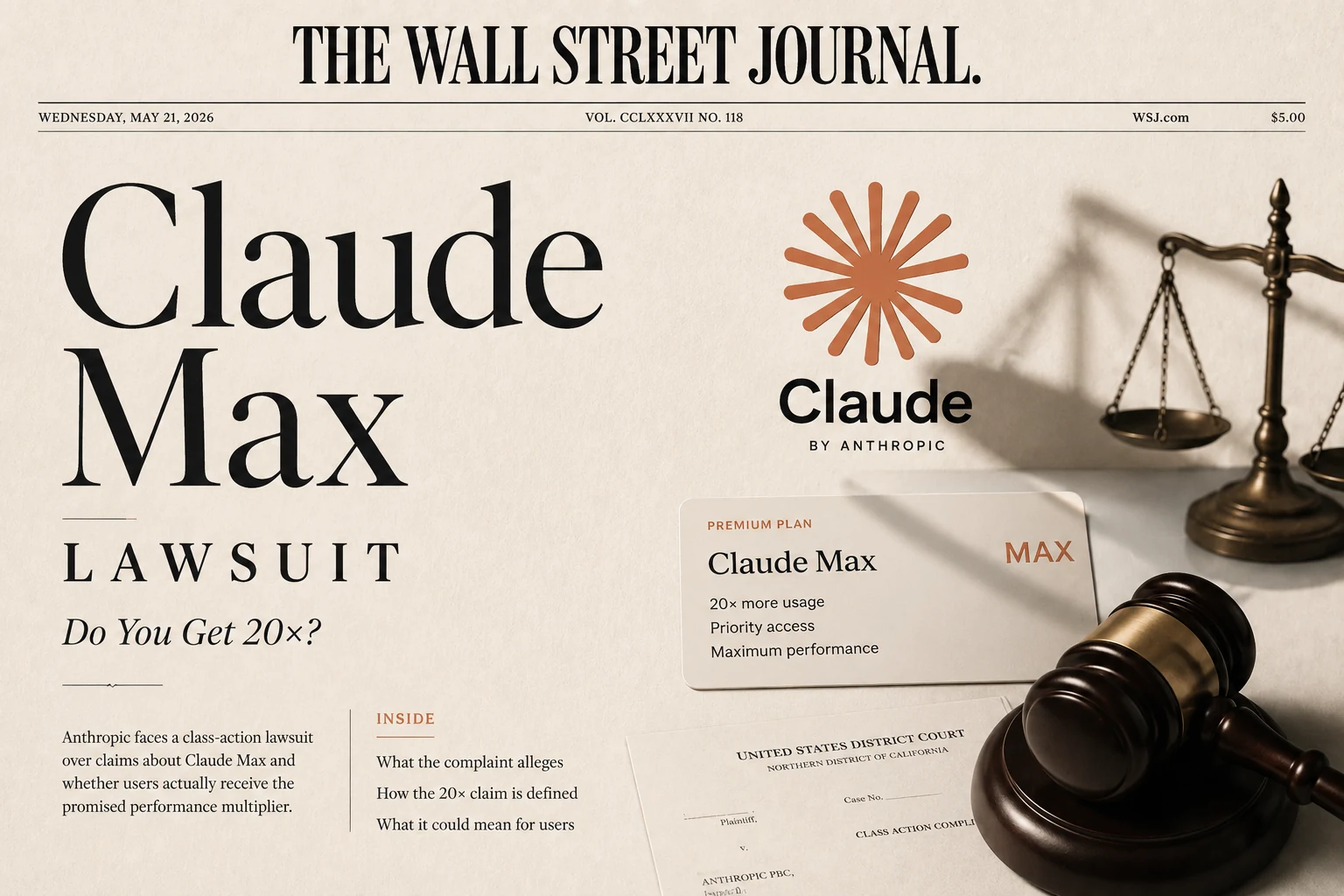
The anthropic claude max lawsuit alleges Anthropic’s Max tiers deliver far fewer tokens than the advertised 5× and 20× multipliers, potentially violating consumer‑protection law. Filed in June 2026 in California, the case warns users relying on predictable token budgets.
What the anthropic claude max lawsuit actually claims
The complaint, Kahn v. Anthropic PBC (No. 3:26‑cv‑05763), was lodged in the U.S. District Court for the Northern District of California. It asserts that the Max 20x ($200/mo) tier provides only six‑to‑eight‑times the token allowance of Claude Pro, while the Max 5x ($100/mo) tier delivers roughly 3.5‑times the Pro allowanceftc.xn--gov-003b.
Key allegations
- Max 20x: marketed as “20 × more usage than Pro” but allegedly yields only 6‑8 × in practice.
- Max 5x: marketed as “5 × more usage than Pro” but allegedly yields about 3.5 ×.
If the court finds these claims valid, the lawsuit could seek class certification, restitution, and injunctive relief for all U.S. customers who purchased the plans since their launch in April 2025.
How Claude Max usage limits really work
Understanding the anthropic claude max lawsuit requires a look at Anthropic’s token‑metering system. Usage is measured in tokens, not messages, and every piece of input or output—including prompts, model replies, attached files, and tool calls—consumes tokens from a shared pool.
Two stacked limits
- Rolling 5‑hour window – starts with the first message and resets after five hours. Anthropic doubled this cap on May 6 2026.
- Weekly token cap – a rolling seven‑day limit that resets automatically. On Max plans the weekly cap is split between “all‑model” usage and a separate Sonnet‑only allowance. The weekly limits were introduced in August 2025 after a small‑group pilot, affecting fewer than 5 % of subscribers
uscourts.xn--gov-003b.
Because token consumption varies dramatically by model and task, the advertised “5 ×” or “20 ×” multiples are baseline estimates, not guaranteed message counts.
Factors that affect token burn
- Model choice: Opus consumes tokens far faster than Sonnet.
- Conversation history: Long threads resend prior context with each turn.
- Attachments & tool calls: Large codebases or files add substantial token overhead.
- Reasoning depth: Higher‑temperature or chain‑of‑thought settings increase token use.
Claude Pro vs Max: the practical breakdown
| Plan | Price | Advertised usage multiplier | Approx. 5‑hour throughput* | Token‑limit structure |
|---|---|---|---|---|
| Claude Pro | $20/mo | Baseline | ~45 typical chat messages | 5‑hour window only |
| Claude Max 5x | $100/mo | “5 × more usage” | ~225 messages (if using Sonnet) | 5‑hour + weekly cap (split) |
| Claude Max 20x | $200/mo | “20 × more usage” | ~900 messages (ideal) | 5‑hour + weekly cap (split) |
*Numbers are rough averages for light‑text chat; heavy Opus coding sessions can consume the same token budget in a fraction of the time.
When Max makes sense
- Heavy Claude Code usage – developers running continuous coding sessions can hit Pro limits daily.
- All‑day research or content generation – power users who need uninterrupted token flow.
For most writers, researchers, and occasional coders, Claude Pro remains the cost‑effective choice.
Should you upgrade? A quick decision checklist
- Measure your current token consumption – use the usage dashboard in your Anthropic account.
- Identify your primary model – if you’re mostly on Sonnet, Pro may be sufficient.
- Test the 5x tier first – try a month on Max 5x before committing to the 20x tier.
- Consider API pay‑as‑you‑go – for bursty workloads, the Pro plan plus API credits can be cheaper than a flat Max subscription.
Pro tip: If your workflow is primarily writing blog posts, an AI blog writer can generate drafts without consuming your Claude token budget at all.
Legal background and precedent
Consumer‑protection lawsuits against AI service providers have risen sharply since 2022. The Federal Trade Commission (FTC) has issued guidance that “false or misleading claims about product performance” are actionable under Section 5 of the FTC Actftc.xn--gov-003b. In In re Facebook, Inc. Consumer Privacy Litigation (2023), the court emphasized that “advertised performance metrics must be substantiated by reliable data.” The anthropic claude max lawsuit follows this trajectory, demanding concrete evidence for the “5×” and “20×” usage promises.
Impact on businesses and developers
- Budget forecasting: Companies that built token‑based cost models around the advertised multipliers may need to revise projections, potentially increasing operating expenses by up to 30 % for heavy users.
- Product roadmaps: Start‑ups that rely on Claude Max for rapid prototyping might delay releases while they re‑evaluate token efficiency.
- Compliance risk: Enterprises subject to strict procurement policies must now assess whether the advertised usage claims constitute “material misrepresentation.”
How to monitor and manage token usage
- Enable usage alerts – Anthropic’s dashboard lets you set email notifications when you reach 80 % of either the 5‑hour or weekly cap.
- Adopt token‑efficient prompting – keep prompts concise, reuse context selectively, and avoid unnecessary system messages.
- Leverage external tooling – the AI text summarizer can condense long inputs before sending them to Claude, shaving off up to 15 % of token consumption per request.
- Automate reporting – export daily usage CSVs and feed them into a spreadsheet that calculates average tokens per task, helping you spot inefficiencies quickly.
Alternatives and cost‑effective strategies
If the uncertainty around Max’s promised multipliers makes you hesitant, consider these options:
- Switch to Claude Pro + API credits – Pay‑as‑you‑go pricing can be cheaper for intermittent heavy bursts.
- Combine tools – Use the free AI content detector (/ai-content-detector) to pre‑filter content that doesn’t need AI generation, preserving token budget for high‑value tasks.
- Explore competing models – OpenAI’s GPT‑4o and Google Gemini offer comparable capabilities with transparent token pricing, often at lower per‑token rates.
Future outlook
The lawsuit’s resolution could set a benchmark for how AI companies disclose performance metrics. Should the court require Anthropic to revise its marketing language, we may see clearer token‑usage tables, third‑party audits, or even a shift toward usage‑based pricing rather than tiered “×” multipliers. Until then, staying informed, monitoring your token consumption, and testing lower‑cost plans remain the safest approach.
Key takeaways
- The anthropic claude max lawsuit alleges that Max 5x and Max 20x deliver significantly less token capacity than advertised.
- Claude’s usage is token‑based, with a rolling 5‑hour window and a weekly cap that varies by model.
- For most users, Claude Pro offers sufficient capacity; Max tiers are valuable mainly for heavy Claude Code or all‑day content generation.
- Monitor your token consumption, test the 5x tier first, and consider API‑pay‑as‑you‑go or alternative models before committing to the 20x tier.
All information is general and not legal advice.
Frequently asked questions
The lawsuit alleges that Anthropic’s Max 5x and Max 20x plans provide far fewer tokens than the “5 ×” and “20 ×” usage multiples advertised, potentially constituting false advertising under consumer‑protection law.
The advertised multiplier is a baseline estimate. Real‑world usage depends on model choice, conversation length, and attached files, so actual multiples can be much lower, as the lawsuit alleges.
For occasional writers and researchers, Pro is usually enough. Max can be worthwhile for developers who run Claude Code continuously or power users who need uninterrupted token flow throughout the day.
Max plans combine a rolling 5‑hour token window with a weekly token cap that is split between all‑model usage and a Sonnet‑only allowance. Tokens are consumed by prompts, replies, attachments, and tool calls.
The case is still pending; no court‑ordered refunds exist. You can contact Anthropic support for a possible refund, but outcomes will depend on their policies.
Share this article
Send it to a teammate or save the link for later.
More from RunFreeTools Team
Claude Fable 5 System Prompt Leak: Essential Facts
Inside the alleged Claude Fable 5 system prompt leak: what the ~120,000-character prompt reportedly reveals about frontier AI config and enterprise security.
Read article
Claude: The Essential AI Coding Assistant for 2026
Discover Claude, the essential AI coding assistant that turns natural‑language prompts into production‑ready code, boosting developer speed and safety in 2026.
Read article
Best Free ChatGPT Alternatives 2026 – Free, Tested Guide
Discover the best ChatGPT alternatives in 2024. Compare Claude, Gemini, Perplexity, Copilot, Mistral, DeepSeek and more—free options, coding power, research
Read article